

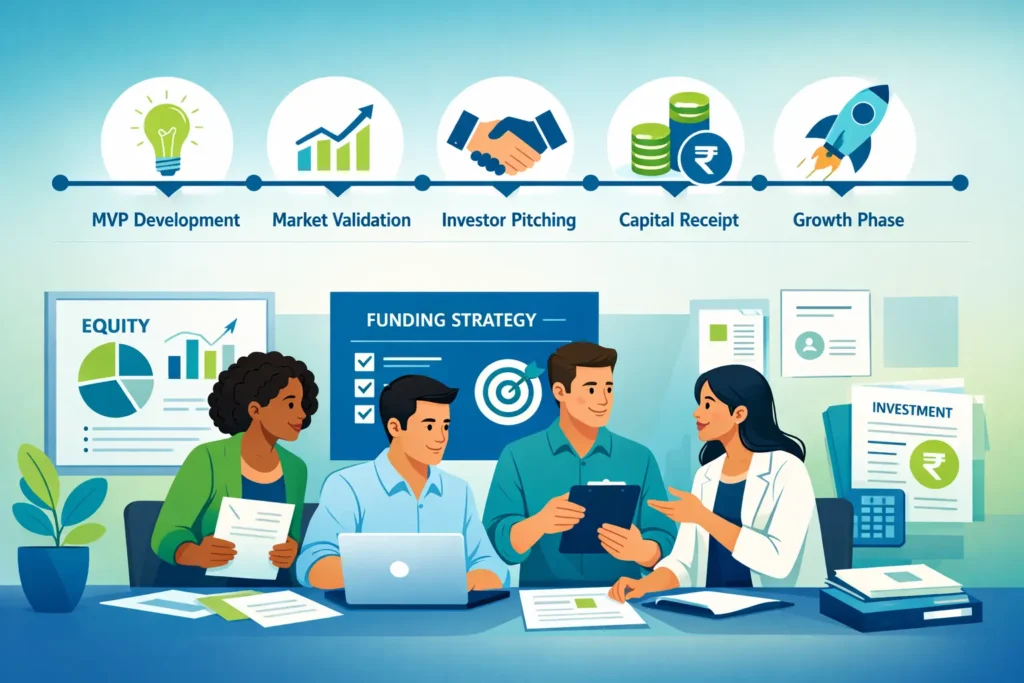
Your startup has a brilliant idea, passionate team, and clear vision. But transforming that into reality requires capital. Seed funding is the initial institutional capital that early-stage startups raise to turn concepts into reality and build traction before seeking larger investments.
Seed funding ranges from ₹20-50 lakh in India to $500K-$5M globally. It’s typically the first official funding round after bootstrap phase, enabling product development, market validation, and initial team building. This comprehensive guide explains what seed funding is, who provides it, and how you can raise it for your startup.
What Is Seed Funding and Why Does It Matter?
Seed funding is the earliest institutional capital that startups raise to build a foundation and validate market fit. Unlike personal savings or loans, seed investors receive equity ownership in exchange for capital investment.
Here’s what makes seed funding unique:
- Equity-Based Structure – Investors receive ownership stake in your company
- High-Risk Capital – Investors believe in your idea despite limited traction
- Foundation Building – Funds develop MVP, validate market fit, establish operations
- Gateway to Growth – Successful seed funding positions you for Series A rounds
“Seed funding is not just money—it’s validation that your idea solves a real problem for real customers.” – Industry experts consistently emphasize seed capital’s role in startup ecosystem.
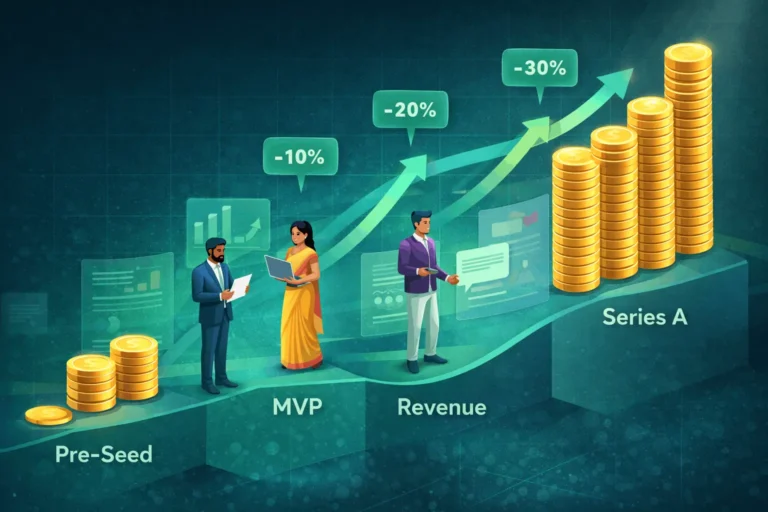
Seed vs. Pre-Seed vs. Series A Funding
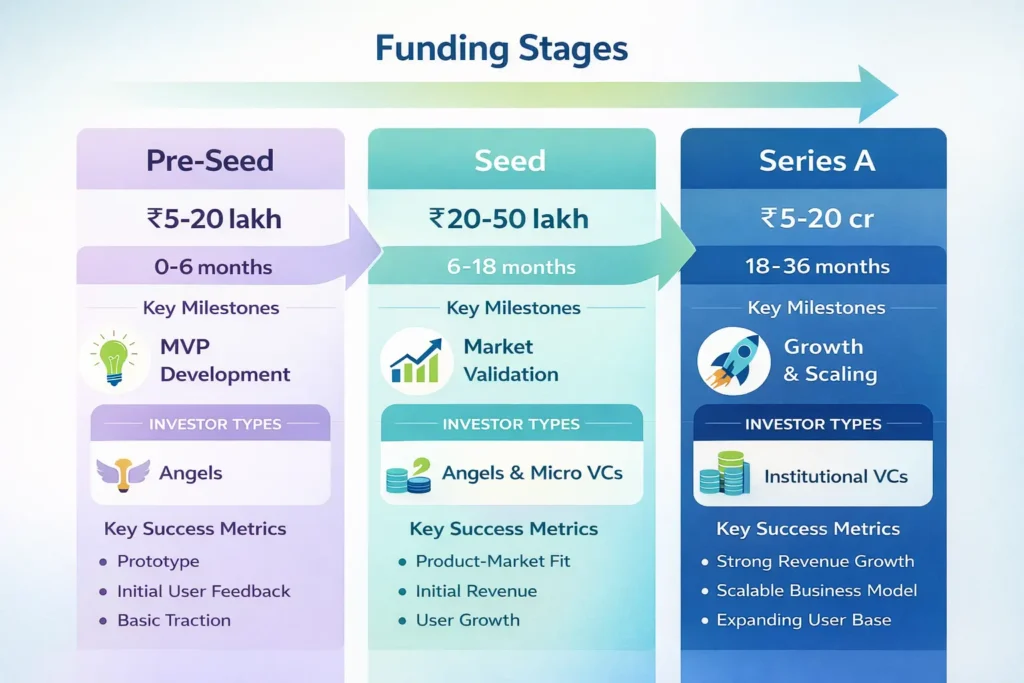
Understanding the funding landscape helps you time your capital raise correctly:
| Funding Stage | Typical Size (India) | Typical Size (Global) | Purpose | Timeline |
|---|---|---|---|---|
| Pre-Seed | ₹5-20 Lakhs | $25K–$500K | MVP development, initial validation | 0–6 months |
| Seed | ₹20-50 Lakhs | $500K–$5M | Market fit, hiring, go-to-market | 6–18 months |
| Series A | ₹5-20 Cr | $1M–$10M+ | Growth acceleration, scaling | 18–36 months |
Key insight: India’s seed rounds are typically 10x smaller than US equivalents, creating a unique “traction gap” that micro VCs now address through strategic guidance alongside capital.
How Seed Funding Works: Key Mechanisms Explained
Seed funding operates through different structures, each with distinct advantages. Understanding these mechanisms helps you choose the right approach for your startup.
Priced Equity Rounds
In priced rounds, investors purchase preferred stock at predetermined price per share. This structure:
- Establishes company valuation early
- Creates immediate dilution (founders own smaller percentage)
- Takes 30-60 days to close
- Requires detailed legal documentation
Best for: Startups with significant traction and proven product-market fit
Convertible Instruments (SAFEs & Convertible Notes)
Investors provide capital through convertible securities that convert to equity later, typically at Series A. This structure:
- Faster closing (7-14 days)
- Lower legal costs (simpler agreements)
- Defers valuation discussions to Series A
- Reduces founder dilution immediately
Best for: Early-seed and pre-seed rounds (increasingly popular in 2024-2025)
Who Provides Seed Funding: Investor Types Explained
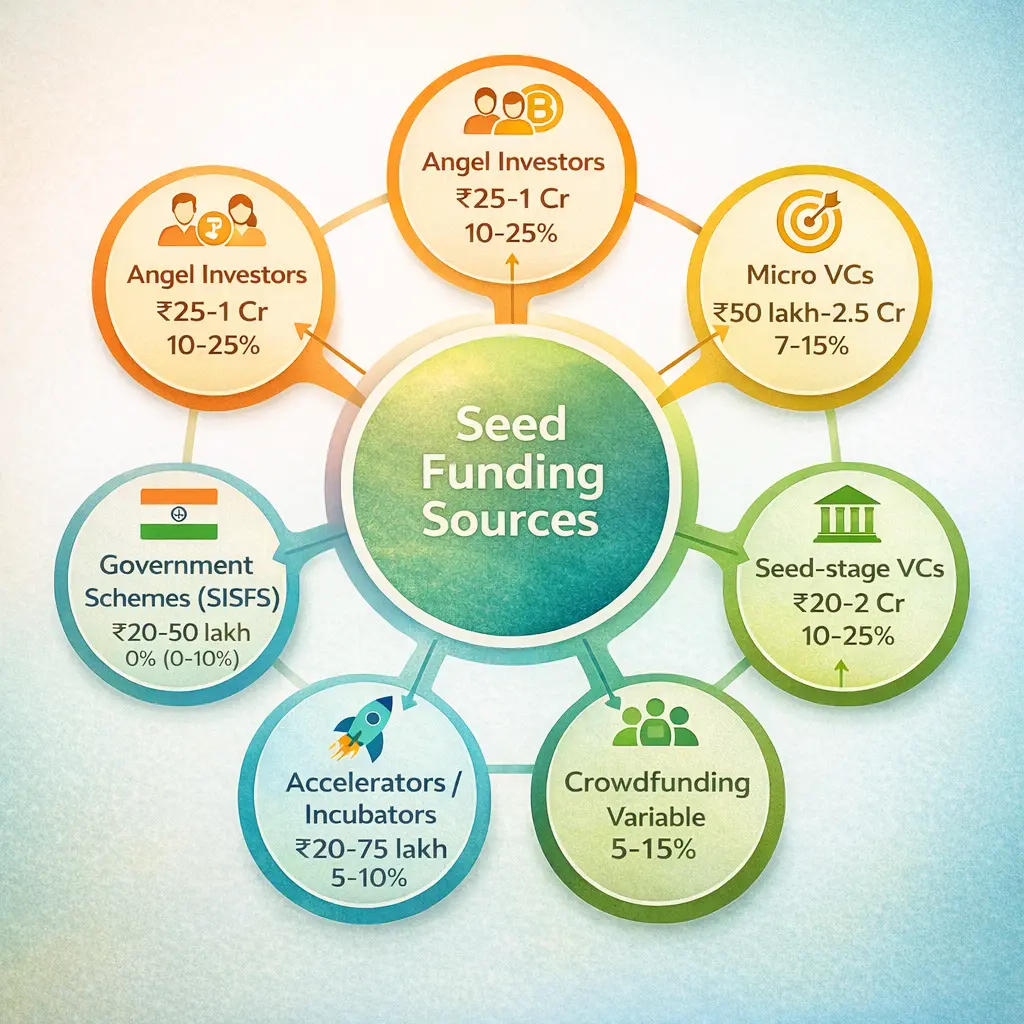
Seed funding comes from multiple sources, each offering distinct advantages and expectations. Diversifying your investor base creates optimal support structure.
1. Angel Investors
Angel investors are high-net-worth individuals investing personal capital in early-stage startups. They typically invest ₹10-50 lakh and provide valuable mentorship.
Advantages:
- More flexible deal structures
- Operational guidance and network access
- Faster decision-making than VCs
- Often industry experts in your sector
2. Seed-Stage Venture Capital Firms
Dedicated seed-stage VCs and micro VCs have become crucial in India’s ecosystem. These investors:
- Fill funding gap between pre-seed and Series A
- Provide strategic guidance alongside capital
- Help achieve Series A-ready traction
- Offer investor connections and networks
India data (2024-2025): Seed funding increased 31% year-over-year, with median ticket size growing from $800K to $1 million.
3. Friends and Family Round
Many founders raise initial capital from friends, family, and personal networks. These rounds:
- Typically ₹5-25 lakh
- Move faster than institutional funding
- Require clear documentation despite personal relationships
- Often precede formal seed round
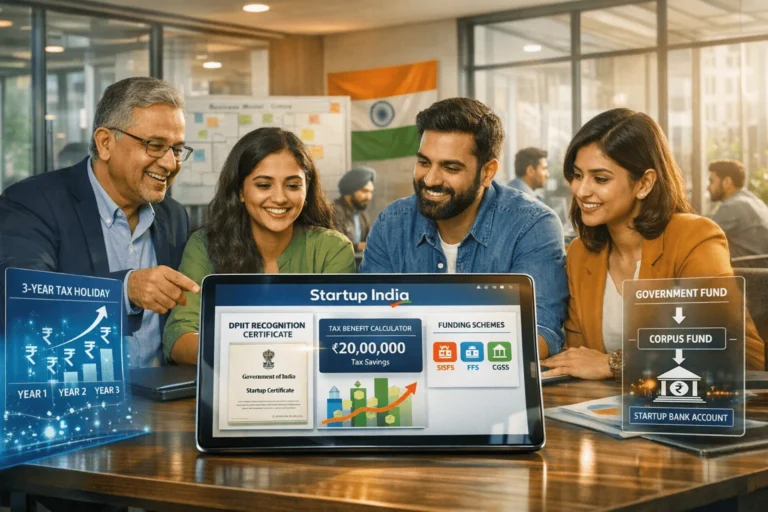
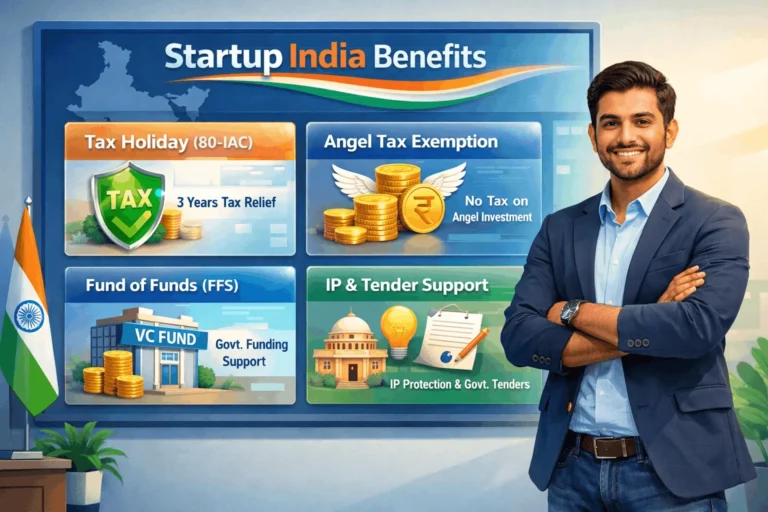
4. Government Schemes: Startup India Seed Fund Scheme
The Startup India Seed Fund Scheme (SISFS) provides government-backed capital to eligible startups:
- Up to ₹20 lakh for proof of concept and prototype development
- Up to ₹50 lakh for market entry and commercialization
- No equity dilution (grants and convertible instruments)
- Allocated ₹945 crore to support ~3,600 startups through 300 incubators
Eligibility for SISFS:
- DPIIT recognition required
- Startup incorporated within last 2 years
- Technology core to product/service/business model
- Indian promoters hold minimum 51% shareholding
- Not received >₹10 lakh from other government schemes
“The Startup India Seed Fund Scheme removes the traditional financing barriers, enabling innovative Indian entrepreneurs to build without immediate equity dilution.” – Government initiative experts highlight SISFS’s impact on startup ecosystem.
5. Accelerators and Incubators
Programs like Y Combinator, Techstars, and regional Indian accelerators provide seed funding (typically ₹20-75 lakh) plus mentorship, office space, and investor networks. DPIIT-recognized incubators play critical role in distributing SISFS capital.
6. Crowdfunding Platforms
Non-dilutive funding through platforms like Kickstarter and Indiegogo uses “all-or-nothing” model. Capital raised only if goal is met.
Seed Funding Sources in India: Complete Landscape
India’s startup funding ecosystem offers diverse pathways to raise seed capital. Here’s what’s available:
Traditional Private Investor Routes
Angel Investors & Super Angels: Invest ₹25-1 Cr and provide mentorship. Build networks through:
- StartupIndia events and communities
- LinkedIn and industry networks
- Accelerator alumni connections
- Personal referrals
Micro VCs: Emerging investors filling pre-Series A gap. Focus on:
- Building Series A-ready traction
- Sector-specific expertise (fintech, healthcare, agritech)
- Hands-on mentorship and guidance
Seed-stage VCs: Dedicated seed investment firms providing:
- ₹20-2 Cr tickets
- Structured investment process
- Network of follow-on investors
Government-Backed Capital
Startup India Seed Fund Scheme remains the most accessible government option, disbursing capital through 300+ DPIIT-recognized incubators.
State Government Schemes: Each state offers startup funding initiatives. Check your state’s department of commerce website.
Financial Institutions
Banks like Kotak offering startup banking support provide:
- Business current accounts with founder-friendly terms
- Cash management solutions
- Secured loans against receivables
- Trade financing options
How Much Seed Funding Should You Raise?
The ideal seed round size depends on multiple factors. Most startups underestimate their needs and raise too little, requiring bridge rounds later.
Key Determinants of Seed Size:
- Industry Type – AI/deep tech raise 2-3x larger than service-based startups
- Geographic Location – US ($2.5-4M median) vs. India (₹20-50 lakh median)
- Team Experience – Founders with prior exits raise 15-25% larger rounds
- Business Model – SaaS startups: ₹20-1.5 Cr; hardware: ₹50-5 Cr
- Market Validation – Startups with customer traction raise 30-40% more
Sector-Wise Breakdown (India, 2024-2025):
| Sector | Typical Seed Size | Why This Range |
|---|---|---|
| SaaS/Platforms | ₹20-75 Lakh | Moderate tech hiring, cloud infrastructure |
| Deep Tech/Hardware | ₹50-2.5 Cr | High R&D, prototyping, manufacturing |
| Fintech | ₹30-1.5 Cr | Compliance, technology infrastructure |
| B2B Services | ₹15-50 Lakh | Lower overhead, sales-focused |
| Agritech | ₹25-1 Cr | Government support, seasonal nature |
Pro Tip: Calculate 18-24 months of runway based on your burn rate and growth milestones. Most founders maintain 3-6 months cash buffer for unexpected challenges.
What Do Investors Look for in Seed Funding Stage?
Understanding investor priorities dramatically improves your fundraising success rate. Investors evaluate multiple dimensions before committing capital.
The Founder-Market Fit Priority
According to research from venture capital experts, investors prioritize founder-market fit above all:
- Founder experience and track record (40% of decision)
- Market size and growth potential (30%)
- Early traction and validation (20%)
- Team composition and skills (10%)
Traction Milestones That Attract Seed Investors
Pre-Seed Stage Metrics:
- ✓ Working MVP or prototype
- ✓ 10-50 early users or beta customers
- ✓ Initial revenue or strong Letters of Intent (LOIs)
- ✓ Co-founder team assembled
Seed Stage Metrics:
- ✓ 100-1,000 active users with engagement data
- ✓ Monthly recurring revenue or strong engagement metrics
- ✓ Product-market fit signals (NPS >40, 20%+ MoM growth)
- ✓ First paying customers or strategic partnerships
- ✓ Complete founding team plus 2-3 key hires
Seed Funding Trends in India: 2024-2025 Market Dynamics
India’s startup funding landscape has evolved significantly. Understanding current trends helps you time your fundraise strategically.
India-Specific Insights:
- Seed funding grew 31% year-over-year in 2024
- Median seed ticket size increased to ₹1 million (from ₹800K in 2023)
- Early-stage funding reached ₹50,000+ crore across all early rounds
- Micro VCs emerged as critical ecosystem players, solving traction gap
- Government schemes (SISFS) distributed ₹500+ crore to 1,200+ startups
Sector Preferences:
According to 2024-2025 data, seed investors favor:
- SaaS & Platforms (40% of seed capital)
- Fintech (25% of allocation)
- Deep Tech/AI (20% of focus)
- Agritech (10% with government support)
- Healthcare/Biotech (5% but growing)
“India’s startup ecosystem matured significantly. Seed rounds now focus on traction and unit economics rather than just ideas.” – Venture capital analysts tracking India’s market evolution.
How-To Section: Step-by-Step Guide to Raising Seed Funding
Time Needed:
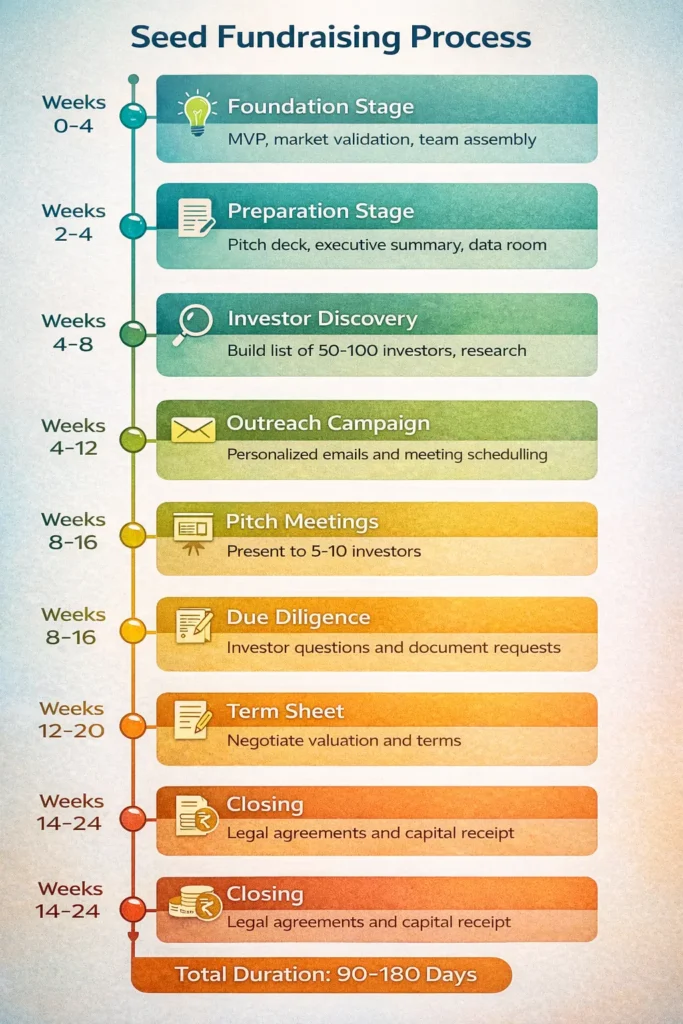
- Days: 90-180
- Hours: 15-20 hours per week
- Minutes: 0
Estimated Cost:
- Currency: USD (approximate INR equivalent provided)
- Price: $5,000-$15,000 USD (₹4.2-12.6 lakh)
Description:
Complete process to raise seed funding from preparing pitch deck through closing capital with due diligence and legal documentation included.
Step 1: Develop MVP and Validate Market Fit
Duration: 2-4 weeks
Build working prototype demonstrating concept feasibility. Acquire 10-20 early users providing feedback. Document customer pain points and initial validation. Without MVP, most seed investors decline further meetings.
Step 2: Assemble Founding Team and Early Hires
Duration: Ongoing (complete before fundraising)
Recruit co-founders and first hires in critical functions (CTO, product lead). Investors evaluate team composition heavily. Demonstrate complementary skills within founding team. Complete team increases investor confidence 40-50%.
Step 3: Create a Compelling Pitch Deck and Story
Duration: 2-3 weeks
Build 10-15 slide presentation covering problem, solution, market, business model, go-to-market, team, financials, and funding ask. Craft memorable narrative. Test pitch with advisors and mentors before investor meetings.
Step 4: Build Investor List and Warm Introduction Strategy
Duration: 2-4 weeks
Research 50-100 potential investors using AngelList, Crunchbase, and PitchBook. Warm introductions convert 10x better than cold outreach (5-15% vs. <1%). Leverage accelerator alumni, advisors, and mutual connections. Segment investors by check size, sector focus, and geography.
Step 5: Execute Strategic Outreach Campaign
Duration: 4-8 weeks
Send personalized investor emails explaining why they’re good fit for your round. Schedule 2-3 coffee meetings weekly. Expect 5-15% conversion to first meeting. Track all interactions in spreadsheet. Follow up systematically with non-responsive investors after 2 weeks.
Step 6: Prepare Financial Models and Data Room
Duration: 2-3 weeks
Build models showing monthly burn rate, runway, and unit economics (CAC, LTV, payback period). Create conservative, realistic, and optimistic scenarios. Organize legal documents in shared data room: cap table, financials, customer contracts, IP documentation, employment agreements.
Step 7: Pitch Meetings and Lead Investor Conversion
Duration: Weeks 6-12
Schedule 5-10 meetings with most interested investors. Focus on converting one into lead investor. Lead investors set valuation and terms, making other investors faster to follow. Provide post-meeting information as requested. Address investor questions comprehensively.
Step 8: Negotiate Term Sheet and Close Deal
Duration: 2-4 weeks
Once term sheet received, work with legal counsel to finalize agreements. Most seed rounds close 2-4 weeks after terms agreed. Request wire transfers. Announce round publicly for momentum (optional but recommended for credibility).
Tools Name:
- Pitch Deck Software: Pitch, Deckrobot, Keynote
- Investor Relationship Manager: Visible, Gust, Carta
- Financial Modeling: Carta, Excel, LivePlan
- Communication Platform: Slack, Gmail, Calendly
Materials Name:
- Pitch Deck (10-15 slides)
- Executive Summary (1-2 pages)
- Financial Projections (3-year model with monthly breakdown)
- Investor List (50-100 prospects with contact details)
Common Seed Funding Mistakes to Avoid
Avoiding these pitfalls significantly improves your fundraising odds and outcome.
Mistake #1: Raising Too Little Capital
Problem: Insufficient runway forces second fundraise within 12 months, weakening negotiating position
Solution: Calculate 18-24 month runway. Add 20% buffer for unexpected costs. Raise conservatively but adequately.
Mistake #2: Weak Product-Market Fit Before Fundraising
Problem: Investors pass without traction or customer validation
Solution: Delay fundraising if lacking customer traction. Build proof of concept and initial validation first.
Mistake #3: Unfounded Valuations
Problem: Unrealistic valuations scare away investors and signal lack of market awareness
Solution: Use comparable company analysis. Justify valuation with growth projections. Expect ₹50 lakh to ₹2.5 Cr pre-money for typical seed stage.
Mistake #4: Ignoring Investor Relations
Problem: Poor communication and inconsistent updates create trust deficit
Solution: Send monthly updates highlighting progress, challenges, learning. Build relationships before asking for capital.
Mistake #5: Complex Deal Terms
Problem: Non-standard terms increase legal costs and slow closing
Solution: Use standard SAFE templates or convertible note formats. Negotiate valuation cap and discount rate, not every term.
Mistake #6: Poor Cap Table Management
Problem: Messy equity records scare off investors and create legal liability
Solution: Reserve 10-15% for employee stock option pool (ESOP). Track all equity transfers meticulously. Use Carta or similar cap table software.
Seed Funding Challenges Indian Startups Face (and Solutions)
Challenge #1: 10x Smaller Round Sizes
Indian seed rounds (₹20-50 lakh) are 10 times smaller than US rounds ($1.5-3M equivalent). This creates “traction gap”—insufficient capital to build meaningful traction before Series A.
Solution: Partner with micro VCs who provide strategic guidance alongside capital. Achieve specific traction milestones (100 paying customers, 20% MoM growth) to bridge to Series A.
Challenge #2: Series A Expectations Mismatch
Unlike US ecosystem where natural growth leads to Series A, India’s investors expect substantial post-seed traction.
Solution: Use seed capital to:
- Acquire first 50-100 paying customers
- Build repeatable sales process
- Demonstrate 15-20% month-over-month growth
- Document strong unit economics
Challenge #3: Limited Angel Investor Network
Fewer angels in India than Silicon Valley. Access limited to:
- Accelerator alumni networks
- Corporate venture arms
- International angels interested in India
Solution: Participate in Startup India ecosystem events. Join accelerator programs. Attend pitch competitions to gain visibility with investor communities.
Seed Funding Resources and Tools
Having right resources accelerates your fundraising journey:
Investor Discovery Platforms:
- AngelList – 100,000+ angels and VCs (angellist.com)
- Crunchbase – Comprehensive startup and investor database (crunchbase.com)
- PitchBook – Professional investor research platform (pitchbook.com)
- Tracxn – India-focused startup intelligence (tracxn.com)
Documents and Templates:
- SAFE Agreements – Y Combinator standard template
- Convertible Note Template – TechSoup and venture law firms
- Pitch Deck Templates – Stripe, SaaS companies often share examples
- JP Morgan Seed Funding Guide – Comprehensive fundraising resource
Financial Modeling:
- Carta – Cap table and financial modeling (carta.com)
- LivePlan – Business plan and financial projections (liveplan.com)
- Google Sheets Templates – Free startup financial models
FAQ: Seed Funding Questions Answered
What’s the difference between seed funding and angel funding?
Angel funding is capital from individual investors, while seed funding is the funding stage. Angel investors typically provide seed funding, but seed rounds also come from VCs, accelerators, and government schemes. Terms often overlap contextually.
How long does raising seed funding take?
3-6 months typically. This includes pitch meetings (4-8 weeks), due diligence (2-4 weeks), and legal closure (2-3 weeks). Accelerator-backed startups close faster due to investor connections and standardized terms.
What’s a realistic seed valuation for my startup?
Most seed rounds land in ₹50 lakh-2 Cr pre-money valuation (India) to $2-8M (global). Use these benchmarks:
ARR multiple: 3-5x annual recurring revenue if you have it
Comparable companies: Research similar startups in your sector
Safe valuation: Preserve founder equity (aim to own 70-75% post-seed)
Do I need a co-founder to raise seed funding?
Not mandatory, but strongly preferred. Single founders have a harder time. Investors want complementary skills and someone to share the burden during tough times.
Can I raise seed funding without an MVP?
Rarely. Most seed investors require a working prototype demonstrating concept feasibility. Pre-seed (with just an idea) is harder and typically smaller. Build a minimum MVP first.
Should I raise from VCs, angels, or both?
Both is optimal. Angels provide capital plus mentorship; VCs provide larger checks and networks. Typical seed: 70% from 1-2 lead VCs and 30% from angels/super angels.
What happens after I raise seed funding?
You have 18-24 months to build product-market fit, acquire initial customers, demonstrate repeatable sales, establish a complete team, and show 15-20% MoM growth. This positions you for Series A.
Are SAFEs or convertible notes better?
SAFEs are increasingly popular (faster, cheaper, simpler). Convertible notes are traditional. For first-time founders, SAFEs are preferred. Experienced founders negotiate better convertible terms.
Key Takeaways
- Seed funding transforms ideas into reality: It’s the capital enabling product development and market validation before a proven business model.
- India’s ecosystem offers unique pathways: Startup India Seed Fund Scheme provides ₹20-50 lakh without equity dilution. Traditional investors (angels, micro VCs) offer mentorship alongside capital.
- Timing your fundraise matters: Raise after MVP + early traction but before running out of runway. Most founders raise too early (no traction) or too late (missing momentum).
- Diversify your investor base: Combine lead VCs, angels, and strategic investors for optimal support and capital.
- Build to bridge the traction gap: India’s smaller seed rounds require focused execution. Prioritize paying customers, growth, and unit economics over vanity metrics.
- 18-24 months runway is essential: Calculate conservatively and include a buffer. Poor capital planning forces unfavorable secondary fundraises.
Next Steps to Launch Your Seed Funding Journey
Ready to raise seed capital? Here’s what to do today:
- Assess readiness: Do you have MVP plus early traction? Focus here first if not.
- Refine pitch deck: Use the structure outlined above. Get feedback from experienced founders and mentors.
- Secure DPIIT recognition (if applying to SISFS): This prerequisite opens government funding doors. Apply on the StartupIndia portal.
- Build your investor list: Identify 50-100 relevant angels and seed VCs. Prioritize warm introductions over cold outreach.
- Create financial models: Project 3 years of monthly burn, growth, and metrics. Show a clear path to Series A readiness.
- Begin outreach: Start with the 5-10 most promising investors. Build momentum early. Expect 10-20 meetings to close 2-3 investors typically.
Conclusion
Seed funding is your startup’s launchpad. Understanding how it works—from investor types and deal structures to the fundraising process—puts you in control of your capital destiny.
Remember: Investors fund founders, not just ideas. Build something customers want, demonstrate traction, and tell a compelling story about why you’re the team to realize the opportunity. Capital follows execution.
Whether you’re accessing Startup India’s government support or raising from private investors, the principles remain consistent: execute relentlessly, demonstrate traction, build relationships with investors, and let your results speak louder than any pitch deck.
StartupMandi Fundraising Hub – Access complete guides to startup fundraising, investor databases, pitch deck templates, and expert resources. StartupMandi connects founders with the knowledge, tools, and networks needed to raise seed funding successfully.
Explore StartupMandi’s Services to accelerate your fundraising journey and connect with India’s top investors and mentors who can guide your seed stage.
For ongoing insights into startup funding, growth strategies, and founder resources, visit StartupMandi’s comprehensive resource library covering everything from business strategy to investor relations.