

Should you invest in search engine optimization (SEO) or search engine marketing (SEM)? Most business owners face this question when building their digital strategy.
Here’s the confusion: SEO and SEM both drive traffic from search engines, but they work completely differently—different timelines, costs, and ROI.
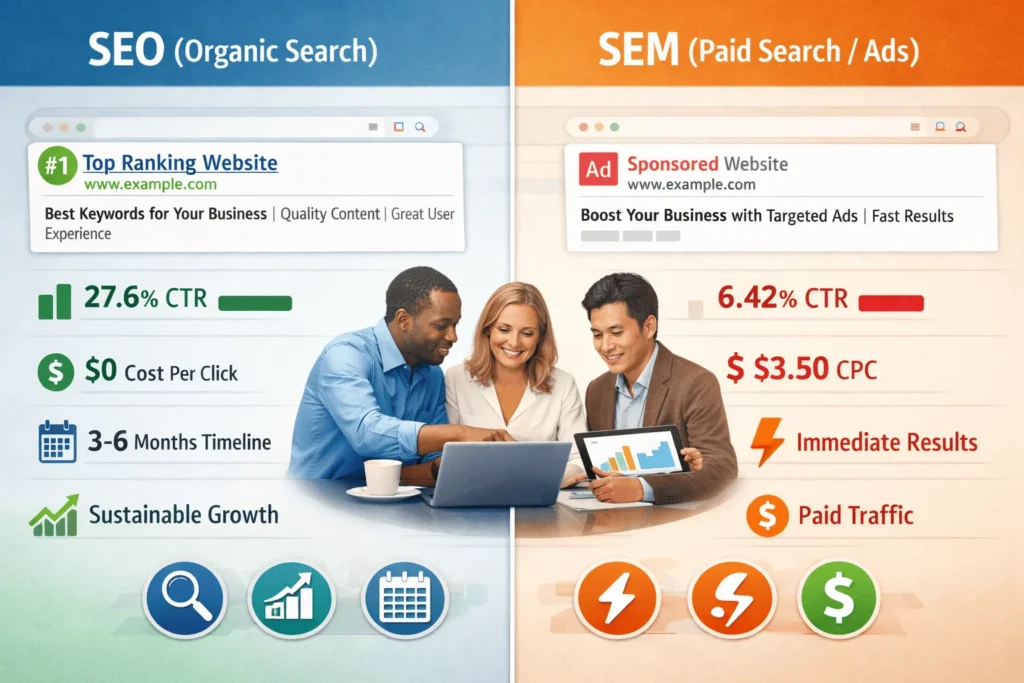
SEO is free traffic that takes 3-6 months to build. Search engine marketing (SEM) delivers immediate clicks but costs $2-$5+ per click. Which one is right for your business depends on your goals, budget, and timeline.
This guide breaks down real-world costs, conversion rates, ROI data, and practical scenarios to help you decide. You’ll understand exactly when to use SEO, when to use SEM, and how to combine both strategically.
What Is Search Engine Marketing (SEM)?
Search engine marketing (SEM) = using paid advertising to appear at the top of search engine results.
When you Google “project management software,” the first 3-4 results labeled “Ad” are SEM. Businesses pay Google every time someone clicks their ad (Pay-Per-Click or PPC).
Key SEM characteristics:
- Immediate visibility (ads go live within hours)
- Pay-per-click pricing ($2-$66 average per click, depending on industry )
- Precise targeting (location, device, schedule, demographics)
- Short-term results (traffic stops whenthe budget runs out)
Example: You launch a new productivity app. Run Google Ads for “best productivity app” and appear #1 instantly—but pay $4.50 per click.
Now, let’s understand how SEO differs fundamentally.
What Is SEO and How Does It Differ from SEM?
SEO (Search Engine Optimization) = optimizing your website to rank organically (free) in search results.
Same Google search, but SEO targets the unpaid results below the ads. You don’t pay per click, but ranking takes 3-6 months of optimization.
Key SEO characteristics:
- Free traffic (no cost per click)
- Long-term results (rankings compound over time)
- Higher trust factor (94% of users prefer organic over ads )
- Requires patience (3-6 months minimum to see results)
The fundamental difference:
- SEM = Rent visibility (pay monthly, traffic stops when you stop)
- SEO = Own visibility (invest upfront, traffic compounds forever)
SEO vs SEM: Complete Comparison Table
Let’s dive deeper into cost differences with real numbers.
How Much Does SEO Cost vs SEM?
SEO costs:
- DIY SEO: $0-$500/month (tools + time)
- Small agency: $1,000-$3,000/month
- Enterprise SEO: $5,000-$20,000+/month
- Average annual cost: $12,000-$36,000
SEM costs:
- Average CPC: $2-$5 (varies by industry)
- Competitive keywords: $10-$66 per click
- Monthly ad spend: $1,000-$10,000+ (depends on goals)
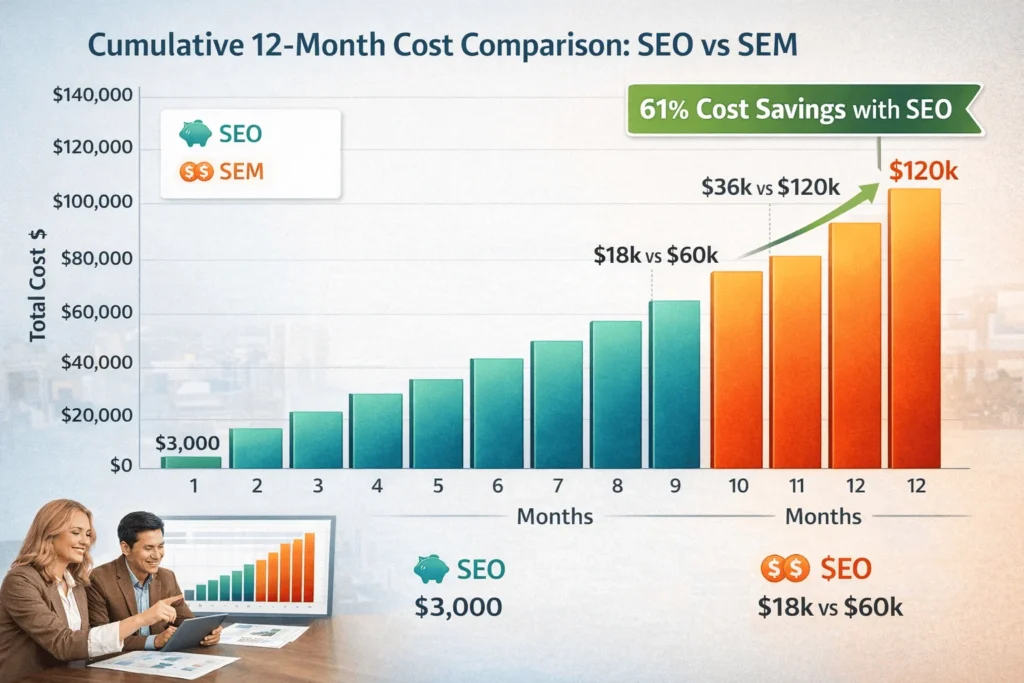
- Average annual cost: $12,000-$120,000
Real-world example:
Keyword: “Project management software” (40,500 monthly searches)
- SEM cost: $8.32 per click × 13,081 clicks = $108,833/month
- SEO cost: $3,000/month agency fee = $36,000/year to rank #1
Winner: SEO is 61% cheaper than SEM long-term.
What Are the Conversion Rates for SEO vs SEM?
Conversion rates determine ROI. Traffic means nothing if visitors don’t convert.
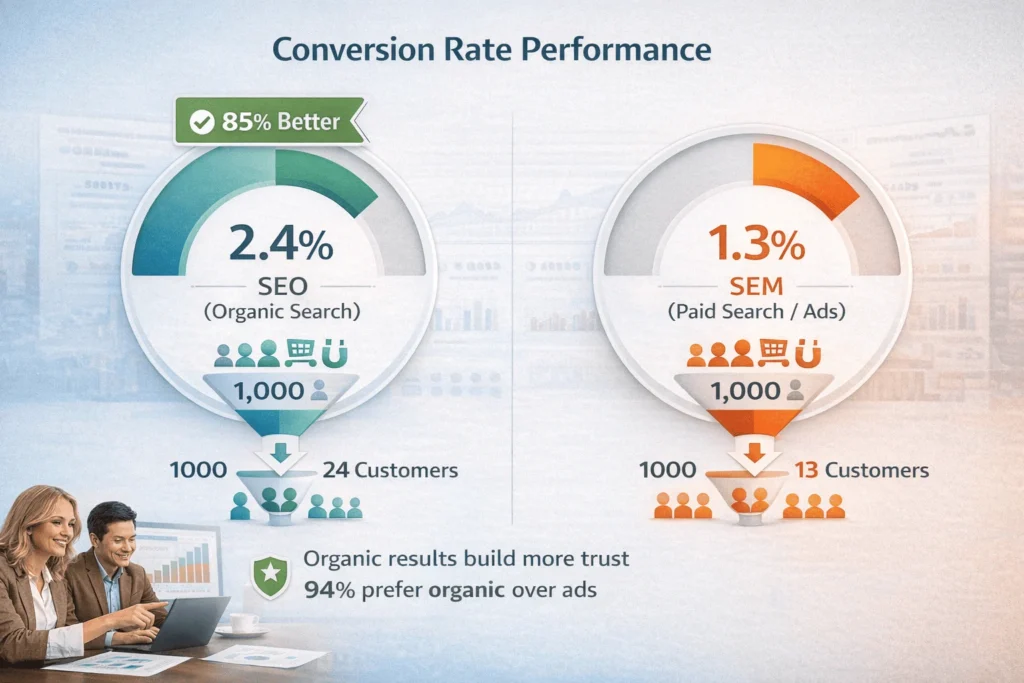
SEO conversion rate: 2.4% average
SEM conversion rate: 1.3% average
Why does SEO convert better?
- Higher trust (organic = credible, ads = skepticism)
- Better intent match (organic results align with user intent)
- Lower bounce rate (users spend more time on organic pages)
“SEO efforts yield a 2.4% average conversion rate, while SEM efforts yield a 1.3% average conversion rate,” according to American Marketing Association research.
But conversion rates don’t tell the whole story. Let’s examine timeline differences.
How Long Does It Take to See Results?
A timeline is critical for decision-making.
SEO timeline:
- Month 1-3: Setup, keyword research, on-page optimization (minimal traffic)
- Months 3-6: Rankings begin appearing on pages 2-3
- Month 6-12: Top 10 rankings for target keywords
- Year 1+: Compounding traffic, authority building
SEM timeline:
- Day 1: Ads go live within hours
- Week 1: Immediate traffic and conversions
- Month 1: Optimize campaigns based on data
- Ongoing: Traffic continues as long as the budget exists
Real example: HiEnd Accents (textile manufacturer) achieved 1,086% organic traffic growth in 6 months using aggressive SEO. But they needed immediate revenue while SEO built up—so they ran SEM campaigns simultaneously.
Winner: SEM for speed, SEO for sustainability.
What’s the ROI for SEO vs SEM?
Return on investment determines profitability.
SEO ROI:
SEO ROI calculation example:
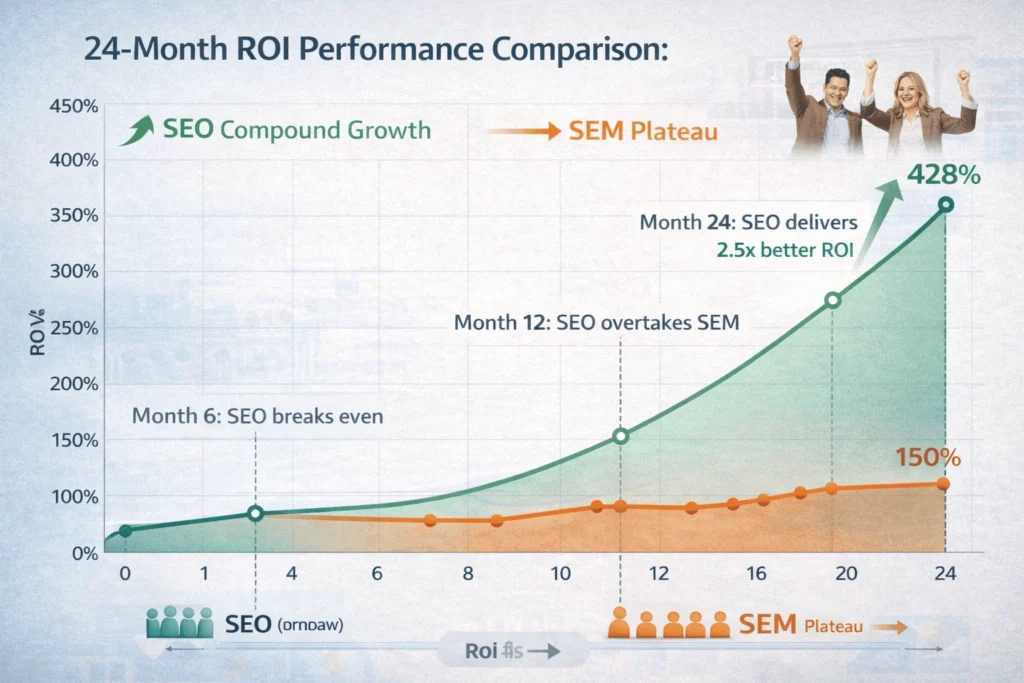
- Investment: $36,000/year (agency + tools)
- Revenue: $190,000 (from organic traffic)
- ROI: (190,000 – 36,000) / 36,000 = 428% ROI
SEM ROI:
- Average: 250% ROI
- Google Ads: $8 return for every $1 spent
- Overall average: $2 return for every $1 spent
SEM ROI calculation example:
- Investment: $50,000/year (ad spend)
- Revenue: $125,000 (from paid clicks)
- ROI: (125,000 – 50,000) / 50,000 = 150% ROI
Which Gets More Clicks: SEO or SEM?
Click-through rate (CTR) reveals user behavior.
SEO CTR:
- #1 organic position: 27.6% CTR
- #3 organic position: ~10% CTR
- #10 organic position: ~2.5% CTR
- Overall: 94% of Google clicks go to organic results
SEM CTR:
- Average Google Ads CTR: 6.42%
- Best category (Arts & Entertainment): 13.04% CTR
- Overall: Only 6% of Google clicks go to ads
Key insight: Organic results attract 19x more clicks than paid ads.
Why?
- Ad blindness (users skip ads automatically)
- Trust factor (70% prefer learning from articles vs. ads )
- Screen position (organic results dominate mobile screens)
When Should You Use SEO?
SEO is best when:
- You have time to build (6+ month runway before needing results)
- Budget is limited ($1,000-$3,000/month vs. $10,000+ for SEM)
- You want sustainable growth (traffic compounds without ongoing spend)
- Building brand authority matters (thought leadership, trust)
- Your industry has low CPC (<$5 per click makes SEO even more cost-effective)
Real-world scenarios:
Scenario 1: B2B SaaS Startup
- Goal: Generate 100 qualified leads/month
- Budget: $3,000/month
- Timeline: 6-12 months acceptable
- Decision: SEO (cost-effective lead generation, builds authority)
Scenario 2: Content-Driven Business
- Goal: Establish thought leadership
- Budget: Limited ($1,500/month)
- Timeline: Long-term (1-2 years)
- Decision: SEO (blog content ranks forever, compounds traffic)
Learn more about how search engine optimization actually works before implementing your SEO strategy.
When Should You Use SEM?
Search engine marketing is best when:
- You need immediate results (product launch, event promotion)
- Budget exists for paid ads ($5,000+/month minimum)
- Testing keyword effectiveness (validate demand before SEO investment)
- Highly competitive keywords (SEO would take 12-18 months)
- Seasonal campaigns (Black Friday, holiday sales)
Real-world scenarios:
Scenario 1: E-commerce Product Launch
- Goal: Sell new product within 30 days
- Budget: $10,000/month
- Timeline: Immediate
- Decision: SEM (instant visibility, drive sales day 1)
Scenario 2: Local Service Business
- Goal: Fill appointment calendar this month
- Budget: $2,000/month
- Timeline: This week
- Decision: SEM (local targeting, immediate bookings)
Scenario 3: Testing New Market
- Goal: Validate demand for new service
- Budget: $5,000 testing budget
- Timeline: 30-60 days
- Decision: SEM (fast data on keyword performance, conversion rates)
Should You Use Both SEO and SEM Together?
The most successful businesses use both strategically.
Hybrid approach benefits:
- SEM drives immediate revenue while SEO builds
- SEO reduces long-term ad costs (less dependency on paid)
- Dominate search results (your ad + organic listing = 2x visibility)
- Data sharing (SEM reveals high-converting keywords → optimize SEO for those)
Strategic framework:
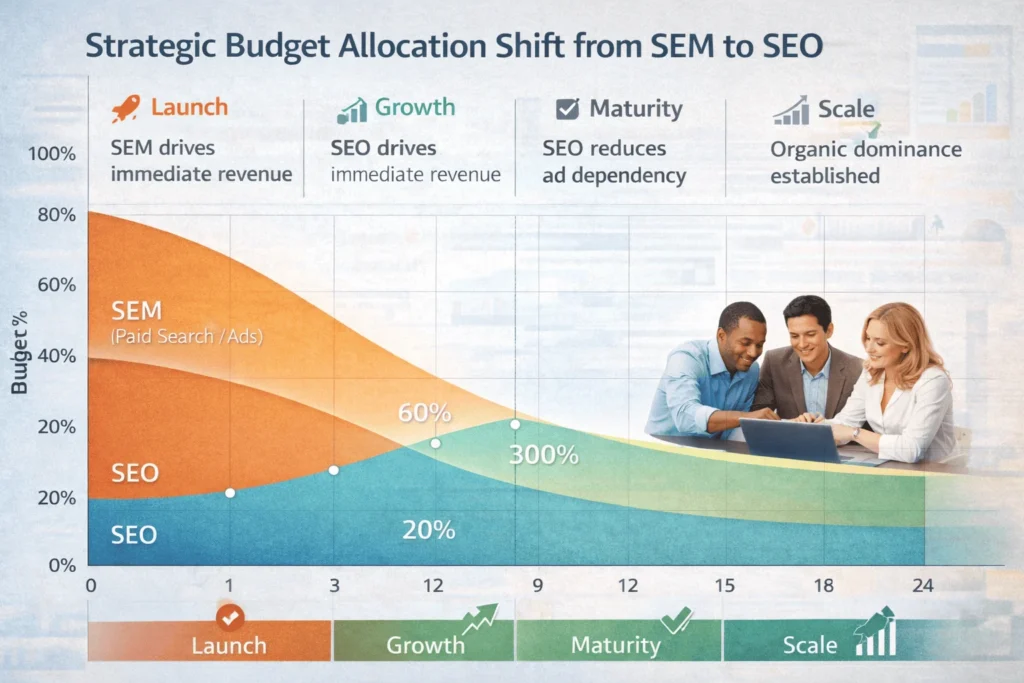
Phase 1: Launch (Months 1-3)
- SEM: 80% budget (immediate traffic + revenue)
- SEO: 20% budget (foundation building)
Phase 2: Growth (Months 4-6)
- SEM: 60% budget (scale profitable campaigns)
- SEO: 40% budget (content production + optimization)
Phase 3: Maturity (Months 7-12)
- SEM: 40% budget (target high-value keywords only)
- SEO: 60% budget (organic traffic reduces ad dependency)
Phase 4: Scale (Year 2+)
- SEM: 20% budget (maintain competitive visibility)
- SEO: 80% budget (organic dominance established)
Real example: REI (outdoor retailer) uses this hybrid approach—SEO drives 70% of traffic, SEM targets seasonal products and competitive keywords.
Common Mistakes to Avoid
SEO mistakes:
- Only focusing on keywords, not user intent (write for humans first)
- Ignoring technical SEO (site speed, Core Web Vitals, mobile issues)
- Forgetting existing pages (optimize what you have before creating new)
- Expecting results in 30 days (SEO takes 3-6 months minimum)
SEM mistakes:
- Sending traffic to poor landing pages (great ad + bad page = wasted budget)
- Using broad match keywords without negatives (wastes 40% of the budget )
- Ignoring conversion tracking (never run ads without measuring ROI)
- Stopping campaigns too early (give campaigns 30-60 days to optimize)
Explore proven social media marketing strategies to complement your search marketing efforts.
FAQ: SEO vs Search Engine Marketing
Is SEO or SEM better for small businesses?
Depends on budget and timeline. Limited budget ($1,000-$2,000/month)? Start with SEO for sustainable growth. Need customers this month? SEM delivers immediate results. Best approach: 80% SEO, 20% SEM for small businesses.
Can you combine SEO and SEM strategies?
Absolutely—and you should. Use SEM to drive immediate traffic while building SEO. Use SEM data (high-converting keywords, customer behavior) to inform SEO strategy. Top businesses allocate 60-70% to SEO, 30-40% to SEM.
How long does SEO take compared to SEM?
SEO: 3-6 months minimum to see rankings and traffic. SEM: Immediate (ads live within hours). Reality check: Anyone promising SEO results in 30 days is lying.
What’s the average cost per click for SEM?
$2-$5 average across industries. Competitive keywords (legal, insurance, finance) cost $10-$66 per click. Industry examples: Arts & Entertainment: $2-$3/click. Legal services: $40-$66/click. E-commerce: $1-$2/click.
Which has a better conversion rate: SEO or SEM?
SEO converts better (2.4% vs. 1.3%) on average. Why? Organic results build more trust, match intent better, and users spend more time evaluating. Exception: Well-optimized SEM campaigns can achieve 6-7% conversion rates.
Is SEM worth it for startups with limited budgets?
Only if you can afford $2,000+/month and need immediate validation. Smaller budgets ($500-$1,000/month) achieve better ROI with SEO. Strategy: Use SEM to test demand for 30-60 days, then shift budget to SEO once validated.
Do SEO and SEM work for B2B businesses?
Yes—61% of B2B marketers say SEO generates more leads than any other channel. B2B SEM works for high-value keywords (enterprise software, consulting services) where CPC justifies high customer lifetime value.
How do I calculate ROI for SEO vs SEM?
SEO ROI: (Revenue from organic traffic – SEO costs) / SEO costs × 100. SEM ROI: (Revenue from paid traffic – ad spend) / ad spend × 100. Track using Google Analytics: Set up conversion goals, attribution models, and revenue tracking.
Key Takeaways
- SEO = Free traffic that takes 3-6 months to build. Average ROI: 5.3x. Best for long-term growth, brand authority, and sustainable revenue.
- SEM = Paid traffic that delivers immediate results. Average ROI: 2-8x. Best for product launches, seasonal campaigns, and immediate revenue needs.
- The cost difference is massive. SEO costs $36,000/year on average. SEM costs $120,000+/year for similar traffic volume. SEO is 61% cheaper.
- Conversion rates favor SEO. SEO: 2.4% average. SEM: 1.3% average. Organic results convert 85% better.
- Click-through rates favor SEO. #1 organic position: 27.6% CTR. Average SEM CTR: 6.42%. Organic gets 19x more clicks than paid.
- Timeline determines choice. Need results this month? SEM. Can you wait 6 months? SEO delivers better ROI.
- The hybrid approach wins. Use SEM for immediate traffic, SEO for long-term growth. 80% budget to SEM initially → shift to 80% SEO over 12-24 months.
- Trust matters. 94% of users prefer organic results over ads. 70% prefer learning from articles vs. ads.
- ROI compounds differently. SEO ROI grows over time (5.3x → 10-15x). SEM ROI stays flat unless optimized constantly.
- Industry affects ROI. E-commerce: 400-700% SEO ROI. B2B services: 300-500% SEO ROI. Local businesses: Highest overall SEO ROI.
Next Steps
Ready to choose your search marketing strategy? Here’s your action plan:
- Assess your timeline: Need results in 30-60 days? Start with SEM. Can you wait 3-6 months? Prioritize SEO.
- Calculate your budget: Under $2,000/month? Focus on SEO. Over $5,000/month? Use a hybrid approach (60% SEO, 40% SEM).
- Define your goal: Brand building + thought leadership = SEO. Product launch + immediate sales = SEM. Sustainable growth = Both.
- Start with quick wins: Run a 30-day SEM test campaign ($1,000-$2,000) to validate demand. Simultaneously, begin SEO foundation (keyword research, on-page optimization).
- Track everything: Set up Google Analytics conversion tracking. Measure cost per acquisition (CPA), conversion rate, and ROI monthly. Shift the budget to what performs better.
Talk to a marketing consultant at StartupMandi to create a custom search marketing strategy combining SEO and SEM based on your business goals, budget, and timeline.
Conclusion
The SEO vs search engine marketing debate isn’t about choosing one—it’s about understanding when to use each strategically.
SEO delivers unmatched long-term ROI (5.3x average), sustainable traffic, and higher conversion rates (2.4%) but requires patience (3-6 months minimum). SEM provides immediate visibility, precise targeting, and fast revenue, but costs 3-5x more and stops when the budget runs out.
The winning formula for most businesses:
- Months 1-3: 80% SEM (immediate revenue) + 20% SEO (foundation)
- Months 4-12: 50% SEM + 50% SEO (balanced growth)
- Year 2+: 20% SEM (competitive keywords) + 80% SEO (organic dominance)
Real-world proof: Companies using this hybrid approach see 428% SEO ROI + 150% SEM ROI, capturing both immediate and long-term revenue.
Your next move: Start with a small SEM test ($1,000-$2,000/month) to validate demand while building an SEO foundation. Track results monthly. Double down on what works.
Talk to StartupMandi’s marketing consultants to build a custom strategy combining SEO and SEM for your specific business goals. Book a free 30-minute consultation.
Follow StartupMandi for more data-driven marketing strategies, SEO guides, and performance marketing insights that drive measurable business growth.
Resources for SEO and SEM
SEO Tools:
- Google Search Console – Free organic ranking tracking
- Ahrefs – Keyword research, backlink analysis
- Semrush – All-in-one SEO platform
SEM Tools:
- Google Ads – Primary SEM platform
- Google Keyword Planner – Free keyword research
- Unbounce – Landing page optimization
Analytics & Tracking:
- Google Analytics 4 – Free conversion tracking
- Hotjar – Heatmaps and user behavior
- CallRail – Phone call tracking
Learning Resources:
- Google Ads Learning Center – Free SEM certification
- Moz SEO Guide – Comprehensive SEO education
- Search Engine Land – Latest SEO and SEM news
About StartupMandi
StartupMandi helps businesses maximize ROI from search marketing through strategic consulting, SEO optimization, and SEM campaign management. Our services include:
- Custom search marketing strategy (SEO + SEM combined approach)
- SEO audits and optimization (technical SEO, content, link building)
- Google Ads campaign management (PPC strategy, bidding optimization)
- Conversion rate optimization (landing pages, A/B testing)
- Free marketing consultation (30-minute strategy session)
Schedule your free consultation to discuss your business goals, budget, and timeline. We’ll create a custom roadmap showing exactly how much to invest in SEO vs. SEM for maximum ROI.
Follow StartupMandi for weekly marketing insights, case studies, and data-driven strategies proven to drive business growth.