



Introduction & Blog Overview
Stripe payment platform revolutionizes how businesses accept digital payments globally. 🌐 Moreover, this comprehensive payment processor powers millions of transactions daily. Additionally, Stripe connects merchants with customers across 195 countries seamlessly. Furthermore, the platform recently integrated cryptocurrency payments through Crypto.com, expanding payment options dramatically.
Therefore, understanding Stripe’s capabilities becomes essential for modern entrepreneurs. Besides, Stripe processes over $1.4 trillion annually with 50,000+ transactions per minute. Finally, this complete guide explores Stripe’s features, benefits, and revolutionary crypto integration launching in 2026.
Read More: Funding for Startups in India 2026 | Complete Guide
Key topics covered in this comprehensive guide:
Understanding Stripe’s Core Payment Platform – Explore features, currencies, and payment methods
Stripe’s Revolutionary Cryptocurrency Integration – Discover Crypto.com partnership and stablecoin solutions
Security & AI-Powered Fraud Prevention – Learn how Stripe protects merchants with advanced AI models
Global Payment Processing Capabilities – Accept payments in 135+ currencies across multiple channels
Stripe vs PayPal Comparison – Detailed analysis of features, pricing, and use cases
Implementation & Integration Guide – Step-by-step setup for merchants and developers
Future Innovations & Growth Opportunities – AI-driven commerce and emerging technologies
Stripe Core Features & Global Payment Capabilities 🌍
Stripe stands as the world’s leading online payment platform. Consequently, businesses trust Stripe for processing global transactions securely. Therefore, the platform supports unprecedented payment flexibility across channels. Moreover, Stripe integrates seamlessly with existing business systems. Additionally, merchants gain access to comprehensive dashboards for transaction monitoring.
Global Payment Processing Excellence
Stripe’s payment infrastructure spans 195 countries. Therefore, merchants can accept payments from virtually anywhere globally. Moreover, the platform supports over 135 currencies, enabling true worldwide commerce. Additionally, Stripe processes these transactions without currency conversion delays. Furthermore, intelligent routing optimizes payment paths automatically. Consequently, businesses experience faster authorization rates and reduced declines.
Stripe’s advanced machine learning continuously analyzes payment patterns. Therefore, failed transactions are identified and retried intelligently. Additionally, Smart Retries reduces recurring payment declines by up to 30%. Moreover, the Adaptive Acceptance feature recovered over $6 billion in falsely declined transactions during 2024. Thus, Stripe maximizes revenue while minimizing customer friction significantly.
Comprehensive Payment Method Support
Stripe accepts over 125 global payment methods. Therefore, customers enjoy maximum flexibility during checkout. Moreover, these payment options include:
Credit and debit cards – All major networks (Visa, Mastercard, Amex)
Digital wallets – Apple Pay, Google Pay, Samsung Pay, Alipay, WeChat Pay
Bank transfers – ACH, SEPA, local bank transfer methods
Buy Now, Pay Later – Klarna, Affirm, Afterpay integration
Cryptocurrencies – Bitcoin, Ethereum, stablecoins via Crypto.com
Regional payment methods – UPI, Pix, local payment options
Additionally, Stripe’s Optimized Checkout Suite uses AI to personalize payment options. Consequently, each customer sees relevant payment methods based on 100+ transaction signals. Therefore, conversion rates increase dramatically through intelligent customization.
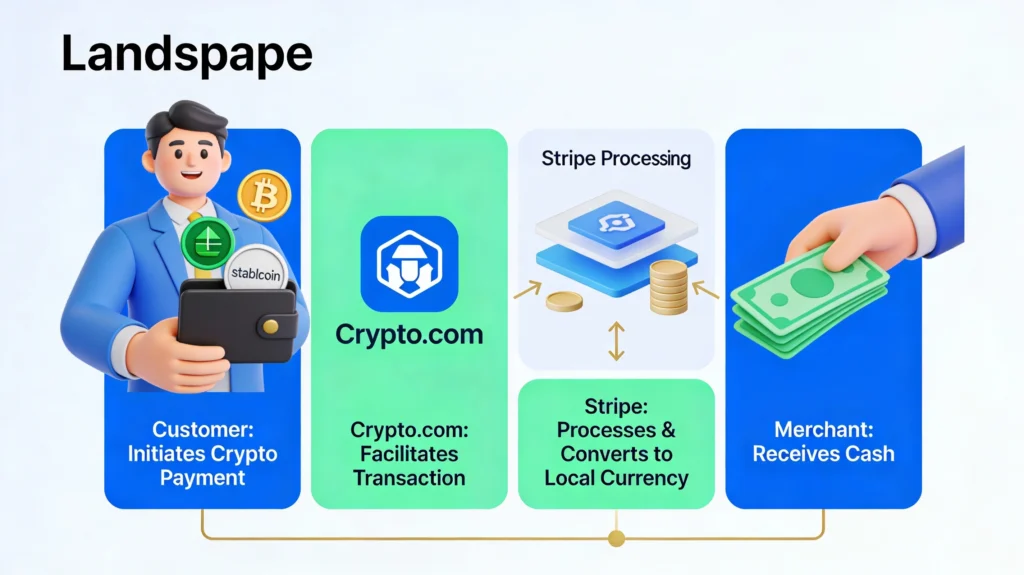
Stripe’s Revolutionary Crypto.com Partnership
Stripe and Crypto.com partnered strategically to integrate cryptocurrency payments. Therefore, merchants now accept crypto directly from customer wallets. Moreover, this groundbreaking partnership launched in early 2026, transforming e-commerce. Additionally, customers can pay using their preferred cryptocurrencies seamlessly.
How Stripe-Crypto.com Integration Works
The integration enables direct cryptocurrency payments at checkout. Consequently, customers select crypto as their payment method. Moreover, Stripe instantly converts crypto to the merchant’s local currency. Therefore, merchants receive funds in their preferred currency automatically. Additionally, customers pay using stablecoins, Bitcoin, Ethereum, or other digital assets. Furthermore, Crypto.com handles the conversion behind the scenes transparently.
This partnership addresses key merchant concerns about cryptocurrency volatility. Therefore, merchants avoid exposure to price fluctuations entirely. Moreover, funds arrive in bank accounts within 24-48 hours typically. Additionally, the process feels identical to accepting traditional card payments. Consequently, merchants gain access to crypto customers without technical complexity.
Benefits for Merchants & Customers
Merchants gain multiple advantages through crypto integration:
Expanded customer base – Access growing crypto-native customer segments globally
Lower transaction fees – Crypto payments often cost less than traditional cards
No chargebacks – Blockchain transactions are irreversible and final
Instant settlement – Funds clear faster than traditional banking
Global reach – Accept payments from anywhere worldwide seamlessly
Customers benefit from enhanced payment flexibility too:
Portfolio utilization – Pay directly using crypto holdings
Privacy options – Cryptocurrency transactions offer enhanced privacy
Cross-border efficiency – Eliminate currency conversion fees and delays
Financial inclusion – Access payment methods in regions with limited banking
| Feature | Traditional Card | Crypto Payment |
|---|---|---|
| Chargeback Risk | Yes (2-5%) | No (immutable) |
| International Fees | 1-3% extra | Minimal/None |
| Settlement Speed | 1-3 days | 24-48 hours |
| Customer Reach | Limited | Global/Unrestricted |
| Payment Certainty | Possible decline | Confirmed immediately |
Comparison with PayPal & Implementation
Stripe and PayPal represent the two dominant payment platforms. Therefore, choosing between them depends on specific business requirements. Moreover, each platform excels in different scenarios. Additionally, understanding key differences helps merchants select optimal solutions.
Stripe vs PayPal: Key Differences
Fee Structure Comparison:
Stripe charges 2.9% + $0.30 for online transactions consistently. Therefore, pricing remains transparent and predictable. Moreover, international cards incur an additional 1% plus 1% for currency conversion. Additionally, there’s clarity about every fee charged.
PayPal’s fee structure varies by transaction type, starting at 2.29% + $0.49 for in-person payments. Therefore, online transactions cost 3.49% + $0.49, making them more expensive. Moreover, international payments add 1.5%+ to total costs. Consequently, Stripe becomes increasingly advantageous for high-volume merchants.
Developer Tools & Customization:
Stripe provides advanced APIs and SDKs for complete customization. Therefore, developers maintain full control over checkout experiences. Moreover, prebuilt payment UI components accelerate development. Additionally, headless checkout flows enable seamless integration anywhere. Consequently, developers appreciate Stripe’s flexibility substantially.
PayPal offers simpler setup with hosted payment buttons. Therefore, non-technical merchants implement payments quickly. Moreover, customization options remain limited compared to Stripe. Additionally, PayPal redirects users to external pages for payment processing. Consequently, Stripe provides superior on-site customer experiences.
Global Currency Support:
Stripe handles 135+ currencies with minimal conversion friction. Therefore, merchants operate seamlessly across global markets. Moreover, adaptive pricing displays costs in customers’ local currencies. Additionally, settlement can occur in multiple currencies simultaneously. Consequently, international expansion becomes significantly easier.
PayPal supports approximately 25 currencies only. Therefore, currency conversion happens before payout to merchants. Moreover, this limits PayPal’s appeal for truly global businesses. Additionally, many countries remain unsupported for merchant payouts. Consequently, Stripe outperforms PayPal substantially for international commerce.
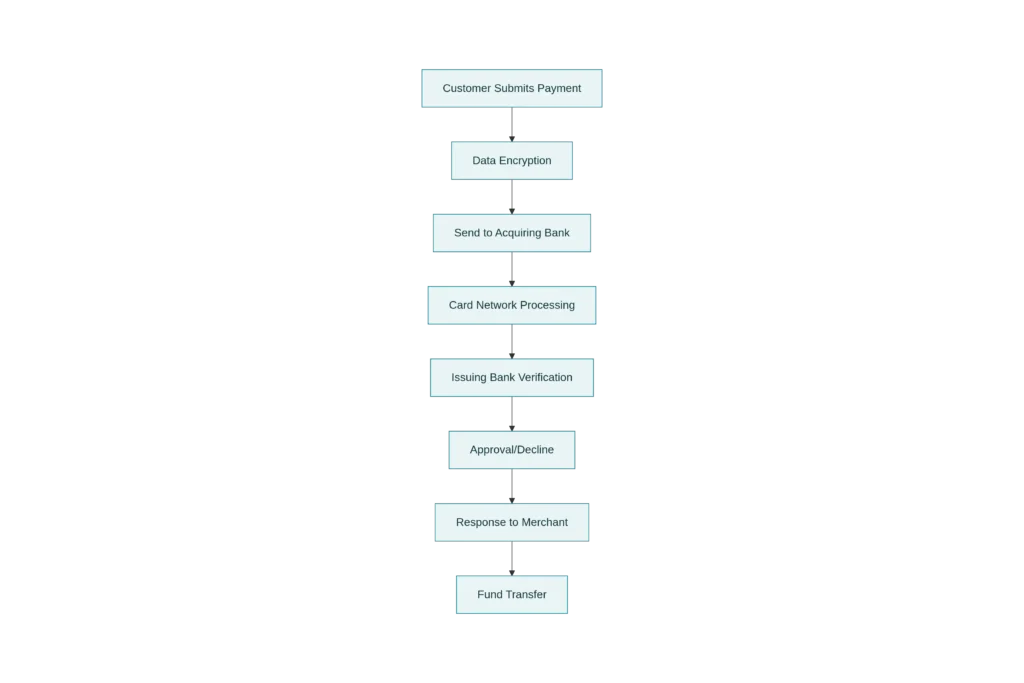
Payment Processing Workflow
Stripe’s payment processing follows a standardized eight-step workflow. Therefore, understanding this process builds merchant confidence. Moreover, each step includes security and verification protocols. Additionally, transparent processing times enable accurate business planning.
Step-by-Step Payment Processing
Step 1: Customer Submits Payment Details 🔐
The customer provides payment information at checkout. Therefore, Stripe’s encryption immediately protects sensitive data. Moreover, all payment details are transmitted securely. Additionally, customers experience frictionless checkout interactions. Consequently, cart abandonment decreases with smooth experiences.
Step 2: Encryption & Data Security 🔒
Stripe encrypts all payment data using industry-standard protocols. Therefore, sensitive information never touches merchant servers directly. Moreover, PCI DSS Level 1 compliance ensures maximum security. Additionally, tokenization converts data into secure reference codes. Consequently, merchants reduce fraud risk substantially.
Step 3: Transmission to Acquiring Bank
Encrypted payment details transmit to the acquiring bank securely. Therefore, the acquiring bank processes the transaction on merchant behalf. Moreover, Stripe maintains direct connections with major card networks. Additionally, this reduces transaction latency significantly. Consequently, faster processing improves customer experience materially.
Step 4: Card Network Processing
Payment travels through Visa, Mastercard, or Amex networks. Therefore, card networks route transactions intelligently. Moreover, they verify card validity and transaction legitimacy. Additionally, networks check for suspicious patterns automatically. Consequently, fraud prevention begins at the network level immediately.
Step 5: Issuing Bank Verification
The customer’s issuing bank verifies account status and funds. Therefore, banks check for sufficient balance or credit. Moreover, banks assess transaction legitimacy based on patterns. Additionally, 3D Secure authentication provides extra verification layers. Consequently, fraudulent transactions are blocked before completion.
Step 6: Approval or Decline Response
Issuing banks return approval or decline messages. Therefore, customers receive immediate transaction status feedback. Moreover, decline codes explain rejection reasons specifically. Additionally, merchants understand failure causes for improved retries. Consequently, declined transaction recovery increases through smart retries.
Step 7: Funds Transfer to Merchant Account
Approved payments transfer to merchant Stripe accounts. Therefore, funds arrive within 1-2 business days typically. Moreover, Stripe Dashboard displays real-time transaction data. Additionally, merchants monitor account balances instantly. Consequently, cash flow visibility improves dramatically.
Step 8: Payout to Bank Account
Merchants withdraw funds to their bank accounts. Therefore, Stripe supports instant payouts to debit cards in 32+ countries. Moreover, standard payouts process automatically on schedules chosen. Additionally, multi-currency payouts reduce conversion complexity. Consequently, merchants receive funds efficiently.
Conclusion & Key Takeaways ✨
Stripe transforms global commerce through innovative payment technology. Consequently, merchants gain access to world-class payment infrastructure. Therefore, the platform’s cryptocurrency integration through Crypto.com revolutionizes payment options. Moreover, AI-powered fraud prevention protects businesses comprehensively. Additionally, support for 135+ currencies enables true international expansion. Furthermore, transparent pricing and developer-friendly tools appeal to modern businesses.
Critical advantages Stripe offers:
Global reach across 195 countries with payment support everywhere
Cryptocurrency integration enabling crypto customer access directly
AI-powered fraud detection achieving 97% accuracy rates
135+ currency support eliminating conversion complexity
Developer-friendly APIs enabling complete customization control
Transparent pricing with no hidden fees or surprises
Advanced analytics providing actionable business insights
💼 At StartupMandi, we guide entrepreneurs through payment solution optimization. Additionally, our expert team helps select appropriate payment platforms matching business needs. Moreover, we provide implementation guidance and best practices for payment gateway integration. Furthermore, our blog offers continuous updates on fintech innovations and payment trends. Therefore, visit StartupMandi.in regularly for curated insights on payment processing, cryptocurrency integration, and merchant solutions. Additionally, leverage our network of fintech experts to optimize your payment infrastructure today.
FAQs ❓
1. What is Stripe and how does it work for businesses?
Stripe is a comprehensive payment processing platform accepting payments across 195 countries. Moreover, it supports 135+ currencies and 125+ payment methods. Furthermore, merchants integrate Stripe via APIs, receive instant payment verification, and access funds within 1-2 days. Additionally, Stripe handles all security, compliance, and fraud prevention automatically, allowing merchants to focus on business growth.
2. How does the Stripe-Crypto.com integration work for merchants?
Customers select cryptocurrency as payment method at checkout. Consequently, they pay using Bitcoin, Ethereum, stablecoins, or preferred digital assets. Moreover, Stripe-Crypto.com instantly converts crypto to merchant’s local currency. Therefore, merchants receive funds in their bank accounts within 24-48 hours. Additionally, merchants avoid cryptocurrency volatility exposure completely since conversion happens immediately.
3. What are Stripe’s fees compared to PayPal?
Stripe charges 2.9% + $0.30 for online transactions with additional 1% for international cards plus 1% for currency conversion. Therefore, PayPal’s 3.49% + $0.49 online fee plus 1.5%+ international fees makes PayPal more expensive. Moreover, Stripe offers significantly lower fees for high-volume merchants and international transactions, making it ideal for scaling businesses.
4. How safe is Stripe for accepting customer payments?
Stripe maintains PCI DSS Level 1 compliance and uses bank-level encryption. Therefore, all payment data is protected automatically. Moreover, Stripe’s AI-powered Radar detects fraud in real-time with 97% accuracy for card-testing attacks. Additionally, Stripe recovered $6 billion in falsely declined legitimate transactions in 2024, demonstrating advanced fraud prevention effectiveness.
5. Can I accept cryptocurrency payments through Stripe?
Yes! Through the Crypto.com partnership launching in 2026, Stripe merchants accept direct cryptocurrency payments. Therefore, customers pay with Bitcoin, Ethereum, stablecoins, or other digital assets. Moreover, Stripe instantly converts crypto to merchant’s preferred local currency. Additionally, merchants avoid wallet management and technical complexity since Stripe handles everything automatically.

Mariyam Bandookwala
i am a professional content writer with a strong focus on clarity, strategy, and audience engagement—helping brands communicate smarter and grow faster.