


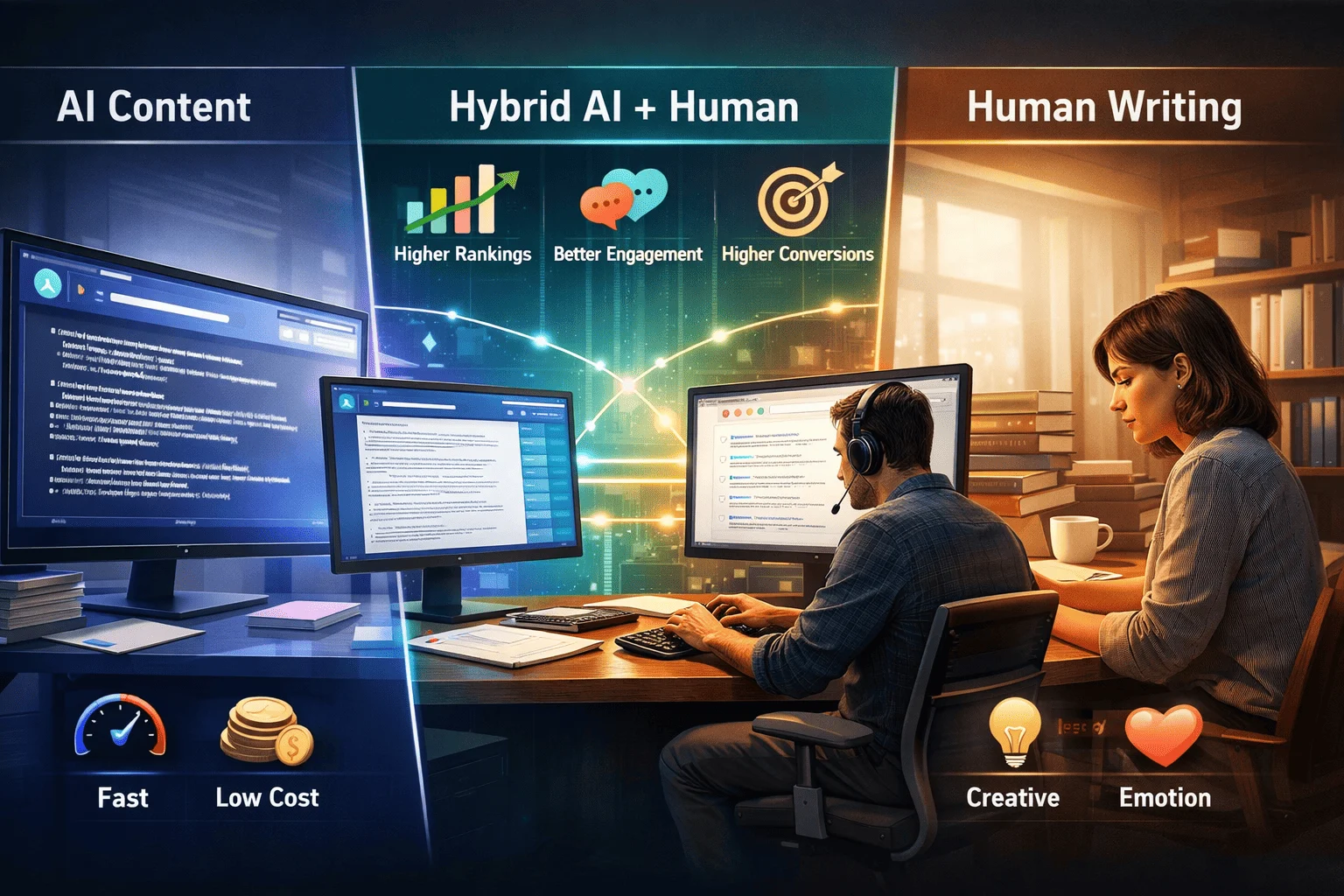
If you’re torn between AI content writing vs human writing, here’s the short answer: AI alone is fast but shallow, humans alone are deep but slow, and hybrid AI+ human workflows usually win on SEO, trust, and conversions. Surveys show around 85% of marketers now use AI for content, and those who do are 25% more likely to report success with their content campaigns.
Quick Summary
- AI is everywhere, but not everything. Around 85% of marketers use AI for content, and 83% report higher productivity, yet only about 12% believe AI can run content strategy alone.
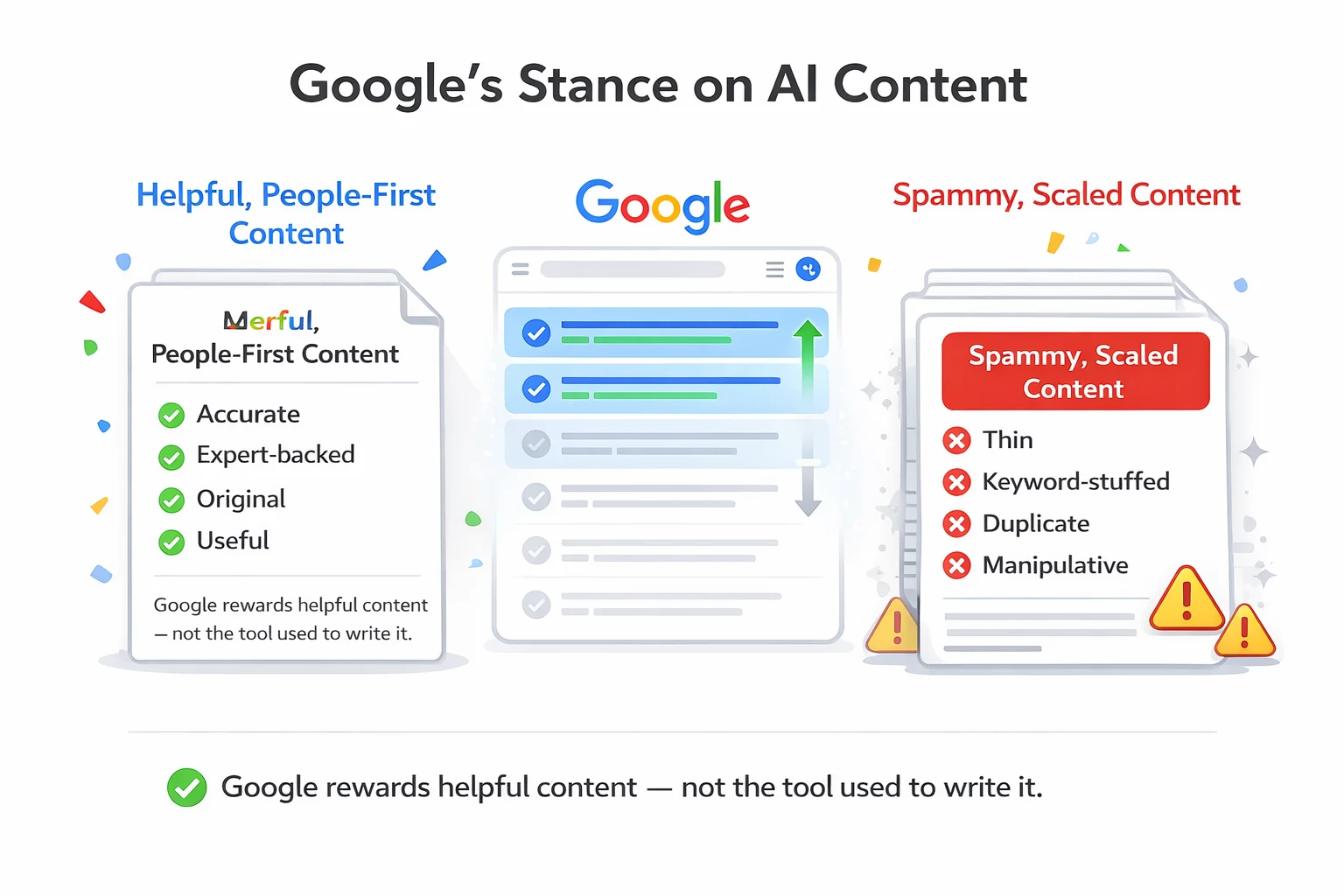
- Google doesn’t penalize AI by default. It rewards helpful, people-first content, whether created by humans or AI—as long as it isn’t spammy or scaled just for rankings.
- AI wins at speed, volume, and consistency. It can cut content creation time by up to 90% and cost by 4–5x in some workflows.
- Humans win at depth, originality, and emotional nuance. Pure AI often produces generic, repetitive, or brand-unsafe content if left unchecked.
- Hybrid content (AI draft + human editor) tends to perform best in SEO tests and case studies, especially after Google’s 2024–2025 helpful content and core updates.
- The real competition isn’t “AI vs humans”—it’s teams using AI intelligently vs everyone still doing everything manually or blindly automating.
What Is AI Content Writing vs Human Writing?
AI content writing uses tools like Chat GPT-style models, AI copywriters, or SEO assistants to generate ideas, outlines, and full drafts based on prompts. Human writing is content crafted manually by writers using their own research, experience, and creativity often slower but more nuanced and contextual.
In practice, most serious teams are already somewhere in the middle:
- AI generates outlines, first drafts, title ideas, and keyword variations.
- Human writers fact-check, restructure, add experience, and refine voice.
- Editors ensure accuracy, compliance, and brand tone before publishing.
Studies show AI is now a “mainstream” tool: ~69–85% of marketers have integrated AI into their workflows, and 79–84% cite efficiency and speed as top benefits.
“AI doesn’t replace what we do; it expands what we can do and lets us focus on quality instead of starting from scratch.” — AI in Marketing survey, 2025
How Does Google Treat AI Content in 2026?
Google doesn’t care if content is written by AI or humans it cares if it’s genuinely helpful, trustworthy, and people-first. Spammy, scaled AI content made “for search engines” still gets hit; “AI-assisted, human-reviewed” content can rank very well.
Google’s Stance
1. AI is allowed. Google explicitly says AI-generated content is fine if it’s helpful and follows E-E-A-T (Experience, Expertise, Authoritativeness, Trustworthiness).
2. Spam is not. Purely auto-generated, low-quality, mass-produced content designed just to manipulate rankings violates spam and helpful content policies.
3. Signals still matter. Google looks at engagement, backlinks, depth, originality, and user satisfaction—not just whether AI was involved.
Case studies from 2024–2026 show sites that scaled generic AI content without human editing were hit hardest by core updates, while sites using AI as a starting point—but adding human expertise and examples—either held or improved rankings.
Where Does AI Content Writing Work Best?
AI content shines at speed, scale, and structure especially for repetitive tasks, first drafts, and data-light content. It is incredibly efficient at “doing more with the same team.”
Strengths of AI Content
1. Speed and productivity
- 83% of marketers using AI report higher productivity, and AI saves 5+ hours per week on average.
- Content creation can be up to 93% faster in some AI-assisted workflows.
2. Scaling content output
55%+ of marketers use AI to scale content volume, especially short posts, social content, and emails.
3. Cost efficiency
AI-assisted content can be up to 4.7x cheaper than fully human-written content at scale.
4. Structured tasks
Great at outlines, meta descriptions, product descriptions, FAQs, keyword variations, and repurposing content.
5. Brainstorming and overcoming blank pages
AI is often used as a “creative partner” for idea generation and draft refinement.
However, only about 12% of marketers believe AI can manage an entire content strategy alone—most see it as a powerful assistant, not a replacement.
Where Does Human Writing Outperform AI?
Human writers outperform AI in originality, emotional depth, storytelling, niche expertise, and brand voice especially for high-stakes content.
Strengths of Human Writing
1. Emotion and nuance
AI still struggles with subtle tone, cultural context, and complex emotions, which humans can intuitively express.
2. True originality and POV
Humans can inject first-hand experience, contrarian views, and lived examples which Google’s E-E-A-T framework rewards.
3. Ethics, judgment, and compliance
Humans are needed to avoid plagiarism, hallucinations, factual errors, and brand/industry violations.
4. Deep expertise content
For medical, legal, financial, and technical content, subject-matter experts are non-negotiable.
5. Building trust and brand connection
Human-centered stories, founder narratives, and case studies connect better and reduce bounce rates.
Most serious case studies now talk about “humanized AI content”—AI-assisted but heavily shaped by human insight ranking and converting better than either extreme.
AI Content Writing vs Human Writing: Which Wins for SEO?
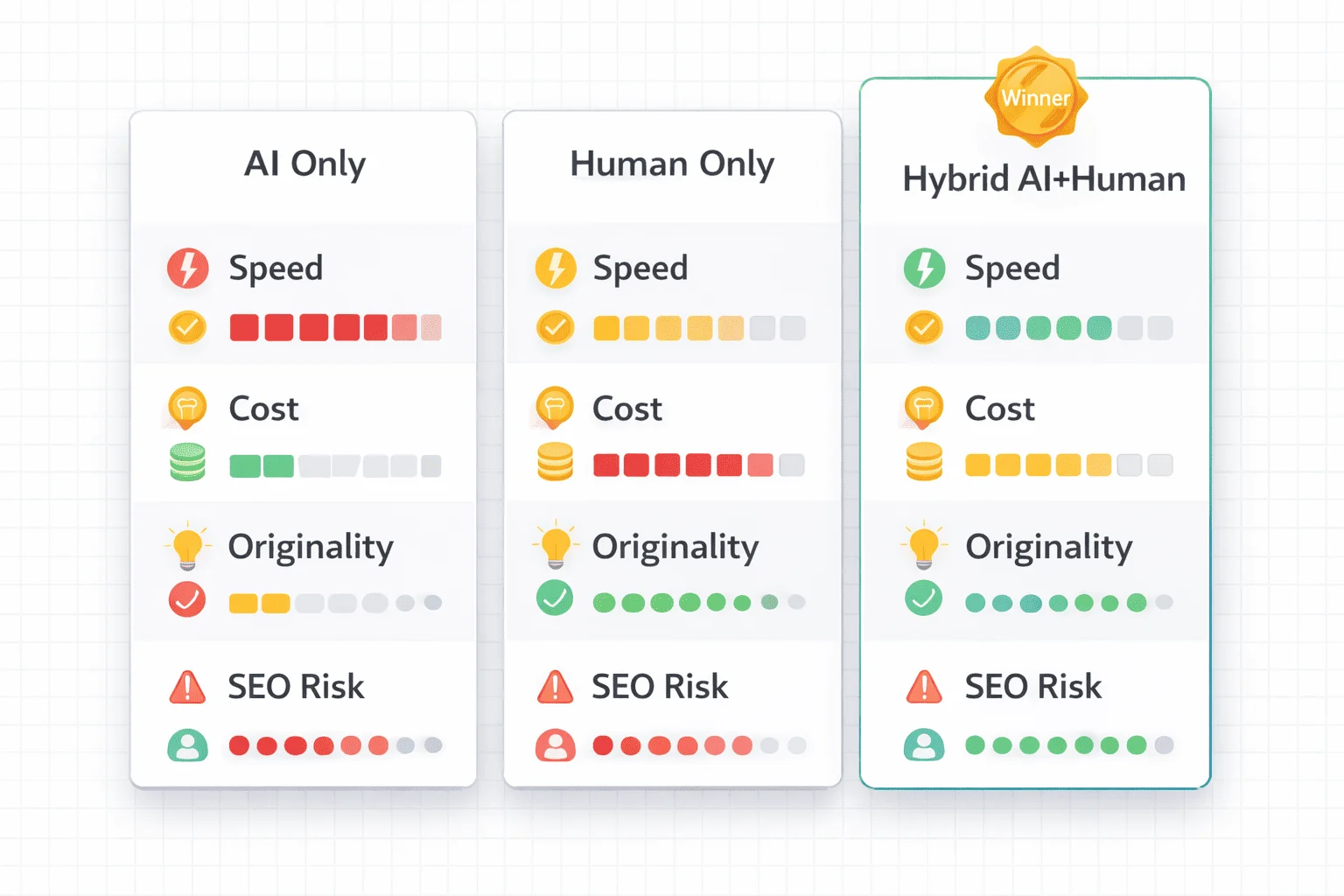
Hybrid wins more often than pure AI or pure human for SEO, as long as content is helpful, accurate, and experience-backed.
Comparative Overview
Multiple 2024–2026 case studies show AI-assisted, human-optimized articles keeping or improving rankings after core updates, while thin, unedited AI content lost visibility.
What Does AI vs Human Content Look Like in Practice?
AI is great at structure and clarity; humans make it memorable, trustworthy, and on-brand. The magic is in combining both.
Example: AI-Only vs Human-Edited Snippet
- AI-only version (generic):“AI content writing helps businesses create blogs, social media posts, and marketing copy quickly and efficiently. It can save time and reduce costs while maintaining quality for different industries and audiences.”
- Human-edited hybrid version (more specific):“AI content writing can draft your blogs and emails in minutes, but without human editing it often sounds generic. When a writer adds real examples, customer stories, and brand tone, the same AI draft becomes a focused, conversion-ready asset instead of ‘just another article’.”
The second version feels more concrete, more honest, and more persuasive—exactly what Google and readers reward.
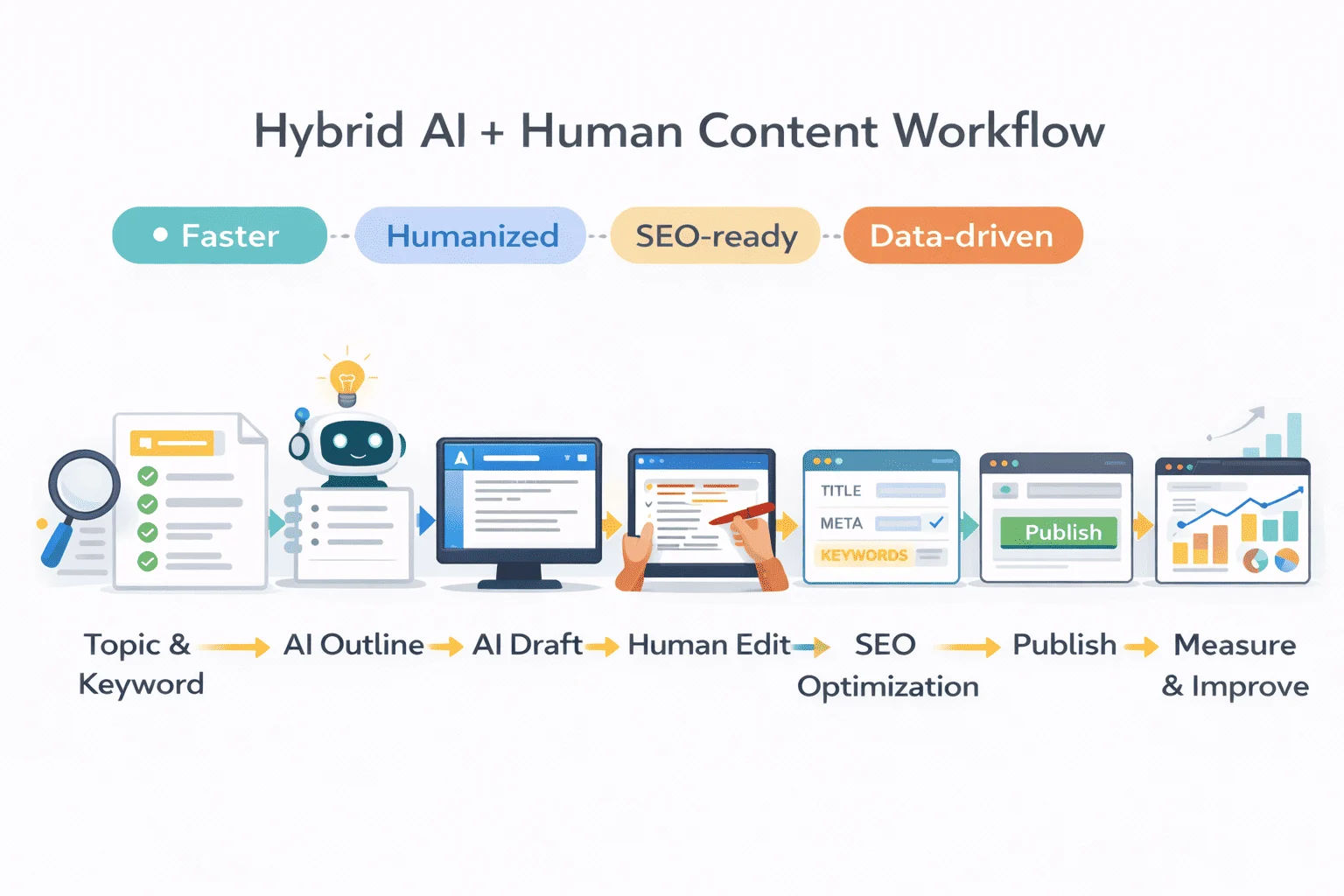
How Do I Build a Hybrid AI + Human Workflow?
Times Needed: 7 Days, 6 hours
Estimated Cost: Price: 0–150 (depending on tools)
Steps:
1. Define content goals and roles (Day 1, 1 hour)
Clarify what you want content to achieve (traffic, leads, authority). Decide who does what: AI for drafts and outlines, humans for research, editing, and examples.
2. Choose and connect your AI tools (Day 1, 1–2 hours)
Pick 1–2 AI writing tools and integrate them with your CMS or docs. Configure brand voice guidelines and topics you focus on.
3. Create prompt templates for AI drafts (Day 2, 1 hour)
Design prompt frameworks for blog posts, product pages, and emails that include audience, tone, structure, and SEO keyword guidance.
4. Draft with AI, review with humans (Days 3–4, 2 hours)
Use AI to create outlines and first drafts. Human editors then fact-check, inject experience, add examples, and adjust voice and structure.
5. Add SEO and E-E-A-T layers (Day 5, 1 hour)
Optimize titles, headings, and internal links. Add author bios, references, and personal insights to strengthen trust signals.
6. Quality checklist + publish (Day 6, 1 hour)
Run every piece through a quality checklist: originality, clarity, factual accuracy, and helpfulness. Only then publish to your site and search.
7. Measure and iterate (Day 7, 1 hour)
Track rankings, CTR, and engagement. Identify which hybrid pieces perform best and refine prompts and editing standards accordingly.
Tools Name: AI writing tool (ChatGPT-style), Google Docs/Notion, SEO plugin or on-page checker
Materials Name: Brand voice guide, SEO keyword list, Content calendar
If you want it may help you, StartupMandi’s SEO service by AI agents specializes in exactly this hybrid model AI-assisted, human-optimized content designed to rank and convert.
Key Takeaways Section
- AI content writing vs human writing isn’t a fight; it’s a partnership. AI gives you speed and scale; humans bring depth, originality, and trust.
- Google rewards helpful, people-first content, regardless of whether AI was used—spammy scaled content gets punished, human or not.
- 85% of marketers use AI for content, and 83% report increased productivity, saving 5+ hours per week.
- Hybrid workflows (AI draft + human editor) outperform pure AI or pure human content in many 2024–2026 SEO case studies.
- The real edge in 2026 is AI with humans vs everyone else—teams that combine AI efficiency with human creativity will win on rankings, trust, and conversions.
Next Steps Section
- Evaluate your current content process. Where are you slow—ideas, drafting, or publishing?
- Introduce AI gradually. Start with outlines, ideation, and simple drafts for low-risk content.
- Create a human editing standard. Define what “good enough” looks like before anything goes live.
- Test hybrid vs human-only. Publish both and compare SEO metrics—rankings, CTR, dwell time, and conversions.
- Document a repeatable workflow. Turn your best-performing process into a checklist for you or your team.
- Consider expert support. If you want a plug-and-play solution, explore AI-powered SEO services that already use this hybrid approach.
Conclusion
In 2026, the question “AI content writing vs human writing: which is better?” is already outdated. The real winner is AI-assisted, human-optimized content—workflows where AI handles the heavy lifting and humans provide judgment, experience, and voice.
Marketers using AI thoughtfully are 25% more likely to report successful content, with 79–84% citing higher efficiency and faster delivery. At the same time, only a tiny minority trust AI to manage content strategy alone, because human creativity and E-E-A-T signals remain irreplaceable.
If you’re serious about ranking, trust, and conversions, don’t choose between AI and humans. Build a hybrid content engine: AI for speed and structure, humans for story, substance, and soul.
FAQ Section
No, not automatically. Google cares how helpful and trustworthy your content is, not whether AI helped write it. It penalizes spammy, scaled, low-value content, whether AI or human.
Studies show AI-assisted content can perform as well or better than human-only content when it’s well-edited and helpful. Around 64% of marketers say AI content performs equal or better tha
Not in serious teams. Only about 12% of marketers believe AI can run content strategy alone, and most still rely on humans for storytelling, strategy, and brand voice.
Yes. AI-assisted content can be up to 4.7x cheaper than fully human content while increasing speed and volume significantly. But low-cost, low-quality AI can hurt long-term SEO.
High-stakes content: medical, legal, financial, strong opinion pieces, and sensitive topics where experience and accountability are critical.
Add your own examples, stories, data, quotes, and local context, and ensure the final draft sounds like your brand, not like a generic blog.
Yes. Poorly used AI can produce content that’s too similar to training data or competitor articles. Always run plagiarism checks and ensure real editorial oversight.
Absolutely. 67–85% of marketers, including many small businesses, already use AI for content, and most report better efficiency and ROI when combined with human input.
Few Links Suggestions for more Research & Facts Check