



Most SEO audits fail because they check 200+ items without prioritising what actually impacts rankings. Effective SEO audits follow the 80/20 rule: 20% of issues cause 80% of traffic loss.
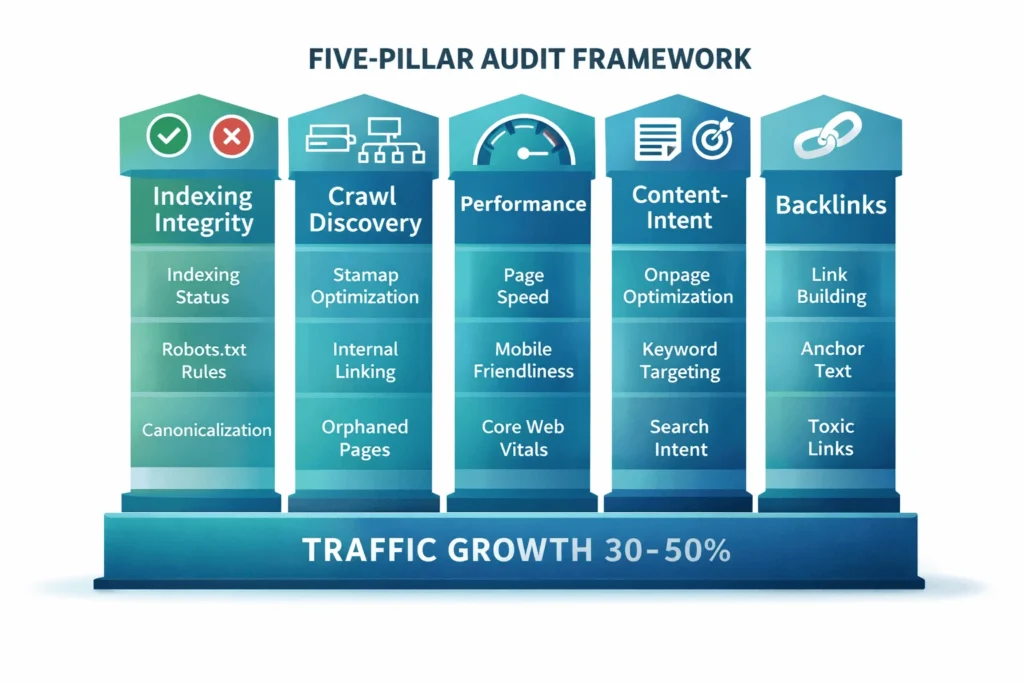
In 2026, prioritisation-based audits focus on five critical areas: indexing integrity, crawl discovery, Core Web Vitals, content-intent alignment, and backlink health. Sites fixing these systematically see 30-50% organic traffic gains within 90 days.
For foundational SEO knowledge, review StartupMandi’s complete SEO guide.
What Makes an SEO Audit Effective vs Useless?
Effective audits = actionable priorities ranked by impact.
Useless audit signs:
- 200+ uncategorized issues (overwhelm, no priorities)
- No traffic/revenue impact estimates
- Generic recommendations (“optimize titles”)
- No implementation roadmap
Effective audit framework:
- Indexing integrity (can Google see critical pages?)
- Discovery paths (internal linking, sitemaps)
- Performance (Core Web Vitals, speed)
- Content quality (intent match, freshness)
- Authority signals (backlink health, E-E-A-T)
“Most ranking failures happen due to intent mismatch. If someone searches ‘SEO Audit Checklist 2026,’ they expect a step-by-step guide—not a service page.” — LinkedIn SEO Guide 2026
What Tools Do Professional SEO Audits Require?
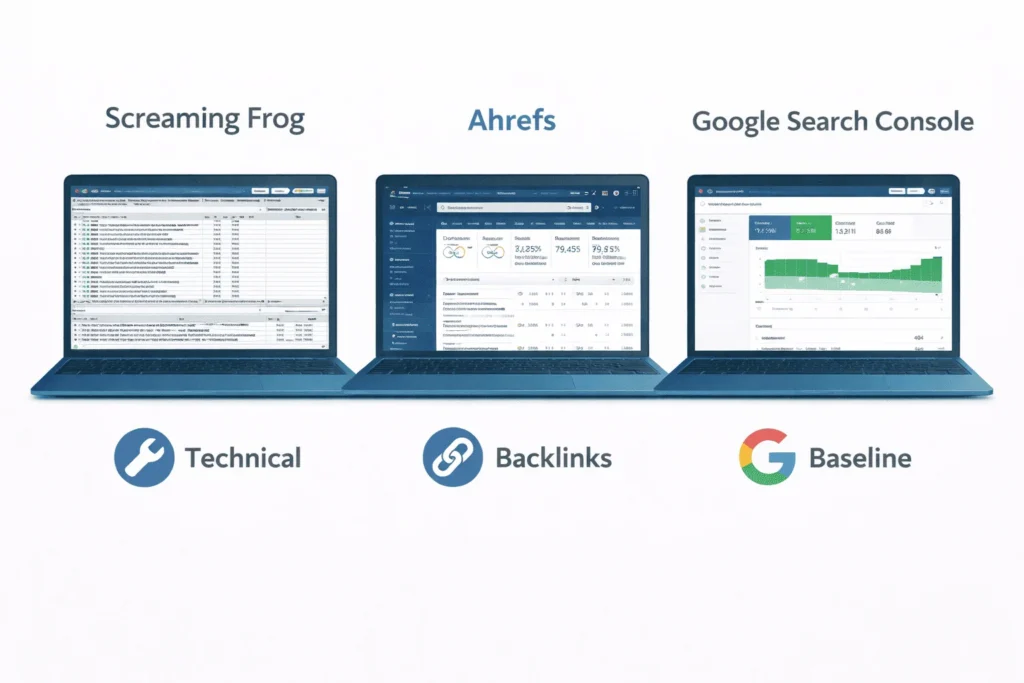
Core audit stack (choose based on budget):
| Tool | Purpose | Cost | When to Use |
|---|---|---|---|
| Screaming Frog | Technical crawl, on-page | $259/year | Deep technical audits |
| Ahrefs | Backlinks, keywords, competitors | $129-999/mo | Competitive analysis |
| Semrush | All-in-one audits | $139-499/mo | Agency workflows |
| Google Search Console | Indexing, performance | Free | Always (baseline) |
| PageSpeed Insights | Core Web Vitals | Free | Always (performance) |
2026 tool reality:
- Screaming Frog = best technical depth, local control
- Ahrefs = best backlink data, competitive insights
- Combination = most professional audits use both
Budget approach: Start with free tools (Search Console, PageSpeed), add Screaming Frog ($259/year), then Ahrefs/Semrush ($1,500+/year) when revenue justifies.
How Do I Prioritize SEO Audit Findings?
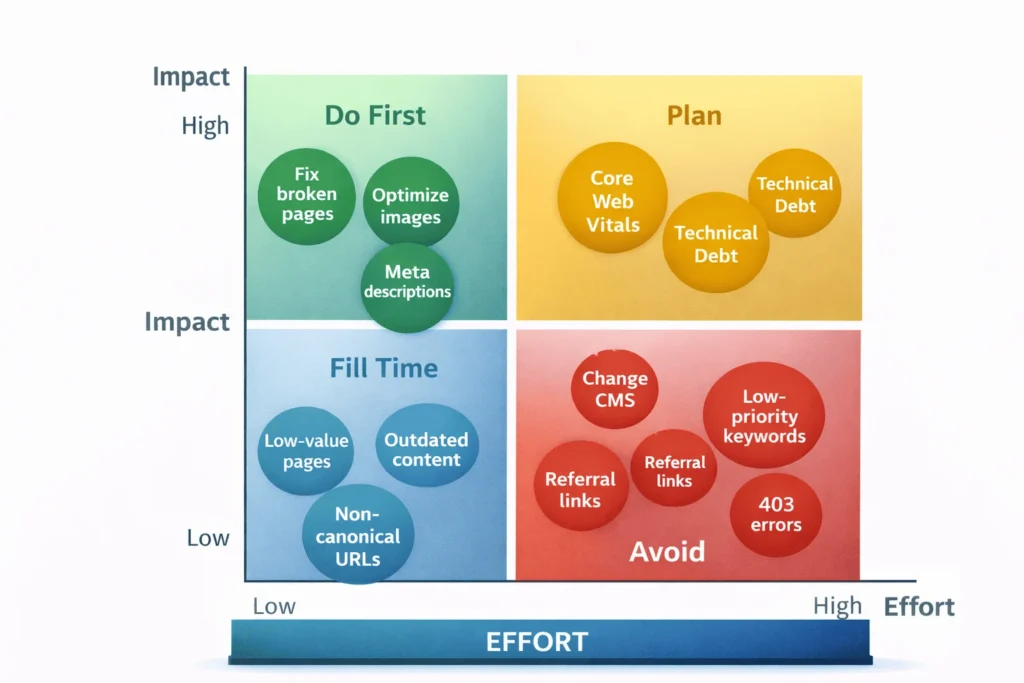
Impact-based prioritization matrix:
- Critical (fix immediately):
- Pages blocked from indexing
- Site-wide speed failures (LCP >4s)
- Major security issues (no HTTPS)
- Broken internal links on key pages
- High impact (fix this month):
- Poor Core Web Vitals (LCP 2.5-4s)
- Content-intent mismatches
- Toxic backlinks
- Duplicate content cannibalization
- Medium impact (fix this quarter):
- Missing schema markup
- Suboptimal title tags
- Image optimization
- Internal linking improvements
- Low impact (nice to have):
- Minor HTML validation errors
- Social meta tags
- Favicon issues
Prioritization formula:
Priority Score = (Traffic Potential × Ranking Impact) ÷ Implementation Effort
Example: Fixing 10 broken product pages (high traffic, easy fix) beats optimizing 200 blog meta descriptions (low traffic, tedious).
What Should a Technical SEO Audit Check First?
Start with indexing integrity—Google can’t rank pages it doesn’t see.
Indexing audit workflow:
- Google Search Console → Pages
- Check “Indexed” vs “Not indexed” counts
- Investigate “Discovered – not indexed”
- Fix “Crawled – not indexed” (quality issues)
- Canonical conflicts
- Find pages with conflicting canonical tags
- Verify self-referencing canonicals
- Fix redirect chains (>2 hops)
- Noindex mistakes
- Crawl site with Screaming Frog
- Export pages with noindex tags
- Remove from critical pages
- Robots.txt blocks
- Check robots.txt doesn’t block key pages
- Verify sitemap location listed
- Test with Search Console tester
Common indexing killers:
- Orphaned pages (no internal links)
- Duplicate content (multiple URLs, same content)
- Thin content (<300 words, no value)
- JavaScript rendering issues (content loads late)
How Do I Audit Core Web Vitals Effectively?
Core Web Vitals = 10-20% ranking factor.
2026 thresholds:
- LCP (Largest Contentful Paint): <2.5s
- INP (Interaction to Next Paint): <200ms
- CLS (Cumulative Layout Shift): <0.1
Audit process:
- Collect field data (PageSpeed Insights, Search Console)
- Identify failing pages (prioritize high-traffic)
- Diagnose root causes:
- LCP: Slow images, render-blocking scripts
- INP: Heavy JavaScript, third-party widgets
- CLS: Missing image dimensions, late-loading ads
- Test fixes in staging
- Re-measure after deployment
Quick wins:
- Compress images (WebP format, <200KB)
- Enable caching (browser + CDN)
- Defer non-critical JavaScript
- Set image dimensions (prevent layout shift)
- Lazy load below fold (reduce initial load)
How Do I Audit Content for Search Intent?
Intent mismatch = #1 content ranking failure.
Content audit framework:
- Pull Search Console data (last 90 days)
- Identify underperforming pages (impressions high, clicks low)
- Check SERP intent for target keywords:
- Informational = guides, tutorials, explanations
- Commercial = comparisons, reviews, “best X”
- Transactional = product/service pages, pricing
- Navigational = brand, specific page lookups
- Match or update content to dominant intent
Content quality signals:
✅ Comprehensive (>1,500 words for competitive terms)
✅ Fresh (updated within 12 months)
✅ Original (not scraped/thin)
✅ Structured (clear H2/H3 hierarchy)
✅ Helpful (solves user problem)
- Keep: Performing well, maintain
- Update: Good foundation, needs refresh
- Rewrite: Wrong intent or poor quality
- Consolidate: Overlaps with similar pages
- Delete: No value, thin, outdated
How Do I Audit Backlink Profile for Risk?
Toxic backlinks = manual penalties or algorithmic suppression.
Backlink audit workflow:
- Pull backlink data (Ahrefs, Semrush)
- Filter by suspicious signals:
- DR <20 (low-authority sites)
- Irrelevant niches (unrelated topics)
- Exact-match anchors (over-optimization)
- Sitewide links (footer spam)
- PBN patterns (same IP ranges)
- Manual review of flagged links
- Disavow toxic domains (Google Disavow Tool)
- Build quality links to dilute bad ratio
✅ 70%+ branded/naked URL anchors
✅ DR 30+ average
✅ Relevant niches
✅ Diverse referring domains
✅ Natural growth pattern
Red flags:
- Sudden spike in low-quality links
- Foreign language irrelevant sites
- Casino, pharma, adult anchor text
- Scraped content sites
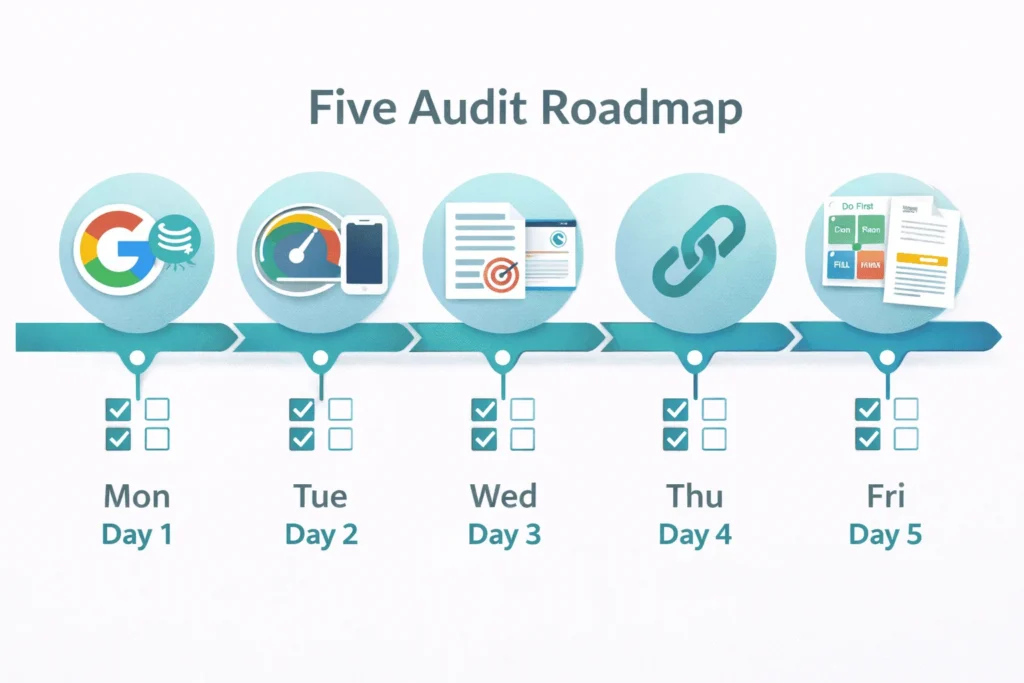
How To Execute Complete SEO Audit (5-Day Framework)
Times Needed: 5 Days
Estimated Cost: 259-400 USD
Description: Systematic 5-day SEO audit framework prioritizing high-impact issues first. Delivers actionable roadmap sorted by traffic potential and implementation difficulty.
Steps
- Day 1: Baseline + Indexing Audit
Step Title: Search Console + Screaming Frog Crawl
Step Description: Export Search Console Coverage report. Run Screaming Frog full crawl. Identify blocked/de-indexed pages, canonicals, redirects. Fix critical indexing errors immediately. - Day 2: Technical + Performance Audit
Step Title: Core Web Vitals + Site Health
Step Description: Run PageSpeed Insights on top 20 pages. Note LCP/INP/CLS failures. Check robots.txt, XML sitemap, HTTPS, mobile usability. Prioritize speed fixes by traffic value. - Day 3: Content + Intent Audit
Step Title: Search Console Analysis + SERP Review
Step Description: Pull queries with high impressions, low CTR. Check top 20 content pages for intent match vs current SERPs. Tag pages: keep/update/rewrite/consolidate/delete. - Day 4: Backlink + Authority Audit
Step Title: Ahrefs Backlink Analysis
Step Description: Export all backlinks. Filter by DR <20 + irrelevant niches. Manual review 100-200 suspicious links. Prepare disavow list. Identify link-building opportunities from competitors. - Day 5: Prioritization + Roadmap
Step Title: Impact Matrix + Implementation Plan
Step Description: Score all issues: traffic potential × ranking impact ÷ effort. Create 30/60/90-day roadmap. Assign critical (week 1), high (month 1), medium (quarter 1) tasks.
Tools Name: Google Search Console, Screaming Frog, PageSpeed Insights, Ahrefs
Materials Name: Site admin access, Analytics access, competitor list, previous audit (if available)
FAQ Section
Quarterly minimum for active sites. Monthly for competitive industries or after major site changes. Annual deep audits for established sites with stable traffic.
Yes—Google Search Console + PageSpeed Insights + free Screaming Frog (<500 URLs) cover 60-70% of critical checks. Paid tools (Ahrefs, Semrush) add backlink/competitor depth.
Indexing problems—pages blocked, duplicate content, orphaned URLs. 30-40% of sites have critical pages Google can’t access or won’t index.
Both serve different purposes. Screaming Frog = technical on-site depth. Ahrefs = backlinks, keywords, competitive analysis. Professional audits use both.
5-20 hours depending on site size. Small sites (<500 pages): 5-8 hours. Medium (500-5K pages): 10-15 hours. Enterprise (10K+ pages): 20-40 hours.
Technical = crawlability, indexing, speed, mobile. Content = quality, intent match, freshness, engagement. Both required for complete picture.
Prioritize by: traffic potential × ranking impact ÷ implementation effort. Always fix indexing/crawl blocks first—can’t rank pages Google can’t see.
No guarantees, but 30-50% traffic gains within 90 days common when fixing critical issues systematically. Results depend on competition, content quality, authority.
Key Takeaways Section
- Prioritize by impact—20% of issues cause 80% of traffic loss; fix critical indexing/speed problems first.
- Five-pillar framework—indexing, discovery, performance, content-intent, backlinks cover 90% of ranking factors.
- Tool combination wins—Screaming Frog (technical depth) + Ahrefs (competitive/backlinks) + Search Console (baseline).
- Intent matching critical—most content failures stem from mismatched search intent, not technical issues.
- Quarterly cadence—audits catch issues before they compound; monthly for competitive niches.
Next Steps Section
- Open Google Search Console—check Coverage report for indexing errors today
- Run Screaming Frog crawl—free version handles <500 URLs
- Test top 10 pages—PageSpeed Insights for Core Web Vitals scores
- Export Search Console queries—identify high-impression, low-CTR content
- Create prioritization matrix—score issues by traffic potential × impact ÷ effort
Conclusion
Effective SEO audits abandon meaningless 200-item checklists for prioritization-based frameworks targeting issues that actually move rankings. Five critical areas—indexing, crawl discovery, Core Web Vitals, content-intent, backlinks—deliver 30-50% traffic gains when systematically addressed.
2026 reality: AI-driven search and zero-click results make technical foundations and intent-matched content non-negotiable. Sites ignoring Core Web Vitals or serving wrong-intent content lose visibility fast.
Execute the 5-day framework above, prioritize ruthlessly, and watch organic traffic climb within 60-90 days. Build deeper knowledge with StartupMandi’s complete SEO guide.