


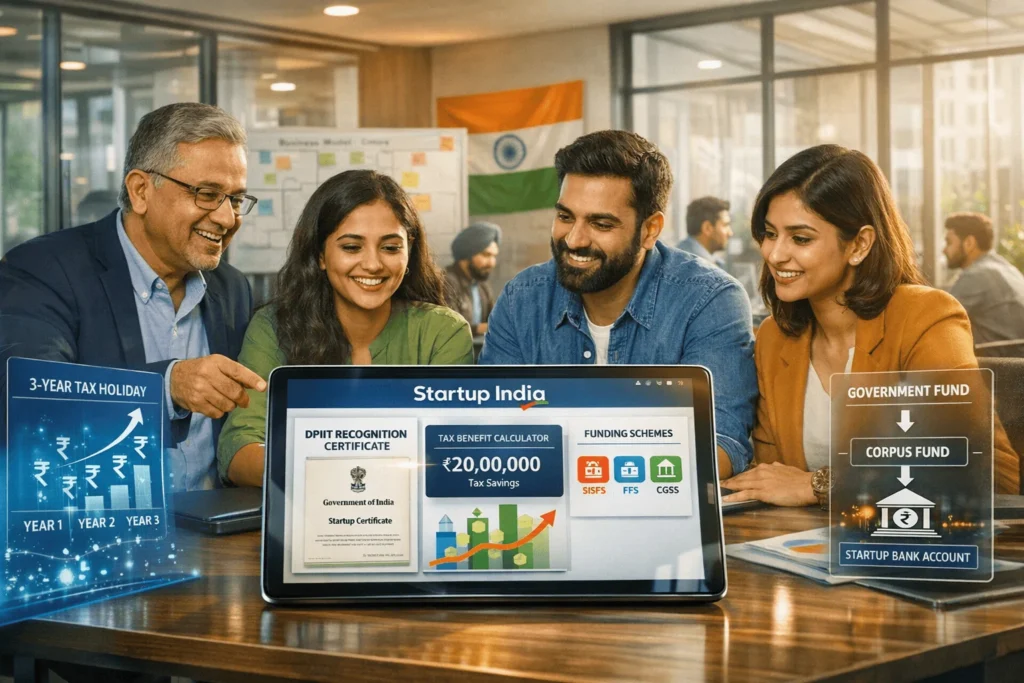
Startup India provides DPIIT-recognized startups with 100% tax exemption for 3 consecutive years, up to ₹50 lakh seed funding, 80% patent filing rebates, and angel tax exemption on investor funding—saving founders ₹15-30 lakhs in the first 3 years. As of January 2026, 1,97,692 startups are officially recognized under this scheme.
What Is Startup India?
Startup India is a flagship government initiative launched January 16, 2016, to build a robust startup ecosystem through regulatory support, funding access, and tax benefits for innovation-driven businesses.
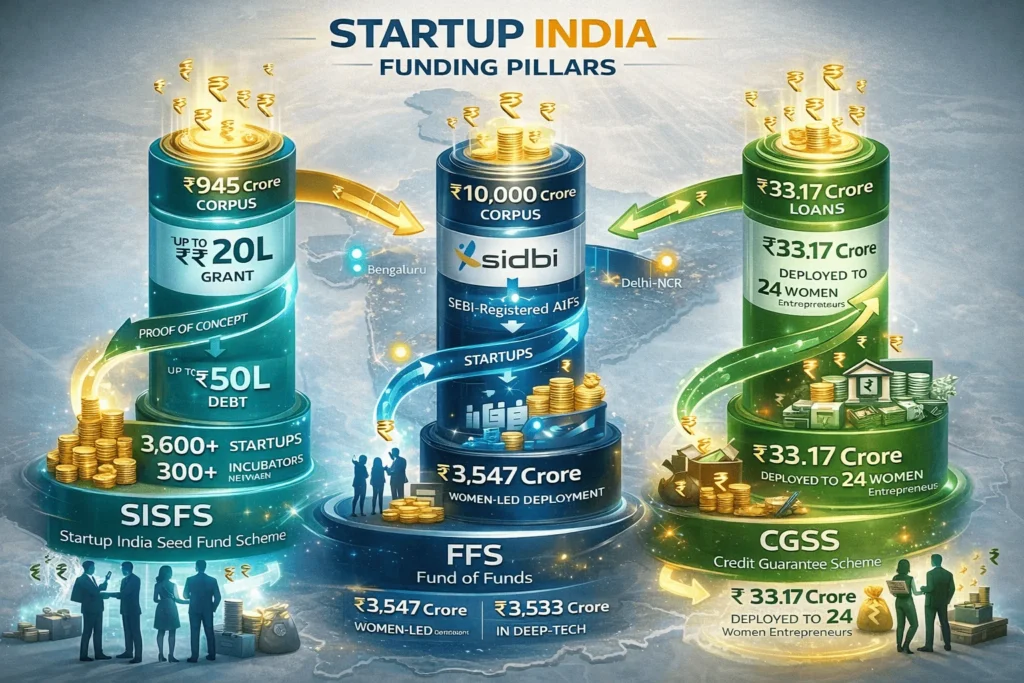
The program operates through Department for Promotion of Industry and Internal Trade (DPIIT) recognition, which unlocks access to three flagship schemes: Fund of Funds (FFS) with ₹10,000 crore corpus, Startup India Seed Fund Scheme (SISFS) with ₹945 crore allocation, and Credit Guarantee Scheme (CGSS) for collateral-free loans.
Current ecosystem size:
- 1,97,692 DPIIT-recognized startups (January 2026)
- 94 unicorns valued at $1B+
- World’s 3rd-largest startup hub
- $11.59 billion total funding raised (2025)
“Startup India has transformed India into a global innovation powerhouse, with 1,97,692 recognized startups creating employment and solving complex challenges across sectors.” — DPIIT Report, 2026
Who Is Eligible for Startup India Recognition?
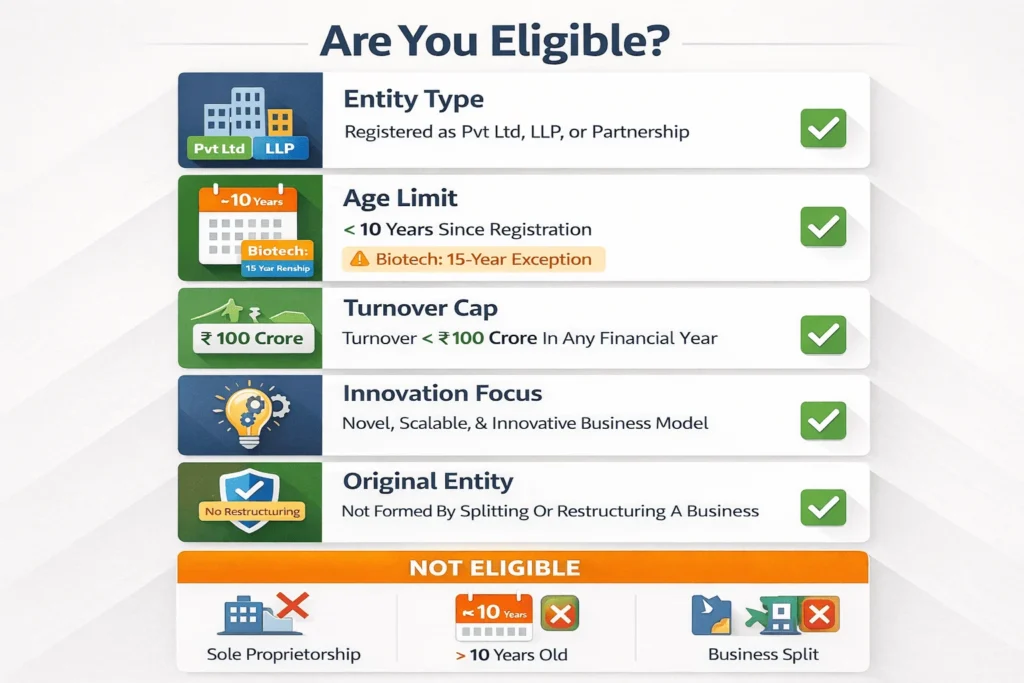
Private Limited Companies, LLPs, or Registered Partnership Firms that are less than 10 years old (15 for biotech), have annual turnover under ₹100 crore, and work on innovation or scalable business models qualify for DPIIT recognition.
Core Eligibility Criteria
Disqualification scenarios:
- 1. Exceeding 10-year age limit (non-biotech)
- 2. Crossing ₹100 crore turnover threshold
- 3. Formed through business reconstruction
- 4. Operating as sole proprietor or unregistered firm
Before applying for Startup India benefits, ensure legal compliance by completing PAN, TAN, and GST registration for startups correctly.
What Are the Tax Benefits Under Startup India?:
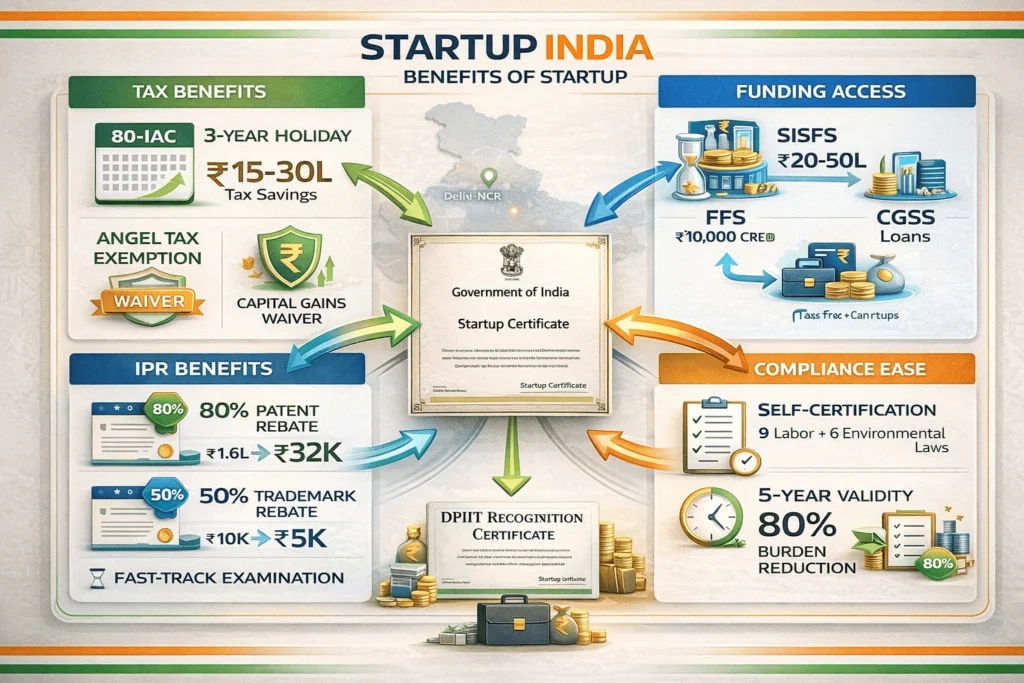
100% income tax exemption for any 3 consecutive years within the first 10 years of incorporation, angel tax exemption on investments above fair market value, and capital gains tax exemption on recognized funding.
1. Three-Year Tax Holiday (Section 80-IAC)
Benefit: Eligible startups enjoy 100% tax exemption on profits for 3 consecutive financial years out of their first 10 years from incorporation.
Eligibility conditions:
- Incorporated between April 1, 2016, and March 31, 2026
- Annual turnover ≤₹100 crore in any financial year
- Must hold DPIIT Recognition Certificate
- Must obtain Inter-Ministerial Board (IMB) approval
Strategic advantage: Founders choose the 3 most profitable years to claim exemption, maximizing tax savings during growth phase.
Savings estimate: A startup earning ₹50 lakh annual profit saves approximately ₹15-17 lakh in taxes over 3 years (assuming 30% corporate tax rate).
2. Angel Tax Exemption [Section 56(2)(viib)]
Benefit: Recognized startups are exempt from Angel Tax on investments exceeding fair market value—eliminating taxation on funding rounds.
Why this matters: Previously, if investors valued your startup at ₹10 crore but tax authorities deemed fair value at ₹5 crore, the ₹5 crore difference was taxed as income. Angel tax exemption removes this barrier entirely.
Impact: Encourages domestic and international investor participation without tax penalties on high-growth valuations.
3. Capital Gains Tax Exemption
Benefit: If your startup attracts investment from recognized angel investors or venture funds, capital gains tax is waived for investors, making your startup more attractive to funding sources.
Tax Benefits Comparison Table
How Much Funding Can Startups Access?
₹20 lakh grant + ₹50 lakh debt under SISFS for seed stage, venture capital through ₹10,000 crore FFS, and collateral-free loans under CGSS for working capital.
1. Startup India Seed Fund Scheme (SISFS)
Total corpus: ₹945 crore supporting ~3,600 startups through 300+ eligible incubators.
Funding structure:
- Proof of Concept grant: Up to ₹20 lakh for prototype development, market validation, and product trials
- Commercialization support: Up to ₹50 lakh (debt/convertible debenture) for market entry and scaling
Application process: Apply through approved incubators listed on Startup India portal—not directly to government.
Women-led startup support: As of October 2025, SISFS approved ₹284.79 crore to 1,635 women-led startups.
For comprehensive funding strategies beyond government schemes you can explore funding for startups in India: complete 2026 guide.
2. Fund of Funds for Startups (FFS)
Total corpus: ₹10,000 crore managed by SIDBI to provide equity funding through SEBI-registered Alternative Investment Funds (AIFs).
How it works: Government contributes to venture capital funds, which then invest in startups—providing 2x leverage and rigorous due diligence.
Track record (2020-2025):
- ₹2,838.9 crore invested in 154 women-led startups
- ₹3,547 crore deployed into women-led/co-led ventures
- ₹3,533 crore channeled into deep-tech startups
Benefit for founders: Access to structured venture capital at less dilutive valuations than traditional VC due to government backing.
3. Credit Guarantee Scheme for Startups (CGSS)
Benefit: Collateral-free loans through eligible financial institutions for working capital needs.
Track record (2023-2025): 24 loans totaling ₹33.17 crore guaranteed to women-led startups.
What IPR Benefits Are Available?
80% rebate on patent filing fees, 50% rebate on trademark fees, expedited examination, and government-funded IPR legal support for filing assistance.
Intellectual Property Rights (IPR) Package
1. Fast-Track Patent & Trademark Filing
- Expedited examination and approval for patents, trademarks, and designs
- Significantly reduces IP protection timeline from 5-7 years to 18-24 months
2. Fee Reductions
- 80% rebate on patent filing fees (from ₹1.6L to ₹32K average)
- 50% rebate on trademark filing fees (from ₹10K to ₹5K)
- Reduces total IP protection cost by ₹1-2 lakh per application
3. IPR Legal Support
- Government-appointed facilitators assist with filing
- All facilitator fees covered by government
- Technical guidance on patent drafting and claims
Value proposition: Deep-tech and product-based startups save ₹5-10 lakh in IP protection costs over 3 years.
How Are Compliance Requirements Simplified?
Self-certification for 9 labor laws and 6 environmental laws for 5 years, 80% reduction in compliance burden, and single-window clearance through Startup India portal.
Regulatory Relaxations
1. Self-Certification Compliance
- Self-certify compliance for 9 labor laws and 6 environmental regulations
- Valid for 5 years from incorporation
- Reduces inspection frequency by 80%
2. Simplified Exit Mechanism
- Fast-track closure process for failed startups
- 90-day wind-up procedure vs 180+ days for regular companies
- Lower exit costs and reduced bureaucracy
3. Single-Window Operations
- All registrations, approvals, and compliances through Startup India portal
- Reduces multi-department coordination
- Faster clearances (30-45 days vs 90-120 days)
Understanding growth stages helps plan compliance needs so you can read how Indian startups grow across funding stages from idea to scale for stage-wise guidance.
What State-Level Benefits Complement Central Schemes?
State governments offer additional grants (₹3-15 lakh), incubation support, interest-free loans, and regional accelerators like Karnataka’s Elevate, Kerala’s KSUM, and Gujarat’s SSIP.
Top State Startup Ecosystems (2026)
Karnataka leadership: Raised $1.7 billion in H1 2025, retaining highest deal volume nationally.
Kerala accessibility: 6,400+ startups supported, created 65,000+ direct jobs, facilitated $665M+ funding.
Gujarat revival: Raised ₹400 crore in 5 months (April-August 2025), signaling post-slump recovery.
How To: Register for Startup India Benefits
Times Needed: 7 Days,3 Hours
Estimated Cost: 0 USD (free registration)
Description: Complete process to obtain DPIIT recognition and unlock all Startup India benefits including tax exemptions, funding access, and IPR rebates within 7 days.
Steps:
1. Incorporate your entity legally (Days 1-3)
Register as Private Limited Company, LLP, or Partnership Firm. Obtain Certificate of Incorporation (COI), PAN, and complete KYC for all directors/partners. Ensure company name reflects innovation focus.
2. Prepare supporting documents (Day 4)
Gather: COI, PAN card, director/partner KYC (PAN, Aadhaar, contact), brief business description (highlighting innovation), website/pitch deck/patent (if available), audited financials (if applicable), authorization letter (if using consultant).
3. Access Startup India portal (Day 5, 1 hour)
Visit www.startupindia.gov.in. Create account using mobile number and email. Verify via OTP. Complete founder profile with education, experience, and entrepreneurial background.
4. Submit DPIIT recognition application (Day 5, 2 hours)
Fill online form with entity details, innovation description, scalability potential, employment generation prospects. Upload all documents (PDF format, <5MB each). Review submission for accuracy. Pay nil application fee.
5. Wait for DPIIT approval (Days 6-7)
DPIIT reviews application (typically 2-5 business days). Check email for approval notification. Download DPIIT Recognition Certificate and Recognition Number upon approval.
6. Apply for tax exemptions (Post-approval)
After DPIIT recognition, apply separately for 80-IAC tax holiday through Inter-Ministerial Board (IMB). Submit financial projections, business plan, and DPIIT certificate. IMB approval takes 30-45 days additional.
Tools Name: Startup India Portal, MCA portal (for incorporation), Digital signature certificate (DSC)
Materials Name: Certificate of Incorporation, PAN card, KYC documents, Business pitch deck
Key Takeaways
1. Startup India provides 100% tax exemption for 3 consecutive years (₹15-30L savings), angel tax exemption on all funding, and capital gains tax benefits for investors.
2. ₹20 lakh grant + ₹50 lakh debt available under SISFS for seed-stage startups, with ₹945 crore corpus supporting ~3,600 ventures through 300+ incubators.
3. ₹10,000 crore Fund of Funds provides venture capital through SEBI-registered AIFs, deploying ₹3,547 crore into women-led startups and ₹3,533 crore into deep-tech ventures.
4. 80% patent fee rebate and 50% trademark rebate save deep-tech startups ₹5-10 lakh in IP protection costs over 3 years with expedited examination.
5. Self-certification for 9 labor and 6 environmental laws reduces compliance burden by 80% for first 5 years, with 90-day fast-track exit mechanism.
6. 1,97,692 startups recognized as of January 2026, making India the world’s 3rd-largest startup hub with 94 unicorns valued at $1B+.
7. State programs complement central schemes—Karnataka’s Elevate (₹50L no-equity), Kerala’s KSUM (₹3-15L grants), Gujarat’s SSIP (student focus), Maharashtra’s ₹500 crore MahaFund.
8. Eligibility requirements strict: Private Limited/LLP/Partnership only, <10 years old (15 biotech), <₹100 crore turnover, innovation focus, not formed by restructuring.
Next Steps
1. Verify eligibility: Confirm entity type (Pvt Ltd/LLP/Partnership), age (<10 years), turnover (<₹100 crore), and innovation focus before applying.
2. Complete legal incorporation: Register entity, obtain COI and PAN, complete director/partner KYC, set up bank account.
3. Gather documentation: Prepare business description highlighting innovation, scalability potential, pitch deck, website/product demo, audited financials.
4. Apply for DPIIT recognition: Visit www.startupindia.gov.in, create account, submit complete application with all supporting documents.
5. Await approval (2-5 days): Monitor email for DPIIT certificate, download recognition number upon approval.
6. Apply for tax exemption: After DPIIT recognition, submit separate 80-IAC application to Inter-Ministerial Board with financial projections.
7. Explore state schemes: Research Karnataka Elevate, Kerala KSUM, Gujarat SSIP, or state-specific programs for additional grants.
8. Access SISFS funding: Identify approved incubators on Startup India portal, submit application for ₹20L grant + ₹50L debt support.
FAQ
Startup India is a government initiative providing tax exemptions, funding, and compliance benefits to DPIIT-recognized startups. Eligible entities: Private Limited, LLP, or Partnership Firms <10 years old (15 for biotech), turnover <₹100 crore, working on innovation/scalable models.
Eligible startups get 100% income tax exemption for 3 consecutive years (chosen from first 10 years). A startup earning ₹50L annual profit saves approximately ₹15-17 lakh over 3 years at 30% tax rate.
SISFS provides up to ₹20 lakh grant for proof-of-concept and up to ₹50 lakh debt/convertible for commercialization. Total corpus: ₹945 crore supporting ~3,600 startups through 300+ incubators. Apply through approved incubators, not directly to government.
No. Only DPIIT-recognized startups receive automatic angel tax exemption under Section 56(2)(viib). Recognition removes taxation on investments exceeding fair market value, encouraging investor participation.
No. Only Private Limited Companies, LLPs, or Registered Partnership Firms qualify. Sole proprietorships must restructure as eligible entity types to access benefits.
80% rebate on patent fees (₹1.6L → ₹32K), 50% rebate on trademarks (₹10K → ₹5K), expedited examination (18-24 months vs 5-7 years), and government-funded legal support for filing assistance.
Typically 2-5 business days after submitting complete application on Startup India portal. Ensure all documents are accurate to avoid delays. Tax exemption (IMB approval) takes additional 30-45 days
Yes. ₹3,547 crore deployed into women-led/co-led startups under FFS, ₹284.79 crore approved to 1,635 women founders under SISFS, and ₹33.17 crore in CGSS loans to women entrepreneurs. Explicitly highlight women leadership in applications.
Conclusion
Startup India delivers comprehensive support saving founders ₹15-30 lakh in taxes, providing ₹20-50 lakh seed funding, reducing IP protection costs by 80%, and eliminating angel tax barriers—transforming India into the world’s third-largest startup ecosystem with 1,97,692 recognized ventures.
The strategic advantage lies in combining multiple benefits: 3-year tax holiday during growth phase, parallel SISFS funding for product validation, 80% IPR rebates for deep-tech protection, and state-level grants for regional scaling. Together, these programs reduce early-stage capital requirements by 40-60% while accelerating time-to-market through fast-tracked compliance and single-window clearances.
Critical action: Obtain DPIIT recognition first—it’s the gateway unlocking all other benefits including tax exemptions, funding access, and IPR rebates. The application process takes 2-5 days with zero fees, making it the highest-ROI early-stage action for eligible founders.
Complement Startup India benefits with proper legal foundation through PAN, TAN, and GST registration, explore comprehensive funding strategies beyond government schemes, and understand how startups grow across different funding stages for stage-wise planning.
A Few Link Suggestion
1. Stocks Mantra: Startup India Complete Benefits List 2025
2. Rest The Case: Startup India Registration Eligibility
3. BestStartup: Startup India Funding & Regional Guide 2026
4. PIB: Government Supports Startup Ecosystem
5. Startup India Official Portal: DPIIT Recognition





Thanks for breaking down the Startup India benefits so clearly—especially the tax exemptions and funding support. It’s great to see how these incentives can save founders 15-30 lakhs in the early stages. Would be interested to know if there are any updates on the registration process, given the current pause.
Thank you for your comment. To use your site link & generate backlink on our platform, 1st go through a paid plan on this page: https://startupmandi.in/services/digital-services/premium-brand-promotion-on-startupmandi/
Thanks for breaking down the Startup India benefits so clearly—especially the tax exemptions and funding support. It’s great to see how these incentives can save founders significant costs in the early stages. Would be interested to hear more about the application process or any common pitfalls founders face while applying for these benefits.
Thank you for your comment. To use your site link & generate backlink on our platform, 1st go through a paid plan on this page: https://startupmandi.in/services/digital-services/premium-brand-promotion-on-startupmandi/
The breakdown of the 80% IPR rebate is particularly helpful, as that kind of early-stage cost mitigation can significantly extend a startup’s runway. Could you share any insights on the documentation nuances for the angel tax exemption to ensure the application goes smoothly?
Thank you for your comment. To use your site link & generate backlink on our platform, 1st go through a paid plan: https://startupmandi.in/services/digital-services/premium-brand-promotion-on-startupmandi/
The Startup India initiative really stands out with its comprehensive support system, especially the 3-year tax holiday and up to ₹50 lakh in seed funding. It’s great to see such targeted benefits that can significantly reduce early-stage financial burdens for founders. The 80% patent rebate is also a smart move to encourage innovation and IP protection.
Thank you for your comment. To use your site link & generate backlink on our platform, 1st go through a paid plan: https://startupmandi.in/services/digital-services/premium-brand-promotion-on-startupmandi/