


Microsoft Copilot Outage: what really happened
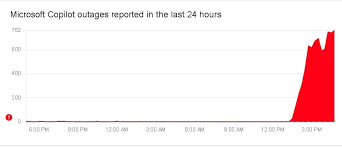
Microsoft Copilot outage reports surged on the morning of 9 December 2025, when users across the UK and Europe suddenly found the AI assistant unresponsive. Copilot stopped replying both on the web and inside Microsoft 365 apps, with many people repeatedly seeing the line: “Sorry, I wasn’t able to respond to that. Is there something else I can help with?”. Consequently, teams that had woven Copilot into daily workflows for emails, documents and meeting summaries had to fall back on manual work.
Microsoft acknowledged the Microsoft Copilot outage in an admin‑centre alert under incident ID CP1193544. The company warned that users in the United Kingdom and parts of Europe might be unable to access copilot.cloud.microsoft and related endpoints, or might experience “degraded functionality” for specific features inside Microsoft 365. Independent outage trackers like DownDetector and Copilot‑status sites confirmed a sharp spike in complaints during the same window.

Root cause: traffic spike, autoscaling failure and load balancing
Capacity scaling problems
Early investigation pointed to a capacity scaling issue in Copilot’s back‑end infrastructure. Telemetry showed an unexpected surge in traffic, which the autoscaling system failed to handle correctly. Instead of smoothly adding compute resources, parts of the service remained under‑provisioned, so requests began to queue, time out or return generic error messages.linkedin+1
Microsoft’s status updates explained that engineers were “manually scaling capacity to improve service availability” while monitoring metrics to verify improvement. This kind of manual override is common when an automated scaling policy misbehaves under rare or extreme load patterns.
Separate load‑balancing incident
However, the Microsoft Copilot outage turned out to be more than just an autoscaling hiccup. A later update revealed “a separate issue affecting load balancing”, which was also contributing to the overall impact. In practice, this meant some Copilot front ends and regional edges were not routing traffic efficiently to healthy back‑end instances.
To mitigate this, Microsoft started changing load‑balancing rules so that incoming requests would be distributed more evenly across regions and clusters. In parallel, they continued increasing capacity, aiming to bring error rates and response times back within normal bounds.
Who was affected and how
Impact on Microsoft 365 users
The Microsoft Copilot outage did not hit every Microsoft product equally, but it was very visible in day‑to‑day tools:
- Copilot inside Microsoft 365 apps (Word, Excel, Outlook, Teams) often failed to load or respond.
- The standalone Copilot web interface and Copilot sidebar in Microsoft Edge also showed errors or refused to start sessions.
- Many users could open the UI but saw missing features such as summarisation, document drafting and Teams meeting prompts.
Reports from UK news and blogs describe thousands of users across businesses and universities suddenly unable to rely on Copilot for meeting notes, email drafts or quick research summaries. Therefore, productivity dipped precisely during busy weekday hours.
Geographic scope
Microsoft and multiple outlets confirm that the Microsoft Copilot outage was heavily concentrated in:
- United Kingdom
- Multiple European countries serviced by the same Copilot region
Some global users outside Europe saw slower responses but did not experience a full outage, suggesting that certain regional clusters bore most of the load stress.
Practical steps during a Microsoft Copilot outage
When an AI‑centred workflow fails suddenly, a calm, structured response helps. During the Microsoft Copilot outage, three simple practices made a difference:
1. Verify status instead of guessing
Rather than endlessly toggling settings, users were encouraged to:
- Check the Microsoft 365 Admin Center for incident ID CP1193544.
- View the public Microsoft 365 status page for live updates.
- Look at third‑party outage trackers like DownDetector for confirmation. issue is on Microsoft’s side, not your network or device, which reduces wasted troubleshooting.
2. Switch to AI‑optional workflows
Because Copilot is integrated into Word, Excel and Teams, many users could continue working by:
- Using standard editing features and templates instead of AI‑generated drafts.
- Falling back to manual note‑taking in meetings instead of relying on AI summaries.
- Scheduling non‑urgent AI‑heavy tasks (like long research prompts) for later.
Although this slows things down, it keeps output flowing while engineers fix the Microsoft Copilot outage.
3. Communicate with your team and clients
For companies heavily using Copilot in client communication, letting stakeholders know about the incident is important. Short, factual internal updates referencing Microsoft’s incident ID and region impact help maintain trust and avoid confusion.
Lessons for startups from the Microsoft Copilot outage
The Microsoft Copilot outage carries several lessons for startup founders, especially those building on top of third‑party AI platforms:
- Avoid single points of AI failure: If every core process assumes Copilot works 24/7, one regional outage can stall your entire operation. Where possible, design processes that still function—at reduced speed—without AI.
- Plan vendor incidents into your risk model: Investors increasingly ask how dependent you are on external APIs. Documenting fallback tools, manual procedures and alternative providers strengthens your risk narrative in pitch decks.
- Monitor and log dependencies: Keep a simple list of critical services (like Microsoft 365, payment gateways, hosting, AI APIs) and who is responsible for watching their status dashboards.
Conclusion
The Microsoft Copilot outage that swept across the UK and Europe shows how even world‑class cloud systems can stumble when traffic patterns and autoscaling collide. A sudden demand spike, failed capacity scaling and separate load‑balancing issues combined to block or degrade Copilot access in Microsoft 365 and the web for thousands of users. Although Microsoft’s engineers moved quickly to manually add capacity and adjust routing, the incident exposed how deeply many businesses now depend on AI assistants for everyday work.
For startups, the message is not to avoid AI but to adopt it wisely. Build AI‑accelerated workflows, yet ensure your core operations remain AI‑optional and resilient to vendor outages.
5 FAQs on Microsoft Copilot outage
1. What caused the Microsoft Copilot outage in December 2025?
Service telemetry indicated an unexpected traffic increase that broke automatic capacity scaling, plus a separate load‑balancing issue that worsened access failures.
2. Which regions were most affected by the Microsoft Copilot outage?
Microsoft identified the United Kingdom and other parts of Europe as the primary impacted regions for this incident.
3. Which Copilot features stopped working during the outage?
Many users could not load Copilot in Microsoft 365 apps or the web; others saw slow, incomplete responses and missing features such as summarisation and drafting.
4. How long do Microsoft Copilot outages typically last?
Reports suggest these incidents usually last from under an hour to a few hours, depending on how quickly capacity and routing changes are rolled out, though exact durations vary.
5. How can startups reduce the impact of future Copilot outages?
Startups should design AI‑optional workflows, document manual fallbacks, and monitor vendor status dashboards so they can inform teams and clients early during any disruption.
Referring blog / page links
- Microsoft Copilot explained as users hit by outage | Express.co.uk
- Microsoft Copilot down: AI assistant not working in major outage | The Independent
- Microsoft investigates Copilot outage affecting users in Europe
- Microsoft Copilot DOWN as AI is crippled by outage affecting users across UK and Europe
- Is Microsoft Copilot down? [December 9, 2025] – Microsoft 365 / Azure / Outlook / Teams down? – DesignTAXI Community: Creative Connections, Conversations and Collaborations