



Japan Earthquake Tsunami: What Happened
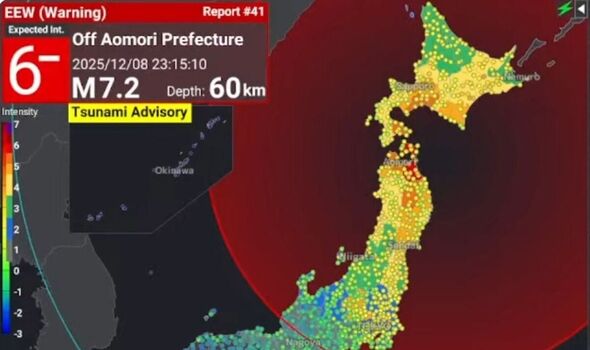
The Japan Earthquake Tsunami alert was triggered after a powerful offshore quake struck the country’s north on Monday night. According to the Japan Meteorological Agency (JMA), a magnitude around 7.2–7.6 earthquake hit off the coast of Aomori and Hokkaido at about 11:15 p.m. local time, at a depth of roughly 50–60 km. As a result, tsunami warnings were issued for northern prefectures, with authorities cautioning that waves could reach up to three metres in some coastal areas.
Initial tsunami waves of up to about 40 centimetres were observed at several ports, and officials warned that larger waves could follow. Consequently, residents in low‑lying coastal zones were urged to move to higher ground or designated shelters and to stay away from beaches and river mouths until advisories were lifted.
Current Impact: Injuries, Power And Transport
Although the Japan Earthquake Tsunami event was severe, early reports suggest no large‑scale devastation on the scale of 2011. Reuters and public broadcaster NHK noted that around 90,000 residents were ordered to evacuate across parts of Hokkaido, Aomori and Iwate as a precaution. However, as of the latest updates, only scattered injuries and localized damage have been reported, including several people hurt at a hotel in Hachinohe, Aomori, who remained conscious after treatment.
Power cuts occurred immediately after the quake, but utilities managed to restore electricity to most homes overnight, leaving only a few hundred still affected. Moreover, East Japan Railway temporarily suspended train services across affected routes while checks were carried out on tracks and infrastructure. Importantly, nuclear plants in the region reported no abnormalities, though operators conducted urgent inspections as a standard safety measure following any strong quake. [source]
Japan Earthquake Tsunami Alerts And Scale
JMA Warnings And Local Intensity
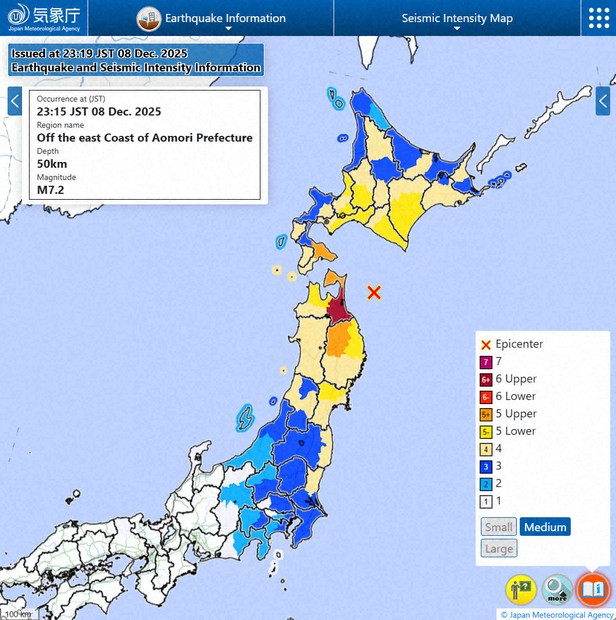
The Japan Earthquake Tsunami trigger came from the strong offshore shaking and shallow depth. On Japan’s own Shindo seismic intensity scale, some areas of Aomori recorded a strong “upper 6” level, which is powerful enough to knock people off their feet, topple heavy furniture and crack walls or windows in many buildings. Because of this intensity, officials also warned about landslide risks and possible aftershocks over the next few days.
Tsunami warnings were issued for Aomori, Hokkaido and Iwate, with estimated wave heights of up to three metres on some coastlines. Later in the night, as data improved and observed waves remained relatively modest, authorities downgraded the strongest warnings to advisories, signalling reduced but still non‑zero risk for further waves and strong currents.
Why Japan Reacts So Quickly
Japan faces frequent seismic activity, experiencing tremors roughly every few minutes somewhere in the archipelago. Consequently, the country has built one of the most advanced early‑warning and evacuation systems in the world, combining real‑time seismic networks, automated phone alerts and loudspeaker systems in coastal towns. This infrastructure, along with strict building codes, helps limit casualties even when earthquakes reach magnitude 7 or higher.
Practical Safety Tips During A Japan Earthquake Tsunami
During The Shaking
When a Japan Earthquake Tsunami risk begins with strong shaking, basic earthquake safety steps still come first:
- Drop to your hands and knees to avoid being knocked down.
- Cover your head and neck, and if possible shelter under a sturdy table away from windows.
- Hold on until the shaking stops, and avoid elevators or rushing to exits during the strongest tremors.
These habits are taught widely in Japan and significantly reduce injuries from falling objects or glass.
After The Shaking: Tsunami Precautions
If you are in a coastal region and feel a strong or long quake, you should act even before any Japan Earthquake Tsunami alert appears on television:
- Move quickly to high ground or to floors in a sturdy building that are well above sea level.
- Stay away from beaches, sea walls and riverbanks, since multiple waves can arrive over hours.
- Follow local authority instructions via sirens, loudspeakers, TV, radio or smartphone alerts.
Even relatively small tsunami waves can generate dangerous currents, overturning small boats or sweeping people off harbour walls.
What This Means For Founders And Businesses
Although the Japan Earthquake Tsunami situation is first a human and humanitarian issue, it also highlights how fragile supply chains and operations can be. Coastal factories, data centres, logistics hubs and small shops can all face sudden shutdowns from evacuation orders, power loss or infrastructure checks.
For Indian startups and SMEs selling into or sourcing from Japan, this kind of event is a reminder to:
- Map critical suppliers and partners located in high‑risk zones.
- Build backup logistics and inventory buffers where feasible.
- Create a simple crisis‑communication plan for staff, customers and investors.
Conclusion
The recent Japan Earthquake Tsunami alerts show once again how quickly nature can disrupt even the most prepared societies. A strong offshore quake near Aomori and Hokkaido triggered tsunami warnings, evacuations for roughly 90,000 people, transport shutdowns and urgent safety checks, yet Japan’s early‑warning systems and building standards appear to have limited casualties and major damage so far. As advisories ease, authorities remain cautious about aftershocks, landslides and continuing wave activity .[source]
For entrepreneurs and business leaders, this event is also a case study in preparedness, communication and resilience. Whether you operate locally or globally, it pays to plan for shocks—financial, operational or environmental.
5 FAQs On The Japan Earthquake Tsunami
1. Where did the latest Japan Earthquake Tsunami threat originate?
The threat followed a strong offshore quake near Japan’s northern coast, with the epicentre about 80 km off Aomori Prefecture at a depth of around 50–60 km.
2. How powerful was the earthquake that triggered the tsunami warning?
Reports from JMA and international agencies placed the magnitude around 7.2–7.6, strong enough to generate tsunami warnings and intense local shaking.
3. How many people were evacuated due to the tsunami warnings?
Roughly 90,000 residents in coastal parts of Hokkaido, Aomori and Iwate were ordered to move to higher ground or shelters.
4. Were there major damages or casualties from the Japan Earthquake Tsunami?
Early reports mention limited injuries and localized damage, including some hurt at a hotel in Hachinohe, but no widespread destruction or severe nuclear issues have been confirmed so far.
5. Are tsunami advisories still in place?
Initial tsunami warnings were later downgraded to advisories as observed waves remained modest, though authorities continued urging people to stay away from coasts until all alerts are lifted.
Read My Other Blogs
- Formula 1 Abu Dhabi GP 2025 Title Thriller
- Goa vs Mumbai Super Cup Semi-Final | Full Details
- Kennedy Center Honors 2025: Trump Hosts Historic Gala
Referring Blog / Page Links
- 7.2 Quake Strikes Off Japan’s Northern Coast, Triggers Tsunami Alert
- Powerful earthquake strikes Japan’s northeast, tsunami warning issued; US strategy warns of Europe’s ‘civilisational erasure’ – India Today
- Japan struck by earthquake, tsunami: Several injuries reported, thousands advised to evacuate; what we know so far – The Times of India
- Japan tsunami live updates: Warning issued over 3 metre wave after rare 7.6 magnitude earthquake strikes | The Independent