


Introduction
The top technology trends 2026 will redefine how businesses operate, compete, and grow.
From autonomous AI agents to quantum computing and zero-trust security, organizations that adapt early will gain massive advantages.
In short: 2026 is not about adopting more tools. It’s about building intelligent, adaptive systems.
This guide breaks down the most important trends, what they mean, and how companies can prepare—without hype or jargon.
What Are The Top Technology Trends 2026?
The top technology trends 2026 are innovations expected to move from experimentation to mainstream adoption across industries.
Direct answer:
- Autonomous AI Agents
- Multimodal Generative AI
- Industry Cloud Platforms
- Quantum Computing Pilots
- Zero-Trust Cybersecurity
- Spatial Computing (AR/VR/MR)
- Sustainable Green Tech
These trends are consistently highlighted by:
- Gartner Technology Outlook
- Deloitte Tech Trends
- IBM AI predictions
See Gartner’s technology trend analysis, Deloitte’s future tech insights, and IBM’s AI trend predictions for deeper research.
Why These Trends Matter
- They reduce operational friction
- They create new revenue models
- They change workforce skill requirements
According to Gartner, over 70% of enterprises will shift from pilots to operational AI systems by 2026.
This shift separates digital leaders from digital laggards.
How Will AI Evolve In 2026?
AI in 2026 becomes agentic, not just reactive.
Direct answer: AI systems will plan, execute, and optimize tasks with minimal human supervision.
Key AI Shifts
- Autonomous task execution
- Cross-app explanation engines
- Decision-making copilots
- Real-time learning systems
What Are Autonomous AI Agents?
Autonomous AI agents are systems that:
- Observe goals
- Create task sequences
- Execute actions
- Evaluate results
Example:
A marketing AI agent launches ads, tests creatives, optimizes budgets, and reports performance automatically.
Business impact:
Up to 40% reduction in repetitive knowledge work (IBM Research).
How Multimodal AI Changes Interfaces
Multimodal AI understands:
- Text
- Voice
- Images
- Video
- Data tables
One input → many output types.
This enables:
- Voice-driven dashboards
- Image-based analytics
- Video summarization
Result: Lower learning curves and faster decisions.
“AI is shifting from tools to teammates.” — IBM Think Insights
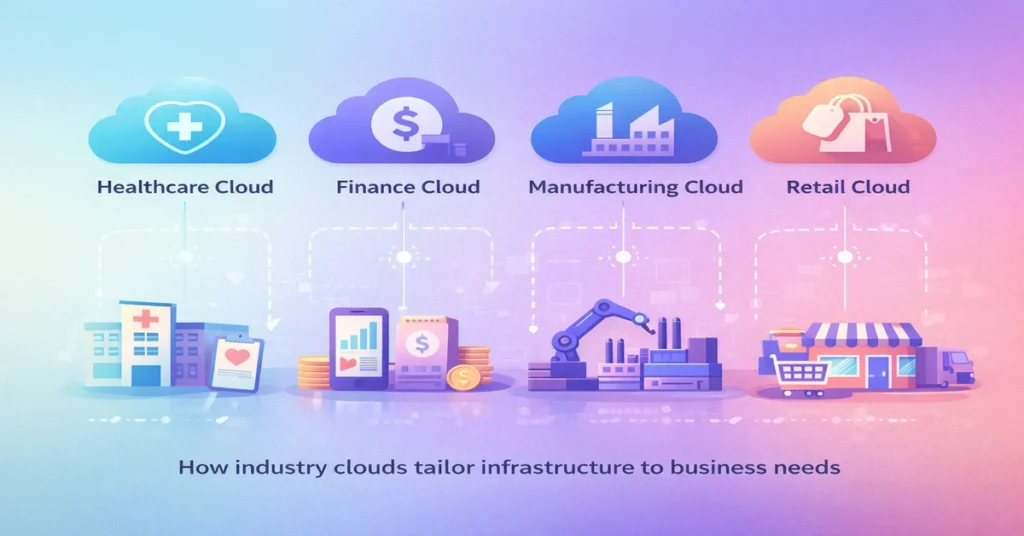
Why Industry Cloud Platforms Are Growing?
Industry cloud platforms combine:
- Cloud infrastructure
- Industry-specific data models
- Compliance frameworks
Direct answer: They reduce customization time and deployment cost.
Examples By Industry
| Industry | Industry Cloud Focus |
|---|---|
| Healthcare | Patient data interoperability |
| Finance | Regulatory-ready banking stacks |
| Manufacturing | Digital twins & IoT |
| Retail | Demand forecasting |
| Logistics | Route optimization |
Capgemini reports companies using industry clouds experience 30–50% faster digital deployment.
Business Benefits
- Faster time to value
- Built-in compliance
- Lower engineering effort
If you’re building a startup, see StartupMandi’s guide on digital transformation for startups (Internal Link Suggestion).
What Role Will Quantum Computing Play?
Quantum computing in 2026 remains early-stage but commercial pilots expand.
Direct answer: Quantum will focus on optimization and material simulation.
Practical Use Cases
- Drug discovery
- Supply chain optimization
- Financial risk modeling
IBM estimates quantum advantage in selected tasks within 2–4 years.
Important note: Businesses should experiment, not depend on quantum yet.
How To Prepare
- Partner with cloud quantum services
- Train small R&D teams
- Track algorithm breakthroughs
How Is Cybersecurity Changing In 2026?
Cybersecurity moves from perimeter defense to zero-trust architectures.
Direct answer: Never trust, always verify.
Core Zero-Trust Principles
- Continuous authentication
- Least-privilege access
- Device posture checks
- Encrypted data everywhere

Why This Matters
With AI-driven attacks increasing, traditional firewalls fail.
Deloitte reports cyber incidents rising 25% year-over-year globally.
Zero-trust reduces breach impact by isolating compromised systems.
What Is Spatial Computing?
Spatial computing blends:
- Augmented Reality
- Virtual Reality
- Mixed Reality
Direct answer: It places digital information into physical environments.
Business Use Cases
- Remote equipment repair
- Virtual training simulations
- 3D product design
According to Forbes Tech Council, immersive technologies improve training retention by up to 75%.
Adoption Reality
2026 adoption focuses on:
- Enterprise training
- Industrial design
- Healthcare visualization
Not mass consumer gaming yet.
Why Sustainable Technology Is Becoming Mandatory
Green technology is now a regulatory + financial necessity.
Direct answer: Energy-efficient systems lower cost and carbon footprint.
Sustainable Tech Examples
- Carbon-aware cloud scheduling
- Low-power AI chips
- Smart energy grids
IBM estimates efficient infrastructure can cut data-center energy by 20–30%.
How Do These Trends Affect Startups?
Startups gain leverage through:
- Faster MVP creation
- Lower infrastructure costs
- Automation-first operations
Startups that build AI-native products outperform traditional SaaS competitors.
Related reading: StartupMandi article on AI business ideas for entrepreneurs (Internal Link Suggestion).
How Can Businesses Prepare For Technology Trends 2026?
Direct answer: Create a future-ready technology roadmap.
Step-By-Step Strategy
- Audit current tech stack
- Identify automation opportunities
- Pilot one emerging technology
- Upskill teams
- Measure ROI
How To Build A 2026 Tech Adoption Roadmap
Times Needed: Days: 07, Hours: 10, Minutes: 00
Estimated Cost: USD 500–2000
Description: Create a prioritized technology roadmap aligned with business goals and emerging trends.
Steps to Implement
- Assess Business Objectives
Map growth goals to technology needs. - Evaluate Current Systems
Document strengths and gaps. - Select Pilot Technologies
Choose one high-impact trend. - Build Small Prototype
Test with limited users. - Measure Impact
Track productivity, cost, speed. - Scale Successful Pilots
Roll out organization-wide.
Tools Name: Notion, Miro, Google Sheets
Materials Name: Strategy documents, Budget plan, Skill matrix
Comparison: 2024 vs 2026 Enterprise Technology
| Area | 2024 Focus | 2026 Focus |
|---|---|---|
| AI | Assistants | Autonomous agents |
| Cloud | Generic platforms | Industry clouds |
| Security | Firewalls | Zero-trust |
| Interfaces | Screens | Multimodal |
| Computing | Classical | Hybrid quantum |
“Technology advantage is no longer about ownership, but orchestration.” — Gartner Research
Key Takeaways
- AI becomes autonomous
- Security becomes identity-centric
- Clouds become industry-specific
- Sustainability becomes mandatory
- Early experimentation wins
Next Steps
- Choose one trend to explore
- Launch a small pilot
- Train your team
Explore StartupMandi’s startup technology stack guide and digital marketing automation strategies (Internal Link Suggestions).
Frequently Asked Questions
What is the biggest technology trend in 2026?
Autonomous AI agents.
Will AI replace jobs in 2026?
It will automate tasks, not entire professions.
Is quantum computing usable in 2026?
Mainly for pilots and research.
What industries benefit most?
Healthcare, finance, manufacturing, and retail.
Are small businesses affected?
Yes, through automation and low-code tools.
Is cybersecurity more expensive now?
Prevention costs less than breaches.
Should startups invest in AI early?
Yes, it provides structural advantage.
Are these trends global?
Yes, adoption varies by region.
Conclusion
The top technology trends 2026 represent a shift toward intelligent, autonomous, and sustainable systems. Businesses that start experimenting today will define tomorrow’s markets.
Staying informed is no longer optional.
It’s your competitive advantage.
External and Internal links