


Introduction
How AI is replacing jobs is one of the most discussed topics today — but the reality is more complex than headlines suggest. Artificial intelligence is not simply removing work; it is transforming roles, automating repetitive tasks, and creating entirely new career paths. Understanding what’s changing helps professionals and freshers prepare instead of panic.
According to industry reports, automation will reshape millions of roles globally, yet many new opportunities will emerge alongside these changes. This guide explains which jobs are affected, why it’s happening, and how you can stay future-ready.
Quick Summary
- AI is replacing repetitive and predictable tasks first.
- Creative, strategic, and human-centric roles remain valuable.
- New AI-related jobs are emerging rapidly.
- Upskilling and adaptability are the biggest advantages today.
How AI Is Replacing Jobs Today?
AI replaces jobs mainly by automating routine workflows, improving efficiency, and reducing manual processes. This does not always mean entire roles disappear — often, tasks within jobs evolve instead.
A detailed industry analysis from Forbes highlights early automation trends affecting administrative and customer-service roles:
https://www.forbes.com/sites/jackkelly/2025/04/25/the-jobs-that-will-fall-first-as-ai-takes-over-the-workplace/
Why Automation Happens
- Faster data processing and analytics.
- Reduced operational costs for companies.
- Improved decision-making through AI insights.
- 24/7 automation without human fatigue.
“AI will reshape nearly every industry by enhancing productivity rather than simply replacing people.” — BuiltIn AI Research
https://builtin.com/artificial-intelligence/ai-replacing-jobs-creating-jobs
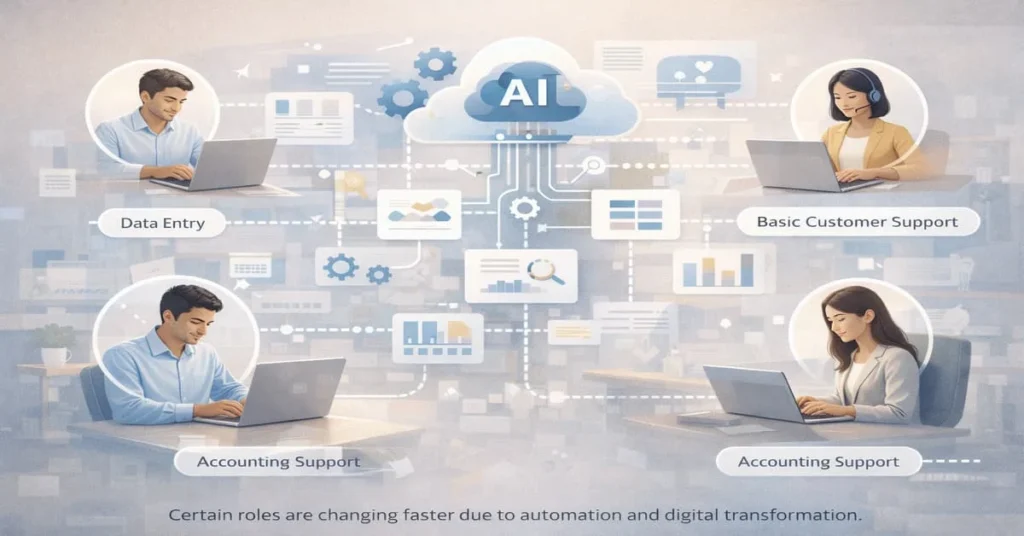
What Jobs Is AI Replacing First?
Certain roles face higher automation risk because they involve repetitive patterns.
| Job Category | Risk Level | Reason |
|---|---|---|
| Data Entry Roles | High — repetitive tasks | Easily automated workflows |
| Basic Customer Support | High | Chatbots handle queries |
| Routine Content Writing | Medium | AI text generation tools |
| Accounting Support Tasks | Medium | Automated calculations |
A Microsoft Research analysis reported by Times of India identified multiple job categories likely to change faster due to AI adoption:
https://timesofindia.indiatimes.com/technology/tech-news/microsoft-research-lists-40-jobs-that-ai-may-replace-fastest-and-40-it-may-not-be-able-to/articleshow/123020092.cms
Transitioning from fear to awareness is important here — understanding trends helps professionals pivot strategically.
Is AI Creating New Jobs Too?
Yes — and this is often overlooked. AI isn’t only replacing jobs; it is also generating entirely new career paths.
Emerging Roles Because of AI
- AI strategist and automation consultant.
- Prompt engineer and AI workflow designer.
- Data ethics specialist.
- Creative AI content strategist.
- Human-AI collaboration specialist.
Research highlighted by BuiltIn explains how automation is driving demand for hybrid skills that combine technology and creativity:
https://builtin.com/artificial-intelligence/ai-replacing-jobs-creating-jobs
Why Some Jobs Are Safer From AI?
Jobs requiring emotional intelligence, complex decision-making, and creativity remain harder to automate.
| Human Skill | Why AI Struggles |
|---|---|
| Empathy | Requires real emotional context |
| Strategy | Needs long-term vision |
| Leadership | Relies on human relationships |
| Creative Thinking | Non-linear problem solving |
The Muse’s career analysis explains that AI often augments professionals rather than fully replacing them:
https://www.themuse.com/advice/what-jobs-will-ai-replace
This shift highlights an important transition: instead of competing with AI, professionals must learn to collaborate with it.
How Can Professionals Stay Relevant in the AI Era?
Staying relevant requires adapting faster than technology evolves.
Practical Steps to Future-Proof Your Career
- Learn AI basics even if you are non-technical.
- Develop strategic thinking alongside technical skills.
- Focus on storytelling and communication abilities.
- Build a portfolio demonstrating AI-assisted projects.
- Stay updated with industry trends consistently.
According to global workforce research, adaptability and continuous learning are among the top skills employers value today.
How To Adapt When AI Is Replacing Jobs
Times Needed: Days: 14, XX Hours: 06, XX Minutes: 00 XX
Estimated Cost: Currency: USD, Price: 0
Description: Build an AI-ready career approach by combining automation tools, learning strategies, and human-centric skills to stay competitive in changing job markets.
Steps
- Understand AI Basics
Learn how automation works and which tools apply to your industry. - Identify Replaceable Tasks
Audit your current workflow and note repetitive responsibilities. - Upskill With AI Tools
Use platforms like ChatGPT or automation apps to increase productivity. - Strengthen Human Skills
Focus on communication, creativity, and leadership development. - Create AI-Enhanced Projects
Build visible proof of your ability to work alongside technology.
Tools Name: ChatGPT, Notion, Canva, LinkedIn
Materials Name: Laptop, Internet Access, Learning Resources
What Mistakes Should You Avoid When Thinking About AI?
Many professionals misunderstand AI trends, which leads to unnecessary fear.
- Assuming AI replaces entire careers overnight.
- Ignoring soft skills that remain valuable.
- Waiting too long before learning new tools.
- Relying only on traditional degrees without adapting.
“Automation shifts tasks, not just job titles.” — World Economic Forum Workforce Insights
Understanding this distinction helps you focus on growth rather than anxiety.
Key Takeaways
- How AI is replacing jobs depends mostly on task automation, not complete role elimination.
- Creative, strategic, and human-focused careers remain strong.
- New AI-driven roles are expanding rapidly.
- Upskilling consistently is the best long-term career strategy.
Conclusion
Understanding how AI is replacing jobs is not about predicting doom — it’s about recognising transformation. Automation is shifting the way people work, but it also opens doors to innovation and new career paths. By combining technology awareness with human skills, professionals can adapt confidently and stay relevant in an evolving job market.
StartupMandi encourages readers to treat AI as a powerful tool rather than a threat — because the future belongs to those who learn faster than change itself.
FAQ Section
Q1: Is AI really replacing jobs completely?
AI mostly automates tasks within roles rather than eliminating entire professions.
Q2: Which industries are most affected by AI?
Customer service, data processing, marketing automation, and finance support roles are evolving quickly.
Q3: Will AI create more jobs than it removes?
Many experts believe AI will create new roles requiring hybrid technical and creative skills.
Q4: How can freshers prepare for AI-driven careers?
Learning AI tools, building portfolios, and improving communication skills are effective strategies.
Q5: Are creative jobs safe from AI?
Creative roles are evolving but still require human insight and originality.
Q6: Do non-technical professionals need AI skills?
Yes. Basic AI literacy improves productivity across industries.
Q7: Is automation only affecting tech jobs?
No. AI is influencing marketing, finance, HR, and many other sectors.
Externall and Internal Links
AI Replacing Jobs vs Creating New Opportunities
Jobs Most Likely to Be Replaced by AI
Jobs AI Will Replace First in the Workplace
How to Get a Government Job in India: Step-by-Step Roadmap 2026
AI YouTube Automation: How to Build a Profitable Faceless Channel in 2026
Airtel Adobe Express Premium Free Offer: How to Get 1-Year Access