




Free Traffic for Startups: How to Get More Visitors Without Ads in 2026
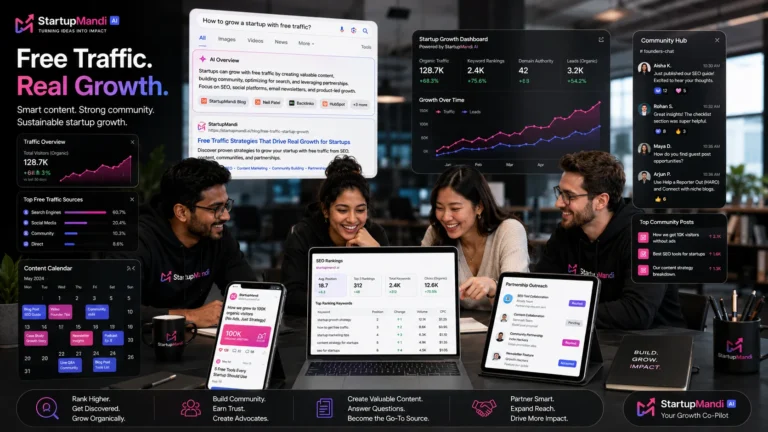
Free traffic for startups means building a steady stream of visitors without depending on paid ads. In practice, the strongest approach combines SEO, founder-led content, active community participation, and smart partnerships that work together over time. As a result, this matters even more in 2026, because startups need growth that is sustainable, measurable, and not tied to a rising ad budget.
Startups can get more traffic without ads by publishing useful content, ranking for real search queries, showing up in communities, and borrowing attention through collaborations. Ultimately, the goal is not simply to post more, but to build channels that continue sending visitors long after the initial effort is done.
What Is Free Traffic?
Free traffic is website traffic that comes from unpaid channels such as search engines, social media, referrals, communities, and direct sharing. For startups, this is especially valuable because it lowers acquisition costs while also building long-term visibility and trust. Moreover, it gives early-stage teams a way to grow without depending on paid campaigns.
In addition, the strongest free traffic sources usually come from helpful content and consistent distribution. That is why many startup growth guides in 2026 emphasize SEO, founder-led publishing, and community-led growth. Ultimately, when these channels work together, they create a compounding system that keeps bringing in visitors over time.
Why Does It Matter?
Paid ads can scale quickly, but they stop the moment you stop paying. By contrast, free traffic can keep compounding over time if your content, brand, and relationships continue to work for you. Therefore, it becomes one of the smartest early-stage growth systems for lean teams that need efficiency as well as momentum. Moreover, it helps startups reduce dependency on one channel and build a more stable acquisition base.
It also helps startups test demand before investing heavily in acquisition. In other words, if people find you organically, that is often a strong signal that your message, problem, or offer is relevant. As a result, you can validate interest earlier, refine your positioning faster, and make better decisions about where to invest next.
“Growth isn’t about finding new tactics. It’s about consistently executing the basics better than everyone else.”
How Do Startups Get Traffic?
Startups get traffic without ads by combining four reliable channels : SEO, content distribution, community engagement, and partnerships. Together, these channels create a simple but effective organic growth engine that can keep attracting visitors over time. Moreover, each channel supports a different stage of the customer journey, which makes the overall strategy more balanced and resilient.
The key is to match each channel to the customer journey. Search captures intent, content builds trust, communities create conversations, and partnerships borrow reach from adjacent audiences. As a result, startups can move people from discovery to interest to action in a more natural and cost-efficient way.
Which Channels Work Best?
| Channel | Why It Works | Best Use Case |
|---|---|---|
| SEO | Captures active search demand | Product, problem, and how-to content |
| Founder content | Builds trust and authority | LinkedIn, X, newsletters |
| Communities | Creates high-intent visibility | Reddit, Slack, Discord, niche forums |
| Partnerships | Expands reach fast | Guest posts, co-marketing, webinars |
| Keeps traffic coming back | Lead magnets and nurture sequences |
This mix is effective because it balances discovery and retention. A startup that only relies on one channel often grows unevenly.
How Do I Use SEO For Getting Free Traffic?
SEO is one of the best free traffic sources for startups because it brings in people who are already searching for a solution. To get the best results, start with long-tail keywords that reflect real problems, and then create content that answers those questions clearly and directly. Moreover, this approach helps you attract more qualified visitors, since the audience already has intent.
A useful rule is to publish content that is specific, practical, and easy to scan. In addition, search engines tend to reward pages that are focused, useful, and aligned with a clear search intent. Therefore, when your topic is narrow and your answer is easy to understand, your content has a much better chance of ranking and converting attention into traffic.
SEO Content Ideas
- What is [Problem] and how does it work?
- How to solve [Problem] without [Common Pain].
- Best tools for [Startup Task].
- Mistakes startups make with [Topic].
- Step-by-step guide to [Outcome].
How Does Content Help Generate Traffic For Free?

Content helps most when it solves a real problem and gives the reader a clear next step. For startups, the strongest content usually comes from founder insights, customer questions, and repeatable use cases because those are grounded in real experience and real demand. Moreover, this kind of content tends to feel more useful and trustworthy, which makes it easier to attract and keep attention.
One strong article can also become many assets. For example, a single blog post can be repurposed into a LinkedIn post, a short video, a thread, a newsletter, and a community answer. As a result, you multiply reach without multiplying effort, and over time, that makes your content engine far more efficient.
How Do I Use Communities?
Communities work because people trust useful participation more than obvious promotion. If your audience hangs out in Reddit, Slack, Discord, LinkedIn groups, or niche forums, your job is to become genuinely helpful there.
Do not just drop links. Instead, answer questions, share templates, explain mistakes, and participate consistently. Over time, that earns profile visits, curiosity, and clicks to your site.
“Visibility is earned through interaction, not just output.”
How Do Partnerships Help?
Partnerships let startups reach warm audiences without spending on ads. The best partners are not competitors; they are adjacent brands, creators, tools, or publications that already serve your ideal customer.
Good partnership formats include guest posts, newsletter swaps, joint webinars, co-created resources, and integration announcements. These work especially well when you can offer value to both audiences at once.
How Should I Distribute Content?
Distribution is where many startups fail. They create one strong piece of content and publish it once, which wastes most of its potential. A better system is to repurpose every useful idea across multiple channels.
Use this simple workflow :
- Write one core article.
- Turn it into a social post.
- Convert key points into a short video.
- Share it in one relevant community.
- Add it to your newsletter.
This is how small teams build reach without adding spend.
What Metrics Matter For Free Traffic?
Traffic is important, but it is not the only sign of growth. For startups, the better metrics are qualified visits, return visitors, email signups, community replies, and referral clicks.
If a channel brings the wrong audience, it can look busy while producing little business value. So the goal is not just more traffic; it is more relevant traffic.
| Metric | What It Tells You | Why It Matters |
|---|---|---|
| Organic visits | Search visibility | Indicates demand capture |
| Email signups | Audience growth | Builds owned traffic |
| Referral clicks | Partnership value | Shows trust transfer |
| Repeat visitors | Content quality | Signals ongoing interest |
| Community replies | Engagement depth | Reveals message resonance |
How To Get Free Traffic

Times Needed : 14 Days, 8 Hours, 0 Minutes
Estimated Cost : USD 0
Description : A practical startup growth workflow for getting visitors without ads through SEO, content, community participation, and partnerships.
Steps :
- Pick one audience problem
Choose one clear pain point your startup solves. The more specific the problem, the easier it is to create content that attracts the right visitors. - Publish one helpful SEO article
Write a long-tail article that answers a real question. Keep the structure simple, direct, and easy to scan for both readers and search engines. - Share the same idea everywhere
Turn the article into posts for LinkedIn, X, Reddit, or your newsletter. Repurposing helps you get more reach from one idea. - Answer questions in communities
Join two or three places where your audience already talks. Add value consistently and only share links when they genuinely help. - Build one partnership
Collaborate with one adjacent brand or creator. A shared post, webinar, or resource can bring warm traffic faster than cold outreach.
Tools Name
- Google Search Console.
- Ahrefs.
- Semrush.
- Notion.
Materials Name
- Keyword list.
- Content calendar.
- Community list.
- Partnership outreach template.
Why Does This Work Long Term?
This approach works because it compounds. SEO content can rank for months, community participation can build trust, and partnerships can keep sending repeat visitors. Unlike ads, these channels often improve as your brand becomes more recognized.
It also makes your startup less fragile. If one channel slows down, you still have others feeding discovery.
FAQ
It is website traffic that comes from unpaid sources like SEO, social sharing, communities, and referrals.
Yes. Many 2026 growth guides focus on organic SEO, community-led growth, and partnerships as viable early-stage strategies.
It depends on your audience, but SEO and community participation are usually the most reliable starting points.
Not always, but a blog helps capture search demand and turn one idea into many distribution assets.
Consistency matters more than volume. One strong piece per week is often better than many weak posts.
Use both if possible. SEO captures intent, while social media and communities create faster visibility.
They expose your startup to an audience that already trusts another brand or creator.
SEO and partnerships may take weeks or months, while community engagement can produce quicker early signals.
Key Takeaways
- Free traffic for startups comes from unpaid channels that compound over time.
- SEO is strongest when it targets specific problems and questions.
- Communities work best when you help first and promote later.
- Partnerships can accelerate visibility without ad spend.
- Repurposing content multiplies reach with the same effort.
Next Steps For Generating Free Traffic
- Choose one startup problem to focus on.
- Write one SEO article around that problem.
- Repurpose it into social posts and a newsletter.
- Join one community where your audience is active.
- Reach out to one potential partner this week.
Conclusion
Free traffic for startups is not about chasing quick hacks; instead, it is about building a repeatable growth system that keeps working over time. When you combine SEO, content, community, and partnerships, you create a more stable way to attract visitors without relying on paid ads. Moreover, this approach helps startups grow with more consistency, stronger trust, and better long-term results. For more resources, you can also explore StartupMandi Global as a reference point.
Few Links Suggestions for more Research & Facts Check
- 10 Organic Growth Strategies For Startups — useful for planning content and partnerships.
- How Startups Grow Without Paid Ads — useful for organic growth framing.
- E-E-A-T SEO in 2026 — useful for trust-building and authority signals.
- AI Overviews SEO in 2026 — useful for AI search visibility.
- SEO For Startups in 2026 — useful for startup SEO direction.
- Zero-Click Search in 2026 — useful for visibility-first SEO strategy.
Resources
- Google Search Central — helpful for SEO basics and indexing guidance.
- Search Engine Land SEO Guides — useful for current search updates.
- Semrush Blog — useful for keyword and content strategy ideas.
- Ahrefs Blog — useful for traffic and keyword research tactics.
- Google Trends — useful for spotting rising topics.


