

Startup India DPIIT Certificate: Complete Step-by-Step Registration Guide
Startup India DPIIT Certificate registration through Startup India Portal represents the most strategic step any Indian entrepreneur can take when formalizing business operations. Therefore, this comprehensive guide walks you through every element of obtaining your Startup India DPIIT Certificate, from initial eligibility verification through final certificate issuance.
Moreover, Startup India registration unlocks transformative tax exemptions, compliance relief, government funding access, and regulatory support that accelerates business growth dramatically. Consequently, understanding the DPIIT Certificate process becomes essential knowledge for any founder serious about building a sustainable, tax-efficient enterprise within India’s thriving startup ecosystem.
Startup India DPIIT Certificate Registration: Complete Step-by-Step Guide
What Exactly is Startup India DPIIT Certificate? How to get this?
Startup India registration establishes formal government recognition of your business as an eligible startup under the Department for Promotion of Industry and Internal Trade (DPIIT) initiative. Therefore, when you obtain a DPIIT Certificate, you receive official validation that your company qualifies for extraordinary benefits. Additionally, this Startup India DPIIT Certificate serves as your passport to accessing ₹10.5 crore in collateral-free loans, three years of complete income tax exemption, and simplified compliance procedures. Furthermore, the Startup India registration certificate carries unique recognition numbers that government agencies, banks, and corporate partners respect universally.
The DPIIT Certificate fundamentally differs from simple business registration—it specifically acknowledges your startup meets innovation criteria and scalability benchmarks established by the government. Therefore, obtaining your Startup India DPIIT Certificate distinguishes your company from ordinary businesses, unlocking doors to resources unavailable elsewhere.
Startup India Registration Eligibility: Can Your Business Qualify?
Before investing time into the Startup India registration process, verifying eligibility proves absolutely critical. Specifically, your business must satisfy all conditions simultaneously—partial compliance results in rejection.
Key Eligibility Requirements for Startup India Registration:
1. Business Age Requirement:
Your company must not exceed 10 years from incorporation date. Therefore, businesses operating longer than a decade become ineligible regardless of other factors.
2. Company Structure Eligibility:
Startup India DPIIT Certificate applications accept only:
- Private Limited Companies
- Limited Liability Partnerships (LLPs)
- Registered Partnership Firms
Additionally, sole proprietorships, Hindu Undivided Families (HUFs), and unregistered entities cannot obtain Startup India registration, eliminating approximately 30% of Indian business structures from eligibility.
3. Annual Turnover Cap:
Your annual turnover must not exceed ₹100 crore in any previous financial year since incorporation. Importantly, once turnover crosses this threshold, permanent ineligibility occurs—you cannot regain Startup India DPIIT Certificate status regardless of subsequent performance.
4. Innovation and Scalability Requirements:
Your business must demonstrate either innovation in products, processes, or services, OR possess a scalable business model with employment generation and wealth creation potential. Therefore, routine retail operations, standard trading businesses, or simple service resale cannot qualify for Startup India registration.
5. No Business Reconstruction:
Your entity cannot exist as a result of splitting or restructuring an existing business. Therefore, if your startup emerged through dividing a parent company while maintaining similar objectives and common directors, you fail Startup India DPIIT Certificate eligibility criteria.
6. No Duplicate Entities:
Startup India registration disqualifies startups incorporating multiple entities with identical addresses, similar production lines, and overlapping directors—practices viewed as regulatory circumvention.
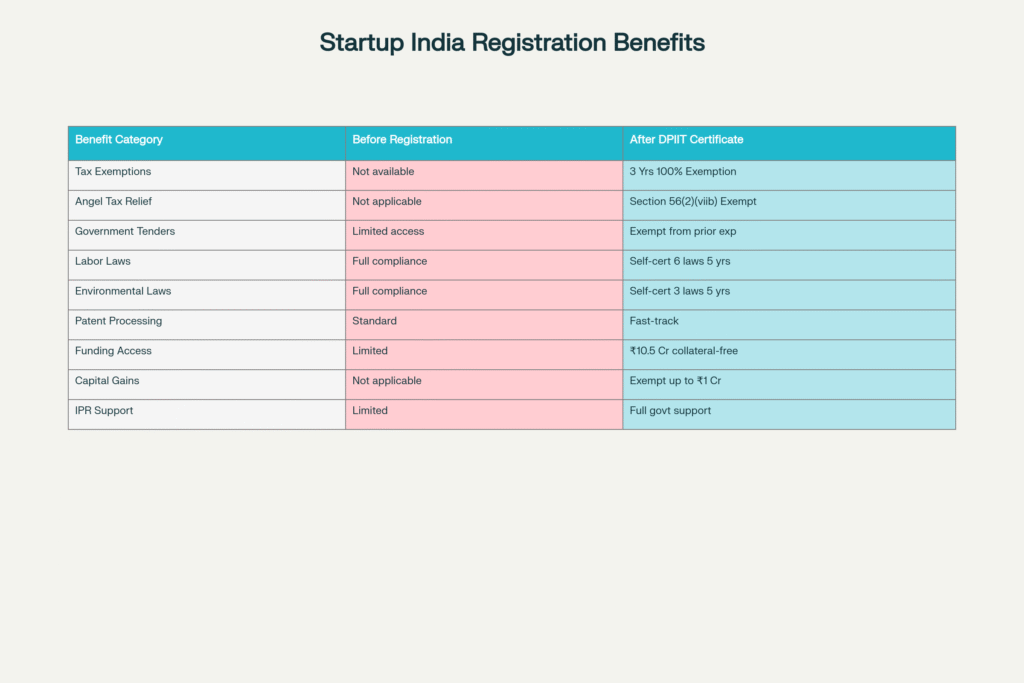 Startup India registration with DPIIT Certificate unlocks substantial tax exemptions, compliance relief, and funding opportunities for recognized startups Checkout Our Latest Services
Essential Documents Required for Startup India DPIIT Certificate Application
Successful Startup India registration depends critically on document preparation completeness. Therefore, compile these materials before beginning your DPIIT Certificate application:
Primary Documents Required:
1. Certificate of Incorporation/Registration
For companies/LLPs: Original Certificate of Incorporation from the Registrar of Companies (RoC)
For partnerships: Registration certificate from the Registrar of Firms
Therefore, secure certified copies—photocopies generate automatic rejections.
2. Entity PAN Card
Your company’s Permanent Account Number (PAN), not individual director PAN cards. Therefore, ensure your PAN was issued in the organization’s legal name exactly as specified in incorporation documents.
3. Proof of Innovation and Scalability
- Working website or mobile application link demonstrating your startup’s operations
- Detailed pitch deck (10-15 slides) explaining innovation, market opportunity, and scalability
- Patent certificates if applicable
- Media coverage or customer testimonials validating market traction
4. Director and Partner Documentation
- Complete director details including DIN (Director Identification Number)
- Designated partner details with DPIN for LLPs
- Full names, email addresses, and contact numbers for all principals
5. Digital Signature Certificate (DSC)
Organization-level Class 3 DSC (not individual director DSC)—absolutely mandatory for secure application submission.
6. Registered Office Proof
- Utility bill (electricity, water, gas) not exceeding two months old
- OR rental agreement for leased premises
- OR property ownership documents for owned premises
7. Authorization Letter
A formal letter on company letterhead authorizing a representative to submit the Startup India DPIIT Certificate application on your behalf.
Step 1: Ensure Business Incorporation
Before initiating Startup India registration, your business must be legally incorporated. Therefore, if your company doesn’t yet exist on MCA records, complete incorporation first through the Ministry of Corporate Affairs portal or engage a professional registration service. This foundational step typically completes within 7-10 days and costs ₹12,000-₹30,000 including professional fees.
Step 2: Create Your Startup India Portal Account
Navigate to www.startupindia.gov.in and click the “Register” button prominently displayed on the homepage. Enter essential information:
- Your full name and role within the startup
- Company name exactly as incorporated
- Email address and mobile number
- Password meeting security requirements (8-15 characters with uppercase, lowercase, numbers, special characters)
- Startup stage (Pre-Revenue, Revenue, Scale-up, etc.)
Therefore, complete this registration within 5-10 minutes by verifying your email through the OTP link sent to your inbox.
Step 3: Register on National Single Window System (NSWS) Portal
Subsequently, proceed to www.nsws.gov.in to create your investor account, which centralizes applications across multiple government services. Enter your email, create a secure password, and complete mobile verification. Therefore, this account becomes the official channel for your DPIIT Certificate application submission.
Step 4: Add “Startup Registration” to Your NSWS Dashboard
After NSWS account creation, click “Add Approvals” then select “Central Approvals.” Search specifically for “Registration as a Startup” and add it to your application dashboard. Therefore, this action unlocks access to the official Startup India DPIIT Certificate application form.
Step 5: Complete the DPIIT Recognition Application Form
The comprehensive form requests information organized into distinct sections:
Entity Details (Auto-populated):
Your company name, registration number, incorporation date, and registered office address auto-populate from profile data—verify accuracy before proceeding.
Business Activities Description:
Provide detailed narrative (500+ words) explaining:
- Your startup’s core innovation or scalable business model
- How your solution differs from existing market alternatives
- Revenue model and customer acquisition strategy
- Projected growth and employment generation plans
Shareholder Information:
List all shareholders, their shareholding percentages, DIN numbers, and contact information.
Director/Partner Details:
Complete information for all decision-makers including addresses, qualifications, and prior entrepreneurial experience.
Therefore, invest adequate time in each form section—vague or incomplete responses prompt rejection or information requests extending approval timelines.
Step 6: Upload Required Documents to DPIIT Certificate Application
Click the upload section and systematically attach all documents in PDF format (maximum 5MB per file). Therefore, ensure documents are:
- Clearly legible with readable text
- Currently dated and valid
- Properly scanned at minimum 300 DPI resolution
- Named descriptively (e.g., “Certificate_of_Incorporation.pdf”)
The system provides immediate feedback on file acceptance or rejection—address errors before final submission.
Step 7: Self-Certify Compliance Declaration
Critically, you must digitally sign and submit a legally binding self-certification confirming that your startup satisfies all Startup India registration eligibility criteria. Therefore, understand that false declarations trigger criminal prosecution under Indian law—penalties include imprisonment and permanent government scheme blacklisting. Therefore, certify only accurate information.
Step 8: Submit Your Startup India DPIIT Certificate Application
After comprehensive form completion and document attachment, click the final “Submit” button. The system immediately generates a unique reference number for application tracking. Therefore, record this number for future correspondence—the government uses it exclusively for status inquiries.
Critical Note: Once submitted, form data cannot be edited—review comprehensively before clicking submit.
Step 9: Monitor DPIIT Certificate Approval Status
Following submission, DPIIT reviews your application—typically within 2-7 working days if documentation is complete. Therefore, check your NSWS dashboard regularly for approval notifications. The government may request additional information or clarification if specific business descriptions lack adequate detail. Therefore, respond promptly to any information requests to avoid application dismissal.
Startup India DPIIT Certificate Benefits: What You Unlock
Upon approval, you access extraordinary advantages unavailable to non-registered startups:
Tax Exemption Benefits:
- Section 80-IAC: Claim 100% income tax exemption for 3 consecutive years within the first 7-year operational period
- Section 56(2)(viib): Exemption from angel tax on funds received from investors
Compliance Relief:
- Self-certify compliance under 6 labor laws for 5 years
- Self-certify compliance under 3 environmental laws for 5 years
- Exemption from numerous regulatory inspections
Government Tender Participation:
- Participate in government procurement without proving prior experience requirement traditionally demanded from private companies
- Exemption from Earnest Money Deposit (EMD) when bidding
Funding Access:
- Eligibility for ₹10.5 crore collateral-free loans through government-backed financial institutions
- Access to government-promoted venture capital and incubation schemes
IPR Support:
- Fast-track patent examination processes
- Reduced trademark registration fees
- Government-provided intellectual property protection support
Capital Gains Tax Exemption:
Investors enjoy tax exemption on capital gains up to ₹1 crore received through investment in your startup
Startup India Registration Timeline: Complete Duration Expectations
The entire Startup India DPIIT Certificate acquisition process typically spans:
| Phase | Duration |
|---|---|
| Business Incorporation (if not yet done) | 7-10 days |
| Portal Registration (both portals) | 15 minutes |
| Form Completion and Document Upload | 1-2 hours |
| DPIIT Review and Approval | 2-7 working days |
| Total Timeline | 12-25 days |
Importantly, this timeline assumes complete documentation without information requests—incomplete submissions extend approval periods substantially.
Common Mistakes to Avoid in Startup India DPIIT Certificate Application
1. Incomplete Innovation Description:
Vague explanations of business innovation invite rejection—provide specific details about product differentiation or scalability mechanisms.
2. Inaccurate Information Across Documents:
Mismatches between incorporation certificates, PAN records, and application forms trigger automatic rejection—verify consistency rigorously.
3. Poor Document Quality:
Blurry scans, illegible text, or improper file formatting cause immediate rejection—invest in professional document scanning.
4. False or Misleading Self-Certification:
Exaggerating innovation, falsifying compliance, or misrepresenting business structure invites legal prosecution—certify only accurate information.
5. Missed Eligibility Criteria:
Applying when turnover exceeds ₹100 crore or business age exceeds 10 years wastes resources—verify eligibility before application.
6. Non-compliance with Company Structure Requirements:
Sole proprietorships cannot obtain Startup India DPIIT Certificate—convert to eligible structure before applying.
Conclusion: Transform Your Startup Through Registration
Startup India registration and DPIIT Certificate establishment represents a transformative decision requiring systematic execution but delivering exceptional rewards. Therefore, by following this comprehensive step-by-step guide, you navigate the DPIIT Certificate application process confidently while avoiding common pitfalls. Moreover, the combination of tax exemptions, compliance relief, funding access, and government support unlocks competitive advantages that accelerate growth dramatically.
If you are planning o hire a consultant for DPIIT Startup India registration, Get the Best Deal from Here
The investment of time and attention in proper Startup India registration pays dividends throughout your entrepreneurial journey. Consequently, prioritize completing this registration early—the earlier you access tax benefits and compliance relief, the more value accumulates over your business lifecycle.
Official Government Resources for Startup India Registration
Access authentic information through these authoritative sources:
- Official Startup India Portal: www.startupindia.gov.in – Primary government resource for all registrations and benefit information
- National Single Window System: www.nsws.gov.in – DPIIT application submission portal
- DPIIT Official Website: www.dpiit.gov.in – Policy documentation and circular updates
- Ministry of Corporate Affairs: www.mca.gov.in – Business incorporation requirements