

Your small business doesn’t need a massive marketing budget to compete with established brands. Social media levels the playing field for small businesses, solopreneurs, and MSMEs. According to recent data, 5.4 billion people use social media worldwide, and 58% of consumers discover new businesses through social platforms—more than traditional search or TV advertising.
The challenge? Spreading yourself thin across every platform wastes time and resources. This guide reveals a platform-wise strategy that focuses your efforts where your target audience actually spends time, delivering measurable results without the marketing chaos.
Ready to transform your social media presence into a revenue driver? Let’s dive into the strategies that actually work.
Why Social Media Marketing is Essential for Small Business Success
Social media has shifted from optional to essential for small business survival in 2025. Here’s why:
1. Cost-Effective Reach
Traditional advertising (TV, radio, billboards) requires budgets small businesses can’t justify. Social media offers free organic reach through quality content and strategic posting. When you do invest in paid ads, platforms like Facebook allow micro-targeting, ensuring your dollars reach only qualified prospects.
2. Direct Customer Engagement
79% of consumers expect a response within 24 hours on social media. This creates an opportunity: small businesses that respond quickly build stronger customer relationships than large corporations with slow customer service.
3. Measurable ROI
Unlike traditional marketing, every social media action generates data. You can track clicks, conversions, engagement, and revenue—making ROI calculation transparent and actionable.
4. Competitive Edge
81% of small businesses use at least two marketing channels, but most spread themselves too thin. A focused, platform-specific strategy gives you an advantage over competitors running unfocused campaigns.
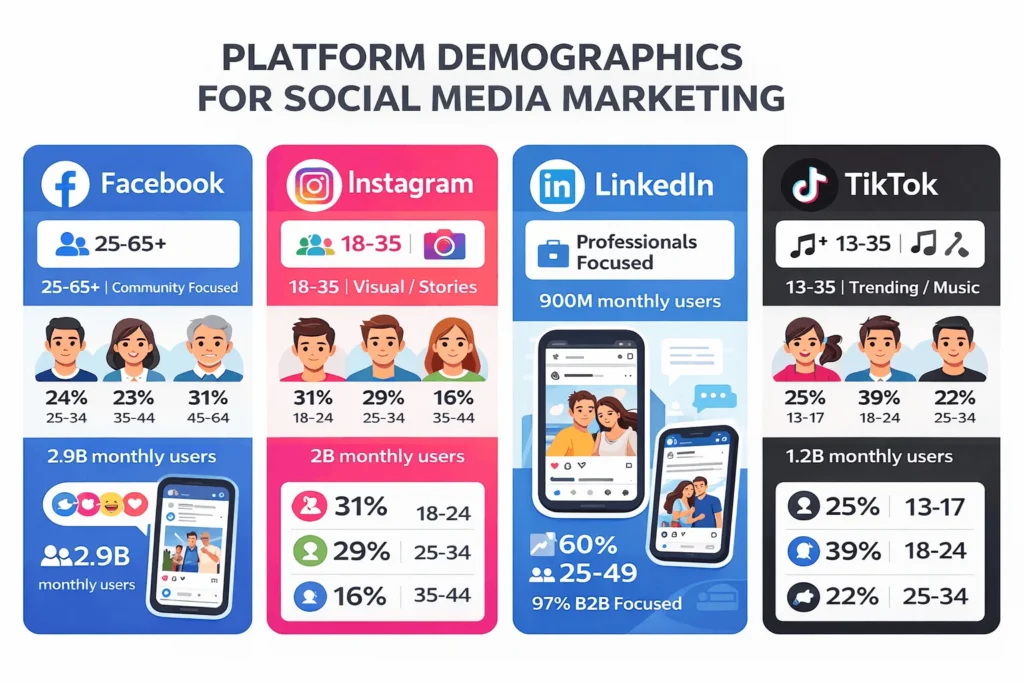
Understanding Your Audience Before Choosing Platforms
Before launching on every platform, identify where your target customers actually spend time.
Step 1: Create Customer Personas
List your ideal customers’ demographics:
- Age group
- Profession/industry
- Income level
- Pain points and needs
- Online behavior
Step 2: Research Platform Demographics
| Platform | Primary Audience | Best For |
|---|---|---|
| 25-65+ (broad demographic) | Community building, local businesses, ads | |
| 18-35 (visual-focused) | Fashion, food, lifestyle, visual products | |
| B2B professionals, executives | Industry insights, thought leadership, recruiting | |
| TikTok | 13-35 (entertainment-focused) | Trendy content, short-form video, younger audience |
| Twitter/X | 18-49 (news, discussions) | Real-time updates, industry conversations, B2B |
Pro Tip: Don’t chase trends blindly. If your customers are 45-year-old business owners, TikTok is a waste of your energy. Focus on Facebook and LinkedIn instead.
Key Takeaway: The best platform is where your customers already spend time, not where you feel most comfortable.
Platform-Wise Social Media Strategy: Deep Dive
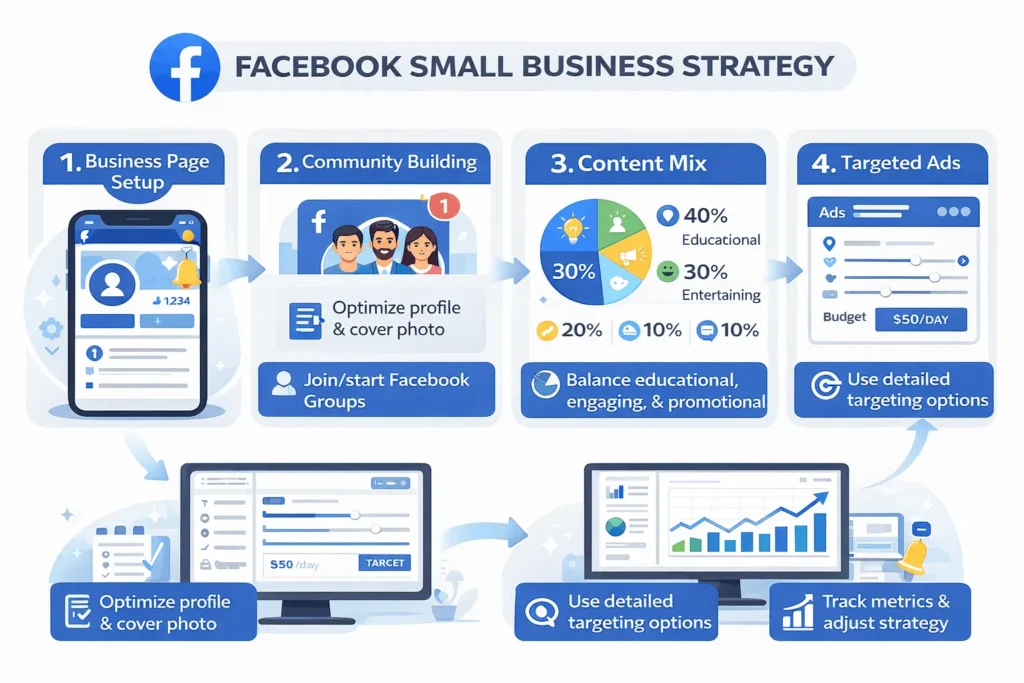
1. Facebook Strategy for Small Businesses
Facebook remains the #1 platform for small business ROI, with 28% of marketers ranking it as their top-performing channel. Here’s why:
Why Facebook Works:
- 2.9 billion monthly active users
- Highly advanced audience targeting (almost as precise as Google)
- Multiple revenue streams (organic posts, groups, ads, marketplace)
- Strongest ROI among all platforms (29% average ROI)
Facebook-Specific Strategy:
- Create a Business Page (Not Personal Profile)
Set up a professional business page with complete information: hours, location, contact details, and a clear “About” section. - Leverage Facebook Groups
Create a group for your community. Groups build loyalty because members feel like they belong to something exclusive. Engagement rates in groups are 60% higher than on pages. - Mix Content Types
- 40% educational content (tips, how-tos, industry insights)
- 30% behind-the-scenes and personal storytelling
- 20% promotional content (sales, special offers)
- 10% user-generated content (customer testimonials, reviews)
- Master Facebook Ads
89% of marketing specialists use Facebook Ads because they work. Start with small budgets ($5-10/day) and test different audiences, creative, and messages.
Posting Frequency: 1-2 posts daily for maximum reach.
Best Times to Post: 11 AM – 2 PM and 7 PM – 9 PM (audience research varies, so test for your specific audience).
2. Instagram Strategy for Small Businesses
Instagram excels at visual storytelling and drives high engagement, especially for fashion, food, beauty, and lifestyle brands.
Why Instagram Works:
- 64.8% of users actively seek entertaining content
- Instagram Reels (short videos) have 3x higher engagement than static posts
- Strong ROI (22% of marketers rank it as top-performing)
- Highest influencer marketing ROI (30% of marketers report best results here)
Instagram-Specific Strategy:
- Profile Optimization
- Clear, keyword-rich bio (e.g., “Handmade jewelry | Sustainable fashion | Free shipping over $50”)
- Link to your website or lead magnet
- Professional profile picture (your logo or face)
- Stories highlight showing key offerings
- Content Pillars (Create 4-5 Themes)
- Product showcases
- Behind-the-scenes production
- Customer stories and testimonials
- Educational content (tips, tutorials, how-tos)
- Lifestyle content aligned with your brand
- Instagram Reels Drive Reach
Short-form video content gets 3x more engagement than carousels. Post 2-3 Reels weekly covering trending sounds while maintaining brand authenticity. - Strategic Hashtag Use
Use 20-30 hashtags combining:- 5-10 high-volume hashtags (1M+ posts)
- 10-15 medium-volume hashtags (100K-1M)
- 5-10 niche hashtags (under 100K)
- Engagement Over Follower Count
Respond to every comment and DM within 2 hours. Ask questions in captions to encourage comments. A smaller, highly-engaged audience (1,000 followers) outperforms a large, passive one (50,000 followers).
Posting Frequency: 4-5 posts weekly (mix of feed posts and Reels).
Tools: Buffer, Later, or Meta Business Suite for scheduling.
3. LinkedIn Strategy for B2B and Professional Services
LinkedIn isn’t just for job searching—it’s a thought leadership and lead generation engine for B2B businesses.
Why LinkedIn Works:
- 900+ million professionals globally
- Decision-makers and business owners spending time here
- 3x higher engagement for educational content
- Strong for LinkedIn lead generation ads
LinkedIn-Specific Strategy:
- Complete Company and Personal Profile
- Add rich descriptions with keywords
- Use professional photos
- Write a compelling headline: “Digital Marketing Strategist | Helping Startups Scale | Author of [Book].”
- Content Strategy for LinkedIn
- 50% educational content (industry insights, trends, how-tos)
- 30% thought leadership (opinions, perspectives on industry changes)
- 15% company updates (milestones, job openings, announcements)
- 5% soft promotions (case studies, webinar invitations)
- Leverage LinkedIn Articles
Long-form articles (1,500-2,500 words) published directly on LinkedIn reach professionals seeking in-depth information. - Build a Community (LinkedIn Groups or Newsletter)
Create a company newsletter or group to nurture leads. Include exclusive insights and early access to services. - LinkedIn Ads for Lead Generation
LinkedIn’s lead gen forms allow you to collect information without users leaving the platform—reducing friction in the conversion process.
Posting Frequency: 2-3 posts weekly (professional content, not daily updates).
Best Format: A short sentence + line break + numbered list (this format generates 2x engagement).
4. TikTok Strategy for Reaching Younger Audiences
TikTok has become a significant revenue channel, especially for brands targeting Gen Z and younger millennials.
Why TikTok Works:
- 50% of marketers view it as the most profitable influencer platform
- 51% of small business owners running TikTok ads report positive ROI
- Short-form video is proven (82% of consumer internet traffic by 2025 is video)
- Algorithm favors authentic, entertaining content over polished ads
TikTok-Specific Strategy:
- Embrace Authenticity Over Perfection
TikTok users can smell artificial marketing. Share real behind-the-scenes moments, bloopers, and imperfect content. Authenticity drives engagement. - Jump on Trends (With Your Brand)
Use trending sounds and effects but customize them for your business. Don’t just copy trends—add your unique twist. - Content Ideas That Work
- Trend-jacking (applying trending audio/hashtags to your content)
- Educational “day in the life” videos
- Product unboxing/demonstrations
- Team introductions and company culture
- Customer success stories
- Call-to-Actions on TikTok
- Link in bio (to your website or landing page)
- Viral invitations (“Follow for more” or “Tell me in the comments”)
- Collaboration hashtags for user-generated content
Posting Frequency: 3-5 videos weekly (consistency matters for algorithm visibility).
Key Metric: Watch time and completion rate (people watching videos fully) matters more than likes.
Content Strategy That Works Across All Platforms
Successful social media isn’t about posting randomly—it’s about strategic content planning.
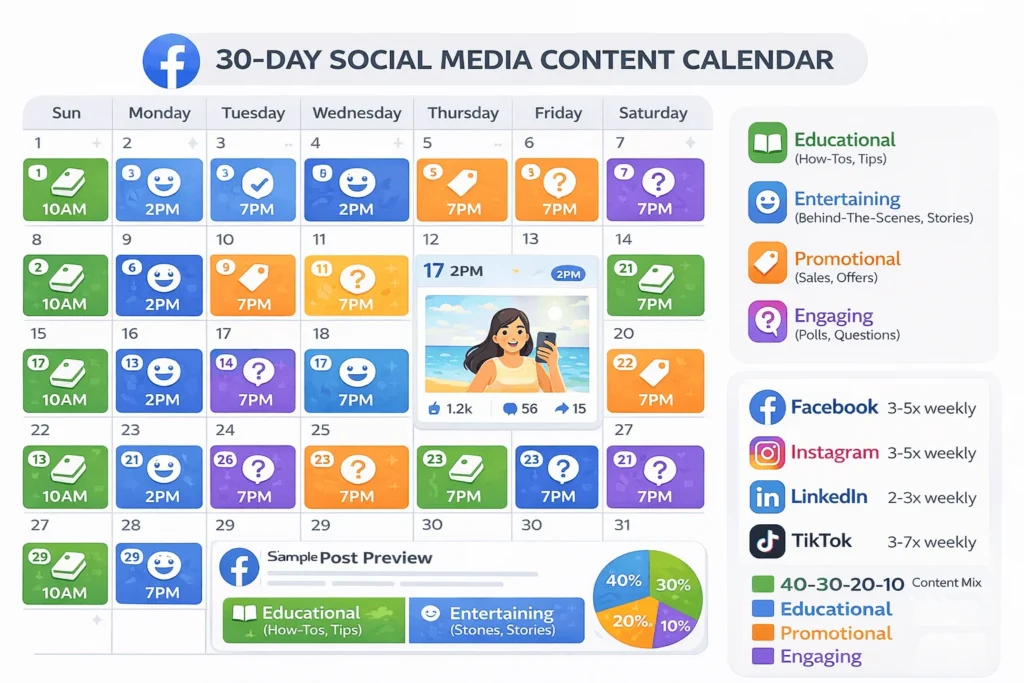
The Content Pillars Framework:
- Educational Content (40%)
- How-to tutorials
- Industry insights and trends
- Tips and tricks
- Webinars or educational videos
- Entertaining Content (30%)
- Behind-the-scenes moments
- Funny or relatable brand personality
- Trending audio/trends
- Customer stories
- Promotional Content (20%)
- New product announcements
- Limited-time offers
- Sales and discounts
- Event invitations
- Engaging Content (10%)
- Polls and questions
- Contests and giveaways
- Live Q&A sessions
- User-generated content
Create a Content Calendar:
Use a simple spreadsheet to plan 4 weeks at a time. Include:
- Date and platform
- Content type (educational/entertaining/promotional/engaging)
- Copy/message
- Hashtags
- Visuals (link to image asset)
- Posting time
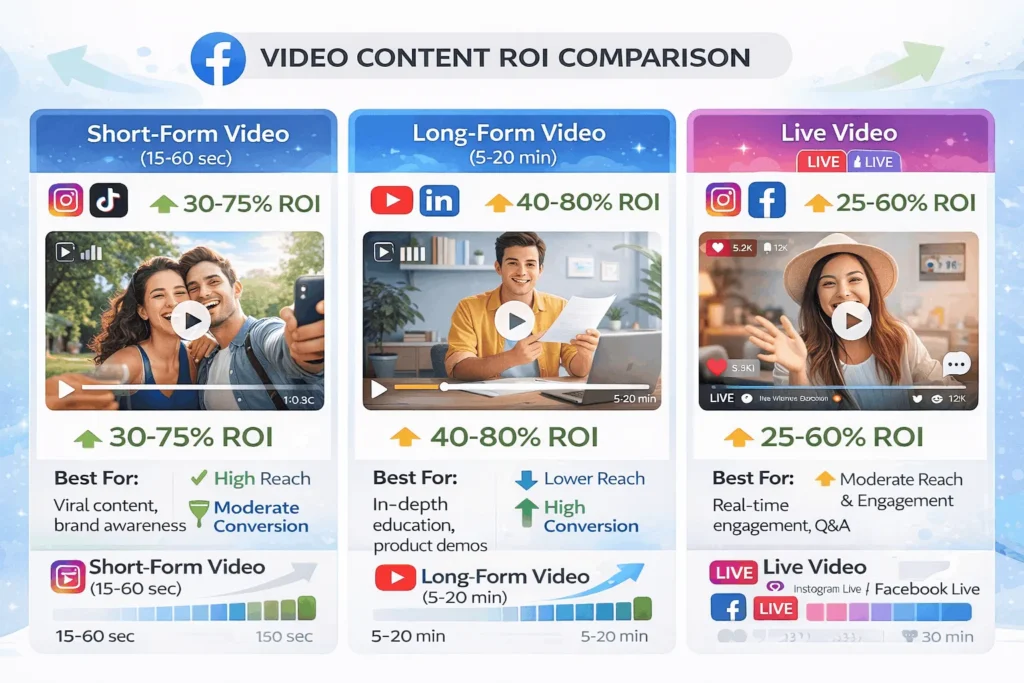
Video Content: The ROI Game Changer
Video is no longer optional. By 2025, 82% of all consumer internet traffic is video. Here’s how to leverage it:
Short-Form Video Formats (15-60 seconds):
- Instagram Reels, TikTok, YouTube Shorts, Facebook Reels
- Best for: Awareness, viral reach, trend participation
- ROI: High reach potential, moderate conversion
Long-Form Video (5-20 minutes):
- YouTube, LinkedIn articles, webinars
- Best for: Education, building authority, lead generation
- ROI: Lower reach but higher conversion quality
Live Video:
- Instagram Live, Facebook Live, TikTok Live
- Best for: Real-time engagement, Q&A, building community
- ROI: Moderate reach, high engagement, relationship building
Video Content Ideas:
- Behind-the-scenes production or day-in-the-life videos
- Tutorial or how-to videos (teaching your audience something)
- Customer testimonials and success stories
- Product demonstrations
- Industry trends and hot takes
- FAQ videos answering common questions
Pro Tip: Video doesn’t need to be professionally produced. Authentic, smartphone-recorded content often outperforms polished ads.
Influencer Partnerships and Collaborations
Influencer marketing delivers $5.78 ROI per $1 spent in 2025—nearly double traditional digital ads.
Key Insight: Micro-Influencers Win
Micro-influencers (10K-100K followers) see 60% higher engagement than larger influencers. They’re also more affordable and have loyal, niche audiences.
How to Partner:
- Find Relevant Micro-Influencers
- Use tools: HypeAuditor, Later, AspireIQ
- Search hashtags related to your industry
- Look at who’s already engaging with similar brands
- Start Small
Offer free products or services first. If the fit is good, propose paid partnerships (typically $500-2,000 for micro-influencers). - Track Results
Provide unique discount codes or affiliate links to measure conversions directly from influencer partnerships.
Measuring Social Media ROI
Only 30% of marketers effectively measure social media ROI. Don’t be in the 70% wasting budget.
Key Metrics by Goal:
| Goal | Key Metrics |
|---|---|
| Brand Awareness | Impressions, reach, followers gained |
| Engagement | Likes, comments, shares, video watch time |
| Traffic | Clicks to website, traffic sources (Google Analytics) |
| Lead Generation | Leads collected, email signups, demo requests |
| Sales | Revenue attributed to social, conversion rate, customer acquisition cost (CAC) |
ROI Formula:
(Revenue from Social - Cost of Social) / Cost of Social × 100 = ROI %
Example: You spent $1,000 on Facebook Ads and generated $5,000 in profit.
ROI = ($5,000 - $1,000) / $1,000 × 100 = 400% ROITools for Tracking:
- Google Analytics (traffic and conversions)
- Facebook Insights, Instagram Insights (engagement metrics)
- Sprout Social, Hootsuite (unified dashboard across platforms)
- UTM parameters (to track specific campaigns)
Common Mistakes to Avoid
- Spreading Yourself Thin – Start with 2-3 platforms, not all of them.
- Inconsistent Posting – Silence kills algorithms. Post consistently, even if less frequently.
- Ignoring Comments – Slow responses frustrate customers. Aim for 2-4 hour response times.
- Chasing Vanity Metrics – Followers don’t matter; engagement and conversions do.
- No Clear CTA – Every post should guide people toward an action (visit website, email signup, purchase).
- Forgetting Mobile Optimization – 80% of social traffic is mobile. Design for small screens.
How-To Section: Building Your Social Media Marketing Plan in 7 Days
Time Needed: 7 Days | 14 Hours Total | (2 hours daily)
Estimated Cost: USD $0-200 (for scheduling tools and basic ads testing)
Description: A practical 7-day framework to launch your platform-wise social media strategy for small business. Includes audience research, platform selection, content planning, and first campaign setup.
Step 1: Define Goals & Audience (Day 1-2 | 2 Hours)
Step Title: Clarify Your Social Media Objectives & Customer Profile
Step Description:
Write down your top 3 social media goals (brand awareness, lead generation, sales, or engagement). Then, create 2-3 detailed customer personas including: demographics, job titles, pain points, and where they spend time online. Use Google Analytics and customer data to inform these decisions.
Tools Needed: Google Analytics, Google Sheets, Canva (for visual personas)
Materials: Customer database, website traffic data, sales records
Step 2: Choose Your Platforms (Day 2 | 1 Hour)
Step Title: Select 2-3 Platforms Based on Audience Location
Step Description:
Don’t try all platforms. Match your audience to platforms where they spend time. Use the platform demographics table from earlier (Facebook for 25+, Instagram for visual content, LinkedIn for B2B, TikTok for under 35). Small teams succeed when focused on 2-3 platforms.
Tools Needed: Platform analytics, competitor research
Materials: Audience persona document
Step 3: Optimize Your Profiles (Day 3 | 2 Hours)
Step Title: Set Up Professional Profiles With Clear Messaging
Step Description:
Complete all profile sections fully: profile pictures, bios, contact information, website links, and business descriptions. Use keywords related to your industry. Create stories highlights (on Instagram) showcasing your top offerings. Upload a cover photo or banner.
Tools Needed: Canva (free design), Meta Business Suite
Materials: Brand guidelines, product photos, business information
Step 4: Plan Your Content Calendar (Day 4 | 2 Hours)
Step Title: Create a 30-Day Content Calendar With Theme Pillars
Step Description:
Decide on 4-5 content themes (e.g., education, behind-the-scenes, promotions, customer stories). Map out 30 days of content using the percentages: 40% educational, 30% entertaining, 20% promotional, 10% engaging. Use a Google Sheet or tool like Buffer to organize dates, captions, hashtags, and images.
Tools Needed: Google Sheets, Buffer, Later, or Meta Business Suite
Materials: Content guidelines, visual assets, product information
Step 5: Create or Source Content Assets (Day 5 | 3 Hours)
Step Title: Prepare Visuals, Captions & Multimedia for First 2 Weeks
Step Description:
Create or collect 14 pieces of content (photos, videos, graphics) aligned with your calendar. Use Canva for simple designs, record short videos on your phone, and write captions for each post. Ensure brand consistency (same fonts, colors, style). Include a mix of educational, entertaining, and promotional content.
Tools Needed: Canva Pro, smartphone camera, Descript (for video editing)
Materials: Product photos, video content, brand guidelines, stock images
Step 6: Set Up Analytics & Tracking (Day 6 | 1 Hour)
Step Title: Enable Tracking for Data-Driven Decisions
Step Description:
Set up Google Analytics goals for social referrals, enable Facebook Pixel on your website, and save native platform insights (Facebook Insights, Instagram Insights, etc.). Create a simple spreadsheet to track weekly metrics: impressions, engagement, clicks, and conversions.
Tools Needed: Google Analytics, Facebook Pixel, Sprout Social (optional)
Materials: Website URLs, conversion goals, business metrics to track
Step 7: Launch & Engage (Day 7 | 3 Hours)
Step Title: Publish Your First Posts & Establish Engagement Routine
Step Description:
Schedule your first 2 weeks of content using a scheduling tool. Set daily reminders to engage: respond to comments within 2 hours, reply to DMs, and engage with 10-15 accounts in your niche. Start with organic content; plan small paid ads for Day 14 after you see engagement patterns.
Tools Needed: Buffer, Later, or Meta Business Suite; time blocking app
Materials: Published content calendar, engagement checklist
FAQs
How much time does social media management take for a small business?
Starting out, expect 5-7 hours weekly for a single person managing 2-3 platforms (1 hour daily for posting, engagement, and monitoring). As you automate with scheduling tools, this can drop to 3-4 hours weekly.
Should small businesses pay for social media ads or stick with organic?
Both. Start with organic content to test messaging and build engagement. Once you identify what works (high engagement posts), invest in paid ads to amplify top-performing content. A 80/20 split (80% organic, 20% paid) is smart for new businesses.
What’s the best posting frequency across platforms?
Facebook: 1-2 daily | Instagram: 4-5 weekly | LinkedIn: 2-3 weekly | TikTok: 3-5 daily | Twitter: 3-5 daily. Test and adjust based on your audience engagement rates.
How long before I see results from social media marketing?
Organic reach builds over 2-3 months. Paid ads show results within days. Most businesses see meaningful traction (10+ qualified leads monthly) after 3 months of consistent posting with optimization.
Do I need to hire a social media manager?
Not at the start. Use scheduling tools and templates to save time. Hire a manager when your business generates $15K+ monthly revenue and you have $500+/month budget for their salary.
Which platform provides the best ROI for small businesses?
Facebook (29% ROI) and Instagram (22% ROI) lead for most small businesses. But your audience determines the answer—LinkedIn works for B2B, TikTok for under-35 audiences, Instagram for visual products.
How do I measure social media ROI if I sell online vs. offline?
Online: Use Google Analytics UTM parameters to track revenue per platform. Offline: Use unique discount codes or promo links per platform. Both: Track customer acquisition cost (CAC) and lifetime value (LTV) per platform.
What’s the difference between social media manager and social media strategist?
Manager executes existing strategy (posts content, responds to comments). Strategist plans the overall approach (which platforms, what content, budget allocation, metrics tracking). Start with a manager; upgrade to a strategist at scale.
Key Takeaways
Remember these core principles:
- Platform selection matters more than platform quantity – Choose 2-3 where your audience lives, not all of them.
- Strategy beats content creation – A focused strategy with consistent 40-30-20-10 content mix outperforms random viral posting.
- Engagement builds ROI – Fast responses (2-4 hours), authentic interactions, and community building convert followers into customers.
- Video dominates in 2025 – Short-form video on Reels, TikTok, and YouTube Shorts generates 3x engagement vs. static posts.
- Data drives decisions – Measure everything. Track which posts, times, and content types generate engagement and conversions, then double down on what works.
- Consistency beats perfection – Regular posting (even if imperfect) outperforms sporadic polished content. Algorithms reward consistency.
- Micro-influencers deliver better ROI – Partner with 10K-100K follower accounts in your niche for 60% higher engagement and better results.
- Small budget, big results – Small businesses out-compete large corporations through focus. You don’t need $10K/month—you need the right strategy.
Next Steps
Ready to transform your social media presence into a revenue driver? Here’s what to do next:
- This Week: Identify your top 2-3 platforms and audit your current profiles.
- Next Week: Create your customer personas and map out a 4-week content calendar.
- Week 3: Build your content assets and set up tracking in Google Analytics.
- Week 4: Launch your strategy and commit to daily engagement (2-4 hours weekly).
Conclusion
Social media marketing for small businesses isn’t complicated—it just requires the right strategy. Instead of chasing every platform and trend, focus on platform-wise tactics where your audience actually spends time.
Start with 2-3 platforms. Create consistent, valuable content aligned with the 40-30-20-10 content mix. Engage authentically with your community. Track what works and optimize based on data. Within 90 days, you’ll have clarity on which platforms deliver real results for your business.
The most successful small businesses in 2025 aren’t those with the biggest budgets—they’re those with the most focused strategies.
About StartupMandi & How We Help
StartupMandi is India’s leading digital marketing platform designed specifically for startups, MSMEs, and solopreneurs. We help small business owners like you build sustainable, profitable online presence through proven digital strategies.
Our Services Include:
- Custom social media strategy development for your niche
- Content creation and management
- Paid social media campaign setup and optimization
- Analytics and ROI tracking
- Community building and engagement strategy
Struggling to manage social media alone? Get a free 30-minute social media strategy consultation with our experts. We’ll audit your current presence and create a personalized platform-wise strategy for your business—at no cost.