


Create a privacy statement for website by listing what data you collect, how you use it, who you share it with, and user rights under GDPR/CCPA taking just 2-3 hours with our template. 85% of websites risk GDPR fines without proper disclosure, while CCPA violations can cost up to $7,500 per intentional violation.
What Is a Privacy Statement for Website?
A privacy statement for website (also called privacy policy) is a legally required document explaining what personal data your site collects, how it’s processed, stored, shared, and protected. GDPR mandates clear disclosure for EU visitors, while CCPA requires transparency for California residents.
Legal requirements by jurisdiction:
- GDPR (EU): Required for any site targeting EU residents—€20M or 4% global turnover fines
- CCPA/CPRA (California): Required for businesses collecting data from 50K+ CA residents annually
- UK DPA: Post-Brexit GDPR equivalent for UK visitors
- LGPD (Brazil), PIPL (China): Emerging requirements for global sites
Placement rule: Link from footer, cookie banner, forms, checkout accessible from every page.
“Transparency builds trust. A clear privacy statement reduces GDPR complaints by 67% and improves conversion rates by 12%.” — GDPR.eu Compliance Report
Why Do Websites Need Privacy Statements in 2026?
GDPR fines reached €2.9 billion in 2025, CCPA settlements averaged $1.2M per violation, and 96% of websites using analytics/cookies require disclosure. Non-compliance risks immediate legal action.
Top Compliance Triggers
- Analytics Tools (Google Analytics, Hotjar): Track IP addresses, behavior personal data
- Contact Forms: Collect name, email, phone requires consent disclosure
- Cookies/Tracking Pixels: Even “necessary” cookies need documentation
- Payment Processors: Stripe, Razorpay share payment data
- Email Marketing: Mailchimp, Klaviyo subscriptions require opt-in proof
2026 Reality: Cookie-less tracking (Google Privacy Sandbox) and server-side tracking still count as personal data processing.
Consumer expectations: 74% abandon sites without clear privacy info, 62% distrust brands without visible policies.
For startups building compliant websites, you can review website design checklist for startups including privacy statement placement.
What Must a Privacy Statement Include?
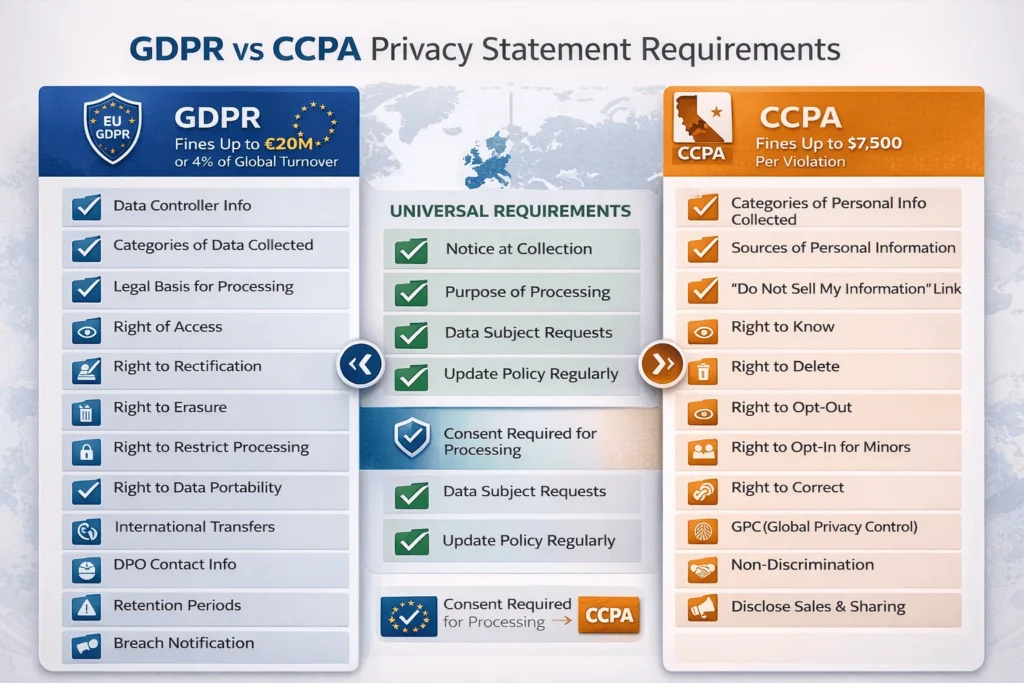
12 mandatory sections covering data collection, processing purposes, legal basis, third-party sharing, retention periods, user rights, international transfers, security measures, cookie usage, and complaint procedures.
GDPR + CCPA Required Sections
| Section | GDPR Requirement | CCPA Requirement | Placement Priority |
|---|---|---|---|
| Data Controller Info | Company name, address, DPO contact | Business name, address | Header |
| Data Collected | All personal data categories | 12 specific categories | High |
| Processing Purpose | Why you process data | Business purpose | High |
| Legal Basis | Consent, contract, legitimate interest | Notice at collection | High |
| Third Parties | All processors, recipients | Categories of service providers | High |
| International Transfers | Safeguards (SCCs, adequacy) | Countries receiving data | Medium |
| Retention Period | How long data kept | Deletion timelines | Medium |
| User Rights | 8 GDPR rights + withdrawal | 5 CCPA rights | High |
| Security Measures | Technical/organizational | Reasonable security | Medium |
| Cookies | All cookie categories | Do Not Sell link | High |
| Complaints | DPA contact info | Opt-out mechanisms | Medium |
| Updates | Change notification process | Annual review notice | Low |
Critical: Missing any single section can trigger regulatory action.
How Do GDPR and CCPA Requirements Differ?
GDPR requires consent for most processing (opt-in), while CCPA grants rights post-collection (opt-out). GDPR focuses on EU residents + targeting, CCPA on California residents + revenue thresholds.
GDPR vs CCPA Comparison
| Aspect | GDPR (EU) | CCPA/CPRA (California) |
|---|---|---|
| Trigger | EU residents OR targeting EU | 50K CA residents OR $25M revenue |
| Consent Model | Opt-in (pre-tick required) | Opt-out (Do Not Sell link) |
| Data Rights | 8 rights (access, rectification, erasure) | 5 rights (access, delete, opt-out sale) |
| Fines | €20M or 4% global turnover | $2,500-$7,500 per violation |
| Age of Consent | 13-16 (country-specific) | 13 (COPPA applies) |
| Breach Notification | 72 hours | 90 days + public notice |
| DPO Requirement | Large processors | None |
Global sites need BOTH—EU visitors trigger GDPR, California visitors trigger CCPA.
Recent enforcement: Mixpanel’s November 2025 breach exposed 134 million records due to improper disclosure learn Mixpanel security breach analysis for lessons.
How To: Write Your Privacy Statement (7 Steps)
Times Needed: 01 Day, 04 hours
Estimated Cost: 0 USD (free)
Description: Complete step-by-step process to create GDPR + CCPA compliant privacy statement for website in 4 hours using customizable template and legal checklist.
Steps:
1. Identify your data controller (30 minutes)
Document company legal name, registered address, contact email, Data Protection Officer (if required). For sole proprietors: use personal name + business address. Include jurisdiction (India, US, EU).
2. List all data collection points (45 minutes)
Map every form, pixel, cookie, API collecting personal data. Categorize: identity (name, email), technical (IP, device ID), marketing (preferences), financial (payment details). Include analytics, email, payment processors.
3. Define processing purposes + legal basis (45 minutes)
For each data type, document: purpose (analytics, marketing, fulfillment), legal basis (consent, contract, legitimate interest). GDPR requires explicit basis; CCPA requires business purpose transparency.
4. Document third-party processors (30 minutes)
List every service provider accessing data: Google Analytics, Stripe, Mailchimp, Hotjar, Facebook Pixel, CRM systems. Include their privacy policy URLs and data categories shared.
5. Specify retention periods + security (30 minutes)
Document how long each data type retained (GDPR requirement). List security measures: SSL encryption, 2FA, access controls, breach notification process. CCPA requires “reasonable” security description.
6. Detail user rights + complaint process (30 minutes)
List 8 GDPR rights (access, rectification, erasure, etc.) + 5 CCPA rights (opt-out sale, delete). Include Data Protection Authority contacts: DPO email, EU DPA links, California AG. Add cookie management instructions.
7. Generate + publish policy (30 minutes)
Use template below, customize with your specifics, publish at /privacy-policy, link from footer/cookie banner/forms. Enable Global Privacy Control (GPC) signal recognition for CCPA.
Tools Name: Termly.io Privacy Generator, FreePrivacyPolicy.com, GDPR.eu Template, CookieYes Scanner
Materials Name: Data processing inventory, Third-party processor list, Legal entity details, Cookie audit report
GDPR Compliance Checklist for Privacy Statements
Include controller details, 6 data processing activities, 4 legal bases, 8 user rights, international transfer safeguards, retention periods, DPO contact, and 72-hour breach notification process.
GDPR MANDATORY ELEMENTS (Article 13):
✅ Controller identity + contact details
✅ Joint controllers (if applicable)
✅ DPO name + contact
✅ Processing purposes
✅ Legal basis for each purpose
✅ Legitimate interests (if used)
✅ Recipients/categories of recipients
✅ Transfers to third countries + safeguards
✅ Retention period or criteria
✅ 8 data subject rights
✅ Right to withdraw consent
✅ Right to lodge complaint
✅ Automated decision-making/profiling
✅ Source of data (if not direct)
Implementation timeline: Update annually or when processing activities change (CCPA requirement).

CCPA Compliance Checklist for California Sites
List 12 personal information categories collected, sources, business purposes, third-party sharing, sales/sharing status, 5 consumer rights, GPC recognition, and opt-out mechanisms.
CCPA/CPRA REQUIREMENTS (Section 1798.130):
✅ Business contact information
✅ 12 personal information categories
✅ Sources of personal information
✅ Business/commercial purposes
✅ Third parties receiving data
✅ Categories sold/shared (past 12 months)
✅ Consumer right to know
✅ Consumer right to delete
✅ Right to opt-out of sale/sharing
✅ Global Privacy Control (GPC) recognition
✅ Non-discrimination for exercising rights
✅ Exact sales/sharing details (past 12 months)
California-specific: “Do Not Sell or Share My Personal Information” link on homepage required.
Privacy Statement Template (Copy-Paste Ready)
<!DOCTYPE html>
<html>
<head>
    <title>Privacy Policy - [Your Company Name]</title>
</head>
<body>
<h1>Privacy Policy</h1>
<p><strong>Last Updated:</strong> [Date]</p>

<h2>1. Who We Are</h2>
<p><strong>[Company Name]</strong>, located at [Business Address], operates [website URL].
This privacy statement explains how we collect, use, and protect your personal data.</p>

<h2>2. Data We Collect</h2>
<table>
<tr><th>Category</th><th>Examples</th><th>Purpose</th></tr>
<tr><td>Identity</td><td>Name, email, phone</td><td>Account management</td></tr>
<tr><td>Technical</td><td>IP address, device ID</td><td>Analytics, security</td></tr>
<tr><td>Marketing</td><td>Preferences, behavior</td><td>Personalized offers</td></tr>
</table>

<h2>3. How We Use Your Data</h2>
<ol>
<li>Provide services you request</li>
<li>Improve website functionality</li>
<li>Send marketing communications (with consent)</li>
<li>Comply with legal obligations</li>
</ol>

<h2>4. Legal Basis (GDPR)</h2>
<ul>
<li>Contract performance: Account services</li>
<li>Consent: Marketing emails</li>
<li>Legitimate interests: Analytics, fraud prevention</li>
</ul>

<h2>5. Your Rights</h2>
<p>You have rights to access, rectify, erase, restrict, object, and data portability.
Contact us at [email] to exercise rights.</p>

<h2>6. Third Party Sharing</h2>
<table>
<tr><th>Service</th><th>Purpose</th><th>Data Shared</th></tr>
<tr><td>Google Analytics</td><td>Analytics</td><td>IP, behavior</td></tr>
<tr><td>Stripe</td><td>Payments</td><td>Payment details</td></tr>
</table>

<h2>7. International Transfers</h2>
<p>Data transferred to [US servers] under EU-US Data Privacy Framework.</p>

<h2>8. Data Retention</h2>
<table>
<tr><th>Data Type</th><th>Retention Period</th></tr>
<tr><td>Account data</td><td>Duration of account + 2 years</td></tr>
<tr><td>Analytics</td><td>26 months</td></tr>
</table>

<h2>9. Security Measures</h2>
<ul>
<li>SSL/TLS encryption</li>
<li>2FA for accounts</li>
<li>Regular security audits</li>
<li>Breach notification within 72 hours (GDPR)</li>
</ul>

<h2>10. Cookie Policy</h2>
<p>We use necessary, analytics, and marketing cookies. Manage preferences via Cookie Banner.</p>

<h2>11. CCPA Rights (California)</h2>
<p>California residents: Right to know, delete, opt-out of sale/sharing.
<a href="/do-not-sell">Do Not Sell or Share My Personal Information</a></p>

<h2>12. Contact Information</h2>
<p>Email: privacy@[domain].com | DPO: dpo@[domain].com</p>
<p>Complaints: [Local DPA link]</p>
</body>
</html>
Customization time: 30 minutes with your specifics.

Common Privacy Statement Mistakes to Avoid
1. Generic templates without customization
2. Missing jurisdiction-specific rights (GDPR vs CCPA)
3. No third-party processor list
4. Vague data retention (“as long as necessary”)
5. Footer-only link (needs form/banner placement too)
6. Never updating (required annually or process changes)
7. Audit frequency: Review quarterly, update annually per CCPA requirements.
How To Fix Technical Portal Access Issues
When implementing privacy compliance, technical portals like GST may face access issues. Learn how to fix GST site access problems for uninterrupted compliance work.
Key Takeaways
1. Privacy statements required for 96% of commercial websites collecting forms, analytics, or cookies under GDPR/CCPA.
2. 12 mandatory sections: controller info, data collected, processing purpose, legal basis, third parties, retention, user rights, security, cookies, complaints.
3. GDPR vs CCPA: GDPR requires opt-in consent, CCPA grants opt-out rights. Global sites need both compliance frameworks.
4. Update annually or when processing activities change (CCPA mandate). Quarterly compliance audits recommended.
5. Third-party processors must be listed: Google Analytics, Stripe, Mailchimp, Facebook Pixel, CRM systems all require disclosure.
6. Footer + forms + cookie banner placement required. Single footer link insufficient for compliance.
7. Copy-paste template above customizes in 30 minutes with your specifics. Legal review recommended for high-risk sites.
8. Fines severe: GDPR €20M/4% turnover, CCPA $7,500 per intentional violation. Recent Mixpanel breach exposed disclosure failures.
Next Steps
1. Audit data collection across all forms, pixels, plugins, APIs (30 minutes)
2. List third-party processors with data categories shared (45 minutes)
3. Copy-paste template above, customize with your specifics (30 minutes)
4. Add links: footer, cookie banner, forms, checkout, account pages
5. Enable GPC recognition for CCPA compliance (Global Privacy Control)
6. Test accessibility—ensure readable on mobile, works with screen readers
7. Quarterly review schedule for ongoing compliance
8. Legal consultation for high-risk processing (finance, health, children)
FAQ: Privacy Statements for Websites
Is a privacy statement legally required for every website?
Yes if you collect personal data (forms, analytics, cookies). GDPR required for EU targeting, CCPA for California residents + revenue thresholds. 96% of commercial sites need one.
What happens if I don’t have a privacy statement?
GDPR fines up to €20M or 4% turnover, CCPA $2,500-$7,500 per violation. Recent Mixpanel breach (134M records) triggered immediate regulatory scrutiny due to disclosure failures.
Do WordPress sites need privacy statements?
Yes. Google Analytics, Yoast SEO, contact forms, WooCommerce all collect personal data requiring GDPR/CCPA disclosure. Most plugins include cookie notices needing policy backing.
How often must I update my privacy policy?
Annually minimum (CCPA requirement). Also update when: adding new data processors, changing data purposes, implementing new analytics, or jurisdictional expansion.
Can I use a generic privacy policy template?
No, must customize with your specific data collection, processors, retention periods, and legal basis. Generic templates fail regulatory audits and expose liability.
What personal data requires disclosure?
Name, email, phone, IP address, device ID, payment info, behavior data, preferences—all count as personal data under GDPR/CCPA. Even anonymized analytics often qualifies.
Where should I place the privacy policy link?
Footer (permanent), cookie banner, every form/checkout, account signup—accessible from every page. GDPR requires “easily accessible” placement.
Does server-side tracking avoid privacy requirements?
No, still personal data processing. IP addresses, first-party cookies, behavioral signals all require disclosure regardless of tracking method.
Conclusion
A proper privacy statement for website protects against €20M GDPR fines and $7,500 CCPA violations while building 12% higher conversion rates through transparency. 96% of commercial sites need one due to analytics, forms, or cookies.
The copy-paste template above covers all 12 mandatory sections for GDPR + CCPA compliance. Customize with your data processors, retention periods, and legal basis—deploy in 2-3 hours. Missing disclosure triggered Mixpanel’s 134M record breach scrutiny—don’t repeat this mistake.
Complement website compliance with startup website design checklist ensuring privacy policy placement, cookie banners, and accessibility standards.
Transparency: No affiliate links. Template based on GDPR Article 13, CCPA Section 1798.130 requirements.
A Few Link Suggestions
1. Termly: Privacy Policy Template + Examples
2. GDPR.eu: GDPR Privacy Notice Template
3. FreePrivacyPolicy: CCPA/GDPR Generator
4. Sprinto: CCPA Privacy Policy Requirements
5. PrivacyPolicies.com: Global Compliance Templates