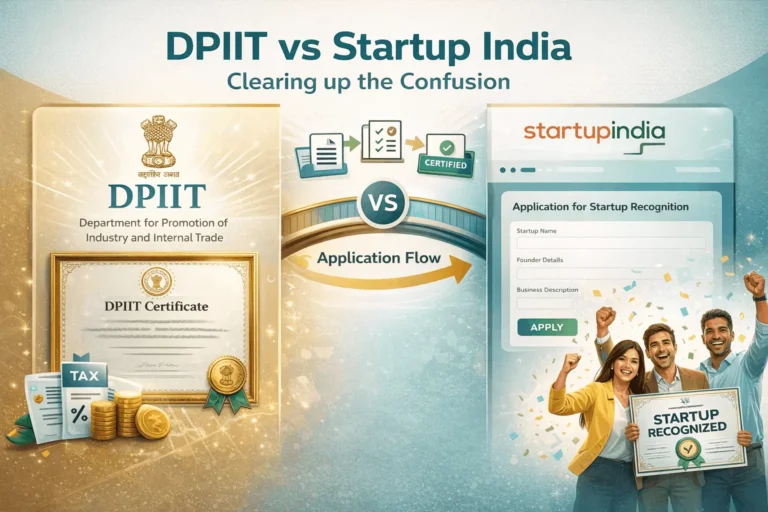



Aspiring founders in India often confuse Startup India recognition with private company registration, but they are not substitutes. Startup India is a Central government scheme offering benefits like tax holidays and easier compliance, while private registration is a legal structure under the Companies Act.
In simple terms, you usually register a private limited company or LLP first, then apply for Startup India recognition if you meet DPIIT conditions. This article gives you a decision-first comparison so you can choose the right combination for your startup vision.
What Is Startup India vs Private Registration?
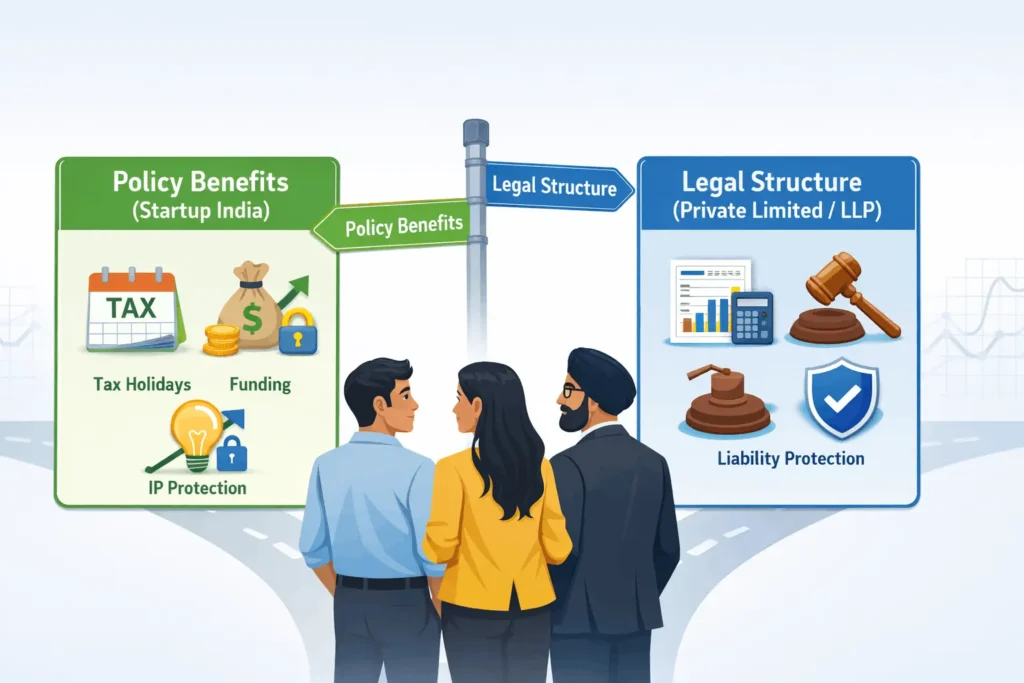
Startup India is a government initiative that grants DPIIT recognition and tax, funding, and compliance benefits to eligible startups. Private registration usually means incorporating a private limited company (or LLP/OPC) as a legal entity with limited liability and separate legal status.
- Startup India (DPIIT Recognition): Policy tag plus benefits like 3‑year income tax holiday and angel tax exemption, available only if your entity is already a private limited, LLP, or registered partnership.
- Private Limited Registration: Legal formation with MCA giving you a separate legal entity, limited liability, and an investor‑friendly shareholding structure.
- Key Link: You cannot get Startup India recognition without first completing an eligible registration like private limited or LLP.
“To be eligible, startups must be incorporated as a Private Limited Company, LLP, or Registered Partnership Firm and obtain DPIIT recognition.” – Razorpay Startup India Guide
Now that the definitions are clear, let’s see how eligibility and benefits differ.
How Does Startup India Recognition Work?
Startup India recognition is a DPIIT certificate that unlocks tax breaks, funding schemes, and relaxed compliance for innovative businesses.
- Eligibility Conditions:
- Incorporated as a private limited, LLP, or registered partnership.
- Less than 10 years old from the date of incorporation.
- Turnover not exceeding ₹100 crore in any financial year.
- Working on innovation, improvement of existing products/services, or a scalable business model with high employment or wealth creation.
- Core Benefits:
- Income tax holiday: 100% profit deduction for any 3 consecutive years under Section 80‑IAC, within the first 10 years (subject to IMB approval).
- Angel tax exemption: Relief under Section 56(2)(viib) on share premium.
- Simplified compliance: Self‑certification for selected labour and environmental laws, plus easier exit.
- IPR and funding support: Up to 80% rebate on patent filing fees and access to Startup India Seed Fund Scheme grants up to ₹20–50 lakh.
- What It Is Not:
- Not a separate legal structure.
- Not a replacement for private limited or LLP registration.
- So, Startup India is about incentives. Next, understand what “private registration” really gives you.
What Is Private Registration for a Startup?
Private registration is the legal step where you choose a business structure like private limited, LLP, OPC, or proprietorship and register with the appropriate authority.
- Main Structures for Aspiring Entrepreneurs:
- Sole Proprietorship – Easiest, but no separate legal entity and unlimited personal liability.
- Partnership Firm – Simple, but partners have unlimited liability and limited investor appeal.
- LLP (Limited Liability Partnership) – Separate entity with limited liability and flexible partnership flavour.
- Private Limited Company – Separate corporate entity, limited liability, share capital, highly investor‑friendly.
- One Person Company (OPC) – Single founder with limited liability and corporate status.
- Why Private Limited is Favoured for Startups:
- Regulation and Compliance:
With both concepts clear, the real question is: which one do you choose and when?
How Is Startup India Different from Private Registration?
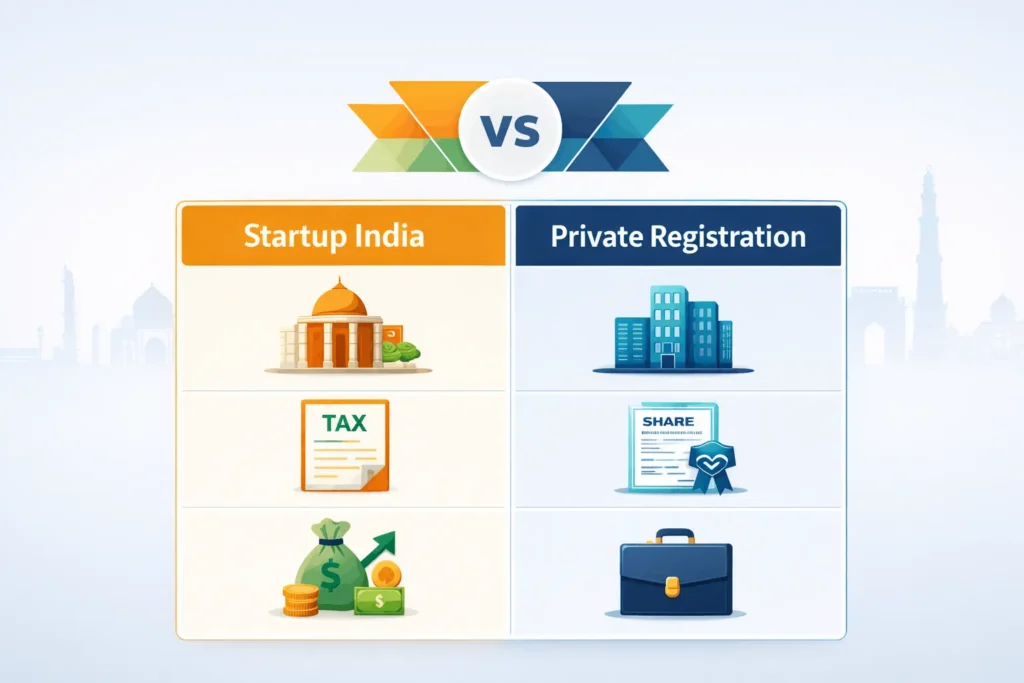
Startup India defines eligibility for benefits; private registration defines your legal identity. You usually need both for a serious, scalable startup.
Key Comparison Table
| Aspect | Startup India (DPIIT) | Private Registration (e.g., Pvt Ltd) |
|---|---|---|
| Nature | Government recognition/benefit tag | Legal business structure |
| Legal Entity | Not a legal form | Separate legal entity (in most types) |
| Who Grants It | DPIIT / Startup India portal | MCA / Registrar of Companies, LLP Registrar |
| Eligibility | Age <10 yrs, turnover ≤₹100 Cr, innovation‑oriented | Varies by structure (Pvt Ltd, LLP, OPC, etc.) |
| Tax Benefits | 3‑year tax holiday, angel tax exemption | Corporate tax regime, but no automatic holiday |
| Funding Edge | Access to seed fund, investor comfort | Required for equity funding, ESOPs |
| Mandatory? | No | Yes, if you incorporate beyond proprietorship |
Practical rule: register a private limited or LLP first, then apply for Startup India recognition if you’re building something scalable.
Let’s see situations where each option is better for you.
When Should You Choose Only Private Registration?
Choose only private registration when you are early, low‑risk, or not fully innovation‑focused yet.
- Lifestyle or Local Service Business
- Example: Local agency, boutique, or consulting with limited tech/IP focus.
- You may not meet DPIIT’s innovation requirement, but you still need a proper entity.
- Testing Idea with Low Funding Needs
- Simple Tax & Compliance Preference
- No Immediate Plan for VC or Angel Funding
“For new start-up businesses seeking scalability and external investment, a Pvt Limited Company registration is far more advantageous than a traditional partnership.”
But if you want tax breaks and government recognition, Startup India can be a game‑changer.
When Should You Choose Startup India Recognition Too?
Choose Startup India recognition in addition to private registration when you plan to scale quickly, raise capital, or build deep innovation.
- High‑Growth, Tech, or Product Startups
- Plan to Raise Angel / Seed Funding
- Want 3‑Year Tax Holiday
- Need Grants and Government Ecosystem Access
- Compliance and IP Support
How Do You Decide Between Startup India and Private Registration?
You don’t usually choose one or the other; you choose whether to add Startup India recognition on top of a strong private registration. Use this decision matrix:
Simple Decision Matrix
| Scenario | Recommended Structure | Startup India Recognition? | Why |
|---|---|---|---|
| Solo freelancer, low risk | Proprietorship or LLP | Not essential | Simpler compliance, limited innovation angle |
| Bootstrapped local business | LLP or Pvt Ltd | Optional | Focus on cash flow, local market |
| Tech product with funding plans | Private Limited | Strongly recommended | Equity funding, tax and angel benefits |
| D2C brand eyeing VC | Private Limited | Strongly recommended | Brand, ESOPs, investor expectations |
| IP‑heavy startup (patents) | Private Limited or LLP | Highly recommended | IPR rebate and fast‑track |
Rule of thumb: If your vision includes innovation + external funding + national scale, combine Private Limited + DPIIT Startup India.

Once you’ve decided, you’ll want a clear implementation roadmap.
How Do You Register as a Private Limited and Then Under Startup India?
Below is a concise “How To” style overview. (Exact legal steps should be done with a professional.)
How To: Choose Private Registration and Apply for Startup India
Incorporate a private limited company or LLP with MCA, then apply for DPIIT Startup India recognition online, to access tax exemptions and ecosystem benefits.
Steps:
- Define Your Business Structure
Decide between private limited, LLP, or OPC based on liability, funding plans, and co‑founders. Consult a professional to avoid costly future conversions. - Incorporate with MCA
Apply for name approval, prepare the MoA/AoA or LLP agreement, and file incorporation forms on the MCA portal. Get the Certificate of Incorporation and the company PAN. - Organise Core Compliance Basics
Open a current bank account, set up bookkeeping, apply for GST if needed, and sign basic founder agreements for clarity. - Prepare Startup India Application Content
Draft a crisp pitch on innovation, problem, solution, and scalability; compile pitch deck, website link, and proof of concept, if any. - Apply on the Startup India Portal
Create an account on the Startup India portal, fill the DPIIT recognition form, upload the incorporation certificate and write‑up, and submit for review. - Apply for Tax & Angel Exemptions (Optional)
After the DPIIT certificate, file for the Section 80‑IAC income tax holiday and angel tax exemption using the prescribed online forms when you meet profitability and funding conditions.
Tools Name: MCA portal, Startup India portal, CAP table/ESOP tool, Accounting software
Materials Name: Incorporation documents, Founders’ KYC, Pitch deck, Financial projections
Next, let’s clear the most common doubts founders have.
FAQ: for Startup India Recognition
Is Startup India the same as registering a company?
No, Startup India is not a legal form. You must first register a legal entity (like a private limited or LLP) and then apply for DPIIT recognition under the Startup India scheme.
Can a sole proprietorship get Startup India recognition?
No, eligibility requires incorporation as a private limited company, LLP, or registered partnership firm—not a proprietorship.
Do I need Startup India recognition to raise funding?
Not legally, but DPIIT recognition improves investor comfort and can save tax via angel tax exemption and a 3‑year profit holiday.
What is the key tax benefit of Startup India?
Recognised startups can apply for 100% income tax exemption on profits for any 3 consecutive years out of the first 10, under Section 80‑IAC, subject to approval.
Which is better for funding: LLP or Private Limited?
For VC or angel rounds, a private limited company is strongly preferred because of share capital, ESOPs, and clearer equity structures.
Can an LLP get Startup India recognition?
Yes, LLPs can be recognised as startups if they meet all other DPIIT criteria like age, turnover, and innovation.
Is Startup India recognition permanent?
No, benefits like a tax holiday are time‑bound (3 years), and recognition applies only while you meet age and turnover thresholds.
Should every new entrepreneur apply for Startup India?
If you are building an innovative, scalable business and may raise equity, it is usually worth the effort; for small local or purely service firms, benefits may be limited.
Key Takeaways
- Startup India is a benefit layer, not a legal structure. You still need private registration like Pvt Ltd or LLP.
- Private limited companies are best for scalable, investor‑backed startups because they offer limited liability and equity flexibility.
- DPIIT recognition unlocks powerful benefits like 3‑year tax holiday, angel tax exemption, and IP rebates that can materially improve runway.
- Most serious founders should aim for Pvt Ltd + Startup India once they validate innovation and growth potential.
- Professional guidance from platforms like StartupMandi can save weeks of trial‑and‑error and prevent rejected filings or missed benefits.
Next Steps That You Can Follow
- Define your growth vision and funding plan – lifestyle business or scalable startup?
- Choose your base structure: proprietorship/LLP for simplicity, or private limited if you see funding, ESOPs, and national scale.
- Validate if you meet the DPIIT innovation and turnover criteria, then plan a Startup India application timeline.
- Book a consultation with StartupMandi to get a tailored registration and recognition roadmap, including MCA, GST, and Startup India filing support.
- Prepare your pitch deck and basic compliance stack early so you can move fast when opportunities appear.
Conclusion
Choosing between Startup India and private registration is not an either‑or decision—it’s about sequencing and strategy. Your legal backbone comes from the right business structure (like a private limited company), and your policy leverage comes from Startup India recognition layered on top.
For most ambitious Indian founders, the winning combination is “Private Limited + DPIIT Startup India Recognition” when innovation and scale are on the roadmap. StartupMandi can guide you from zero to fully compliant—helping you pick the ideal structure, file all registrations, and prepare a strong Startup India application. Explore incorporation and compliance support on StartupMandi’s website, and then dive deeper into startup tax benefits and GST resources published by StartupMandi to keep your growth compliant and investor‑ready.
Transparency Note: This article is for general information only and is not legal or tax advice. Please consult a qualified professional or use StartupMandi’s advisory services before making registration or tax decisions.
Few Links Suggestions for More Research & Fact‑Check
- Startup India Official Scheme Overview – features, eligibility, benefits
- DPIIT Startup Recognition & Tax Exemption Page – 80‑IAC, angel tax details
- Razorpay Startup India Guide – updated eligibility and benefit summary
- IndiaFilings Startup India Scheme Guide – benefits & application walkthrough
- Lendingkart Entity Comparison Table – proprietorship vs LLP vs Pvt Ltd vs OPC