

Introduction
Facebook Ads targeting has fundamentally shifted, and marketers who haven’t adapted are leaving money on the table. Interest-based targeting is now less effective than data-driven, AI-assisted audience selection.
For digital marketers managing performance campaigns, the critical question remains: Advantage+ automated targeting vs. manual interest-based segments vs. hybrid approach?
The answer impacts ROI directly. Advertisers using Advantage+ saw 14.8% lower CPA, yet niche markets and new accounts still benefit from interest targeting. This guide breaks down both approaches and reveals the winning 2026 strategy.
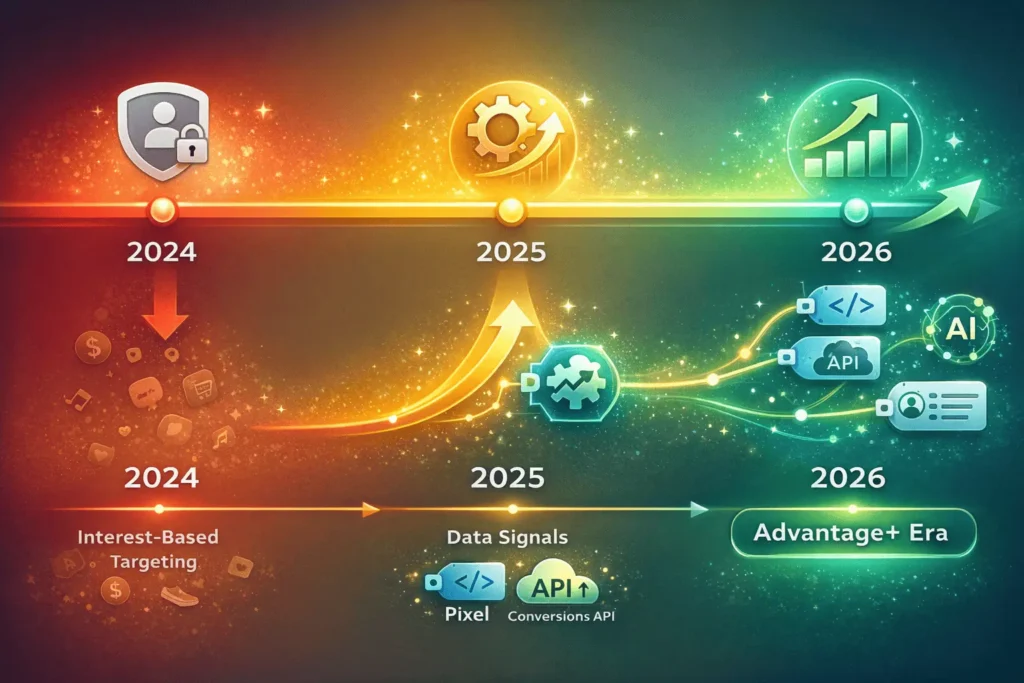
What Changed in Facebook Ads Targeting (2024–2026)?
Two critical shifts transformed the landscape:
- Privacy Restrictions (iOS 14.5+): Apple’s tracking limits reduced Meta’s behavioral data access. This made traditional interest-based targeting less reliable.
- Algorithm Advancement: Meta’s AI now outperforms manual micro-targeting. Advantage+ expanded segments with 44% lower CPM costs.
The result: First-party data (Pixel, Conversions API, customer lists) now powers effective targeting. Manual micro-segmentation fails unless targeting highly specific niches.
“Marketers in 2026 won’t win with the most interests. They’ll win with the cleanest data and patience to let algorithms work.” — Effinity Research, 2025
How Does Advantage+ Compare to Interest Targeting?
Understanding the differences helps you choose the right strategy for your account stage.
| Aspect | Advantage+ | Interest Targeting |
|---|---|---|
| Best For | Scale, broad products, established accounts | New accounts, niche B2B, validation |
| Setup Complexity | Minimal (country, age, language) | Manual (add interests + behaviors) |
| Cost Per Acquisition | 14.8% lower; 44% CPM reduction | Higher; varies by niche |
| Learning Time | 7–14 days required | Immediate (slower scale) |
| Control Level | Algorithm-driven (black box) | Full transparency into targeting |
| Audience Discovery | Finds unexpected converting segments | Limited to defined audiences |
Key Insight: Advantage+ wins at scale and discovery. Interest targeting wins at early-stage validation and precision.

What Is the Hybrid 3-Phase Approach?
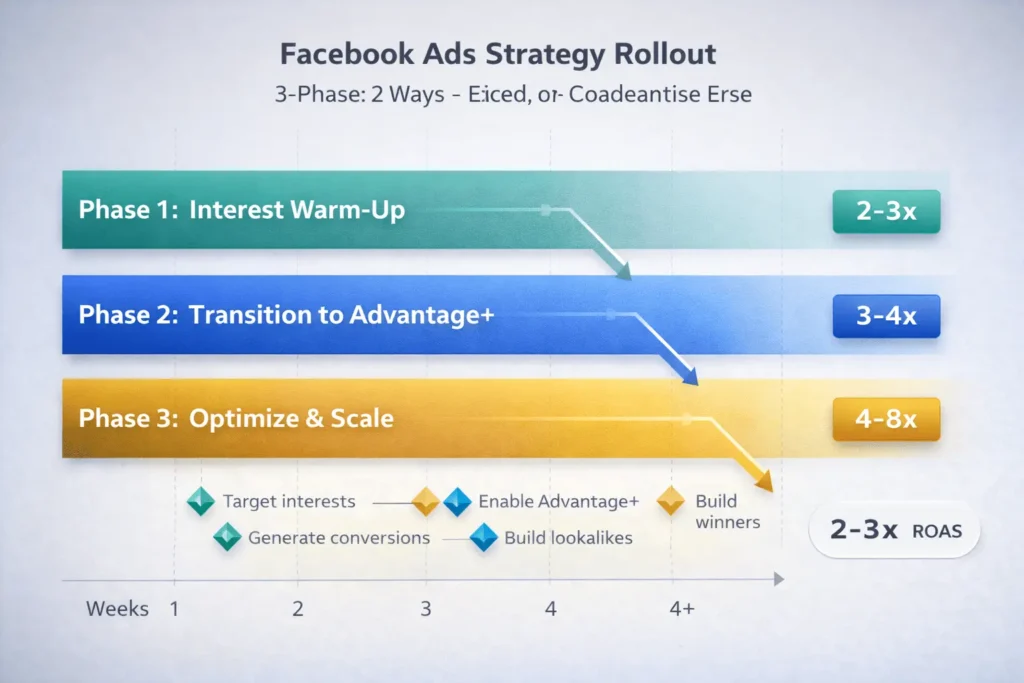
The winning strategy combines both methods in sequence. This approach validates your market while scaling efficiently.
Phase 1: Interest Warm-Up (Weeks 1–3)
- Target 3–4 core interests only (not 10+)
- Layer 1–2 behaviors (income level, engagement type)
- Set daily budget: $20–50
- Generate 50+ conversions for algorithm learning
- Expected ROAS: 2–3x
Why this works: Interest targeting builds conversion history. Meta’s algorithm needs data points to optimize effectively.
Phase 2: Transition to Advantage+ (Week 4+)
- Enable Advantage+ Audience for automatic expansion
- Enable Advantage+ Placements (test all ad formats)
- Keep Pixel + Conversions API clean and accurate
- Maintain geographic/age constraints from Phase 1
- Expected ROAS: 3–4x by week 8
Why this works: With conversion history established, Advantage+ expands your reach while maintaining optimization signals.
Phase 3: Optimize with Lookalikes & Exclusions
- Exclude existing customers from prospecting campaigns
- Build separate retargeting audiences (cart abandoners, viewers)
- Test 1%, 5%, 10% lookalike audiences from best customers
- Rotate creative every 7–14 days to combat fatigue
Why this works: Exclusions prevent wasted spend. Lookalikes find similar high-value prospects at scale.
What Custom Audiences Should You Build First?
These core audiences form the foundation of your targeting strategy. Build them regardless of campaign type.
| Audience Type | Window | ROI Impact | Setup Time |
|---|---|---|---|
| Website visitors (all) | 180 days | Retargeting foundation | 5 min |
| Cart abandoners | 7 days | 4–10x ROAS potential | 10 min |
| Video viewers (75%+ watched) | 365 days | High-intent nurture | 10 min |
| Product page viewers | 14 days | Product-specific offers | 10 min |
| Purchasers | 90 days | Lookalike source quality | 5 min |
| CRM list (high-value customers) | Ongoing | VIP retention campaigns | 15 min |
Pro tip: Once built, these audiences work automatically. Invest 1 hour now, gain months of targeting power.
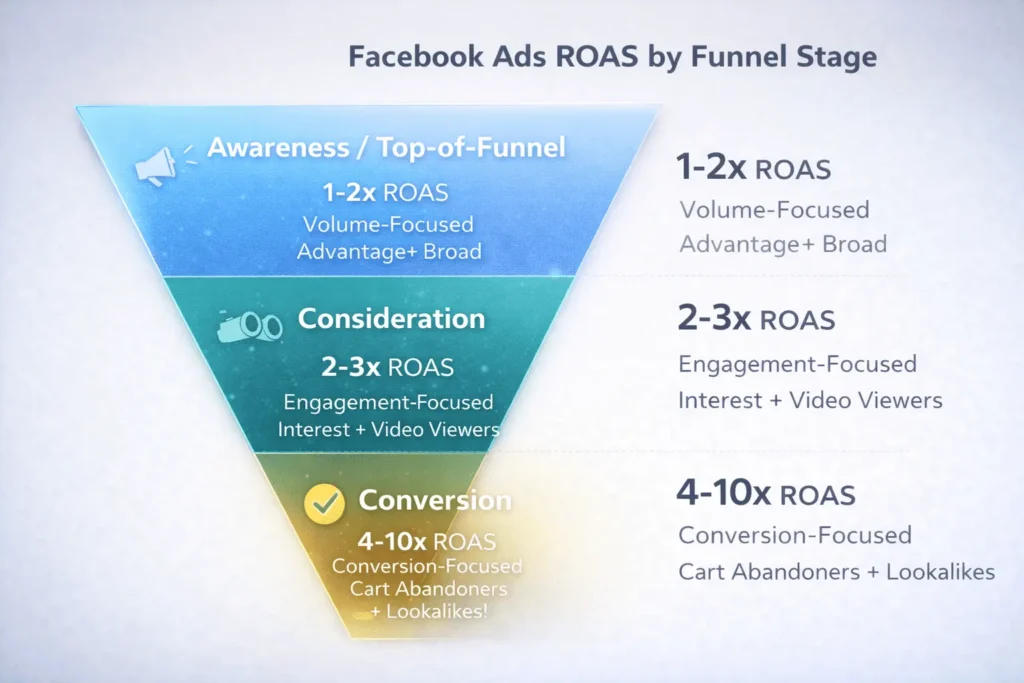
How Should You Structure Targeting by Funnel Stage?
Different funnel stages require different targeting approaches. Optimize each separately.
- Top-of-Funnel (Awareness): Advantage+ broad + Brand Awareness objective → 1–2x ROAS (volume-focused)
- Mid-Funnel (Consideration): Video viewers + Interest targeting → 2–3x ROAS (engagement focus)
- Bottom-Funnel (Conversion): Cart abandoners + purchaser lookalikes → 4–10x ROAS (conversion focus)
Implementation: Create separate campaign sets for each funnel stage. Use distinct budgets and creative messaging. This prevents audience overlap and maximizes efficiency.
Why Does Lookalike Audience Source Matter?
Not all lookalikes perform equally. The source customer data dramatically impacts results.
Best sources: Purchasers (not leads), high-LTV customers (>$500), recent converters (past 30 days)
Recommended sizes:
- 1% lookalike: Highest quality, smallest reach (B2B/niche industries)
- 5% lookalike: Balance of quality + scale (recommended default)
- 10% lookalike: Broader reach, lower intent (scaling phase only)
Common mistake: Using leads as lookalike source. Leads have lower intent than purchasers. Your lookalike reflects this lower quality.
What Tracking Setup Is Non-Negotiable?
Without proper tracking, Meta’s algorithm can’t optimize. Period.
Meta Pixel + Conversions API dual-tracking recovers 10–30% of lost conversions
- Implement Meta Pixel on all pages (base code)
- Install Conversions API (server-side tracking)
- Configure essential events: ViewContent, AddToCart, InitiateCheckout, Purchase, Lead, CompleteRegistration
- Always tag conversion value ($49.99, not just “purchase”)
- Test with Conversion Assistant to verify data flow
Why both? Client-side (Pixel) captures browser events. Server-side (Conversions API) captures backend conversions. Together, they provide complete visibility.
“Marketers with clean tracking see 30% better ROAS than those relying on Pixel alone.” — Cropink Research, 2025
How Do You Combat Ad Fatigue Effectively?
Ad fatigue kills campaigns. Implement these tactics proactively.
- Frequency cap: 1–2 impressions per user per day
- Creative rotation: Refresh ads every 7–14 days
- Pause threshold: Retire ads when CTR drops 20% from peak
- Audience segmentation: Split large audiences into smaller cohorts (reduces frequency naturally)
Result: Lower CPM, higher CTR, sustained ROAS across campaign lifespan.
What Are the Most Critical Targeting Mistakes?
Avoid these costly errors that destroy ROI.
| Mistake | Why It Fails | Solution |
|---|---|---|
| Overly narrow targeting (10+ interests) | Restricts algorithm, prevents discovery | Use 2–3 interests max; let Advantage+ expand |
| Poor conversion tracking | Algorithm can’t optimize properly | Implement Pixel + Conversions API |
| Strategy changes every 3 days | Advantage+ needs 7–14 days to learn | Commit to minimum 7-day test windows |
| No customer exclusions | Burn budget on existing customers | Always exclude purchasers from prospecting |
| Landing page mismatch | High CTR, low conversions | Match ad message to landing page headline |
Remember: Test with patience. Give Advantage+ campaigns at least 7 days before evaluating performance.
How Should You Structure Your Campaign Launch?
Follow this checklist to avoid setup mistakes.
Planning Phase:
- Define your funnel stage (awareness, consideration, conversion)
- Confirm if product has broad or niche appeal
- Verify you have 50+ conversions (for Advantage+ readiness)
Setup Phase:
- Implement Meta Pixel + Conversions API
- Create custom audiences (website visitors, cart abandoners, purchasers)
- Build 1% and 5% lookalike audiences
- Prepare exclusion lists (existing customers, competitors)
Configuration Phase:
- Set country, age range, language parameters
- Enable Advantage+ Audience + Placements
- Set frequency cap: 1–2 impressions per day
- Match campaign objective to funnel stage
Testing Phase:
- Create 3–4 creative variants
- Run minimum 7-day test (100+ conversions if possible)
- Compare ROAS, CTR, Cost Per Result metrics
- Pause bottom 25% performing creatives
- Scale winning ads by 10–20% weekly (if profitable)
How Should Different Industries Approach Facebook Ads Targeting?
One size doesn’t fit all. Tailor your approach to industry dynamics.
E-Commerce (D2C): Advantage+ + strong Pixel tracking → 3–5x ROAS. Budget allocation: 60% prospecting, 40% retargeting
SaaS & B2B: Hybrid approach (interest warm-up → Advantage+) → 4–7x ROAS. Prioritize lead quality over quantity
Local Services: Radius targeting (3–5 miles) + Advantage+ Audience → 2–4x ROAS. Build local lookalikes
B2B Lead Generation: Job title + industry interests → 3–5x ROAS. Use manual targeting only if you have 200+ qualified customers
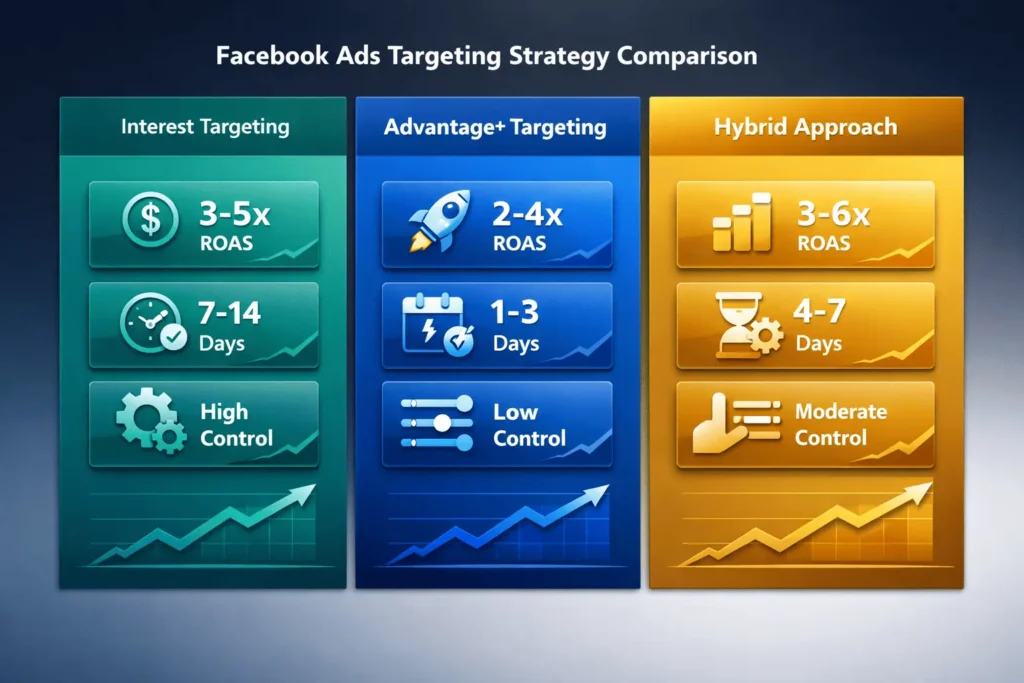
Advantage+ vs Interest Targeting vs Hybrid Approach: Side-by-side comparison for Facebook Ads ROI optimization in 2026
What Metrics Matter Beyond ROAS?
ROAS alone tells an incomplete story. Track these metrics too.
Cost Per Lead: Essential for long sales cycle businesses (B2B, healthcare)
Lead Quality Score: Do leads convert to customers? Track close rate.
LTV:CAC Ratio: Lifetime value vs. customer acquisition cost (should be 3:1 or higher)
Multi-Touch Attribution: Facebook’s last-click attribution hides true impact. A user may see your ad 3 times before converting on the 4th—but Facebook credits only the final click.
Reality Check: Your measured 2.5x ROAS likely equals 4x when accounting for full customer journey.
What Is Your 2026 Action Plan?
Choose your path based on account maturity.
If you have conversion history (50+ sales): Use Advantage+ with pristine tracking. Let the algorithm work. This is the fastest path to scale.
If you’re brand new or targeting a niche: Start with interest targeting for 2–3 weeks, then transition to Advantage+ after 50 conversions. This validates market fit first.
If you have complex funnels: Use a hybrid approach with segmented audiences by stage, separate retargeting pools. Test each funnel stage independently.
For all campaigns: Invest in tracking infrastructure. Meta Pixel + Conversions API with proper event implementation = better data = better optimization.
The 2026 advantage: Winners won’t have the most interests in their targeting. They’ll have the cleanest data, fastest implementation, and patience to let algorithms work.
Learn more about creating a Facebook ad account like a pro to start implementing these strategies today.
Looking for a Digital Marketing & Ads Solution? This 2 Services can be Best for you
Facebook Ads Targeting Strategies That Improve ROI in 2026
How To: Implement Hybrid 3-Phase Facebook Ads Strategy
Times Needed: Days: 21-30, Hours: 5-10 total, Minutes: Varies by step
Estimated Cost: USD: $300-1,500 (ad spend; excludes tools)
Description: Launch your first Facebook Ads campaign using the hybrid 3-phase approach. Test interest targeting, transition to Advantage+, and optimize for maximum ROI in 3-4 weeks.
Step 1: Audit Your Tracking Setup (Day 1)
Install Meta Pixel on all website pages. Verify Conversions API integration (server-side tracking). Test with Conversion Assistant to confirm data flow. This foundation prevents 10-30% conversion loss.
Step 2: Build Custom Audiences (Days 1-2)
Create 6 core audiences: website visitors (180 days), cart abandoners (7 days), video viewers (365 days), product viewers (14 days), purchasers (90 days), high-value CRM list. Setup takes 1 hour total. These audiences reactivate for months.
Step 3: Launch Phase 1 Campaign (Days 1-3)
Create an interest-based campaign. Target 3-4 relevant interests only. Layer 1-2 behaviors (income, engagement). Set a daily budget of $20-50. Create 3-4 creative variants. Go live and collect 50+ conversions (7-10 days).
Step 4: Transition to Advantage+ (Days 14-21)
Enable Advantage+ Audience for automatic expansion. Activate Advantage+ Placements. Keep the conversion pixel clean. Maintain Phase 1 geographic/age settings. Run for 7-14 days minimum before judging performance.
Step 5: Optimize with Exclusions & Lookalikes (Days 21-30)
Build 1% and 5% lookalike audiences from the best customers. Create an exclusion list (existing customers). Test cart abandonment retargeting separately. Rotate creatives every 7-14 days. Scale profitable campaigns 10-20% weekly.
Tools Name: Meta Ads Manager, Google Analytics 4, Conversion Assistant, Lookalike Audience Builder
Materials Name: Product images/videos, ad copy templates, landing pages, customer data (for lookalikes)
Key Takeaways
- Interest targeting is dying—data-driven, AI-assisted targeting (Advantage+) now delivers 14.8% lower CPA
- Hybrid 3-phase approach beats pure Advantage+ or pure interest targeting—validate with interest targeting, scale with Advantage+, optimize with exclusions
- Custom audiences are non-negotiable—build 6 core audiences (visitors, cart abandoners, video viewers, purchasers, product viewers, CRM list) before launching
- Tracking infrastructure determines success—Meta Pixel + Conversions API together recover 10–30% lost conversions
- Give Advantage+ minimum 7–14 days—algorithm needs 50+ conversions to learn. Early changes reset progress.
- Funnel stage targeting outperforms broad targeting—separate awareness, consideration, conversion campaigns with different audiences and ROAS expectations
- Multi-touch attribution reveals true ROI—measured 2.5x ROAS likely equals 4x accounting for full customer journey
Next Steps
Immediate (Next 24 Hours):
- Audit your Meta Pixel setup—verify it fires on all key pages
- Implement Conversions API if you haven’t already
- List your 6 core custom audiences to build
- week1:
- Build all 6 custom audiences (takes ~1 hour total)
- Prepare 3–4 creative variants for testing
- Launch Phase 1 campaign with interest targeting
- Set a daily budget of $20–50 for audience validation
- Week 2&3:
- Monitor Phase 1 campaign for 50+ conversions
- Build 1% and 5% lookalike audiences from the best customers
- Prepare Phase 2 transition plan
- Week 4+
- Enable Advantage+ Audience + Placements
- Let the algorithm run for a minimum of 7 days before optimization
- Build retargeting campaigns (cart abandoners, viewers)
- Scale profitable campaigns 10–20% weekly
For deeper performance tactics, check out how to get better performance in Facebook Ads.
Resources
- Meta Ads Manager: facebook.com/ads/manager — Launch campaigns, configure audiences, monitor performance
- Meta Pixel Helper (Chrome Extension): Verify Pixel installation and event tracking in real-time
- Conversion Assistant (Meta): Test and validate Conversions API setup before going live
- Google Analytics 4: Track customer journey beyond Facebook’s last-click attribution
- Lookalike Audience Builder (Meta): Create quality/reach variants (1%, 5%, 10%) from existing customers
FAQ:
Minimum 7–14 days. Advantage+ needs 50+ conversions to optimize effectively. Switching strategies before this window wastes the learning period and resets the algorithm.
Start with interest targeting (2–3 weeks) to build conversion history, then transition to Advantage+. New accounts lack conversion data that Advantage+ algorithms need to optimize.
1% = highest quality (smallest reach), 5% = best balance of quality + scale (recommended), 10% = broader reach with lower intent (scaling phase only). Source matters most—use purchasers, not leads.
Technically yes, but not recommended. Advantage+ needs 50+ conversions to train effectively. Use interest targeting first to build conversion history.
Every 7–14 days. Monitor CTR—retire ads when it drops 20% from peak. This prevents frequency fatigue and maintains CPM efficiency.
You save budget by not retargeting buyers with acquisition messaging. Separate your prospecting and retargeting campaigns to prevent this overlap.
Client-side Pixel (browser) captures some events. Server-side API captures backend conversions. Together, they recover 10–30% of lost conversions that either method misses alone.
Check if the ad headline matches the page headline. Users should immediately recognize they’re in the right place. Mismatches kill conversion rates despite high CTR.
A Few Links Suggestions for Research & Fact Checking
- Create a Facebook Ad Account Like a Pro – 2026 Guide
- How to Get Better Performance in Facebook Ads 2026
- AI Tools for Facebook Ads 2026: Scale Faster, Spend Smarter
- Strike Social – Advantage+ vs Manual Campaign Setup
- Cropink – Meta Ads Targeting Options That Actually Work in 2026
- Metadata.io – How to Measure Facebook Ads ROI
- Effinity – How to Target Your Facebook Ads Effectively in 2026
- Attribution App – Facebook Ads ROI Guide
Conclusion
Facebook Ads targeting in 2026 rewards data quality over audience size. Advantage+ wins at scale, interest targeting wins at validation, and hybrid approach wins overall—combining early-stage precision with algorithmic expansion.
The shift from interest-based to data-driven targeting mirrors the broader move toward AI-assisted optimization. Your competitive advantage lies in three areas:
- Tracking infrastructure (Pixel + Conversions API)
- Strategic patience (letting algorithms learn for 7–14 days)
- Funnel alignment (matching audiences to purchase stage)
Start with the 3-phase hybrid approach, build your custom audiences, and give Advantage+ time to work. The marketers who implement these strategies now will dominate 2026 performance marketing.
For advanced AI-powered tactics to automate your workflow, explore AI tools for Facebook Ads to scale faster while spending smarter.