

Effective email marketing strategies remain the most powerful conversion tool available today. Email consistently outperforms all other marketing channels in return on investment measurably. Moreover, for every dollar invested, businesses receive an impressive return. Additionally, email provides direct access to customer inboxes without algorithm interference.
Consequently, marketers control their messaging completely and measure results accurately. On average, for every ₹1 you spend on email marketing, you can expect a return of approximately ₹36 to ₹42. This high return on investment (ROI) makes it significantly more profitable than paid ads (like Google or Facebook Ads) or even SEO in terms of immediate revenue per rupee.
Furthermore, strategic campaigns can multiply these returns significantly through optimization. Most importantly, implementing proven strategies transforms casual emails into revenue generators. Beyond doubt, businesses ignoring email marketing miss tremendous growth opportunities. Thus, mastering these strategies becomes absolutely essential for sustainable growth.
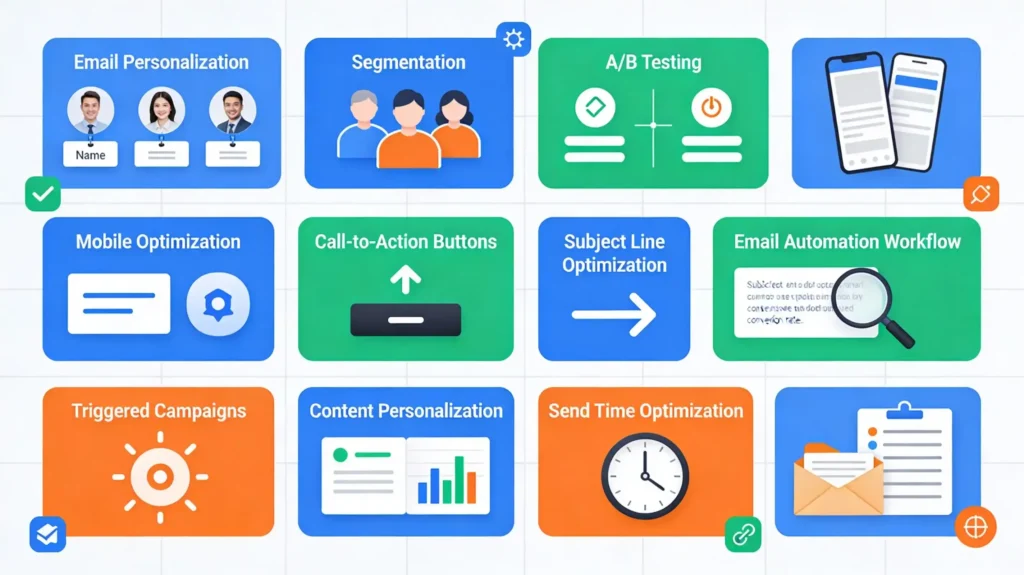
This comprehensive guide covers essential email marketing tactics:
Segmentation strategies target specific audiences with highly relevant messages
Personalization techniques boost conversions by 6x through individualized content
Mobile optimization ensures emails display perfectly across all devices
Automation workflows trigger timely messages based on customer behavior patterns
Testing and metrics reveal what works and drive continuous improvement
FOUNDATIONAL STRATEGIES FOR EMAIL SUCCESS
Understanding Email Marketing Fundamentals
Email marketing has evolved dramatically from batch-and-blast campaigns. Modern email strategies focus on segmentation, personalization, and behavior-driven timing for maximum impact. Today’s successful campaigns treat email as an owned, high-ROI revenue driver. Furthermore, they recognize that relevance drives engagement and conversions consistently. Additionally, strategic email combines data insights with creative messaging effectively.
Email remains undefeated in marketing ROI performance. Personalized campaigns generate 6x more transactions than generic broadcasts. Moreover, segmented email lists see 760% higher revenue compared to unsegmented ones. Consequently, strategic segmentation and personalization represent your biggest ROI opportunities. Therefore, every successful email marketing strategy starts with these fundamental principles.
The Three Pillars of High-Impact Email Marketing
Successful email marketing rests on three essential pillars that drive measurable results. First, know your audience deeply through behavioral data and demographics. Second, meet subscribers where they engage, particularly on mobile devices. Third, deliver relevance at scale through automation and testing consistently. Together, these pillars create the foundation for sustainable email success.
Why Email Outperforms Other Marketing Channels
Email marketing delivers superior ROI compared to paid advertising or social media. Unlike social platforms, you own your email list directly without algorithm interference. Furthermore, email reaches customers in their most private communication channel. Additionally, you control timing, messaging, and frequency completely without limitations. Most importantly, email provides measurable, trackable results that guide optimization continuously.
ADVANCED STRATEGIES THAT DRIVE CONVERSIONS
Segmentation and Personalization: Your Conversion Superpowers
Segmentation represents the single most important strategic decision you can make. Marketers who segment their lists see dramatically higher open rates and click-throughs. Rather than sending identical messages to everyone, segmentation creates targeted groups. Consequently, every subscriber receives relevant content matching their interests and stage.
One real-world example demonstrates this power: a general list achieved 42% open rate, while the segmented version achieved 94% open rate. Additionally, click-through rates jumped from 4.5% to 38% through targeted segmentation. These results show why segmentation must become your priority immediately. Furthermore, 90% of marketers fail to segment consistently, creating massive competitive advantage opportunities.
Building Effective Segmentation for Your List
You can segment subscribers using multiple criteria simultaneously for precision. Start by segmenting by location, role, industry, behavior, or past purchases. Additionally, gather segmentation data when new subscribers join your list. Furthermore, ask about preferences, industry focus, and content interests specifically. The more segmentation data you collect, the better results you achieve. Consider using signup forms asking about specific needs and interests immediately.
Personalization Beyond First Names
True personalization goes far beyond inserting someone’s first name in subject lines. 70% of brands don’t use email personalization despite 91% of consumers wanting it. Instead, use dynamic fields reflecting purchase history, browsing behavior, and preferences. Furthermore, recommend products based on past customer purchases specifically. Additionally, send birthday emails with personalized discounts matching interests. Personalized emails generate 35% of total product sales for major retailers like Amazon. Therefore, real personalization represents your biggest conversion opportunity.
Crafting Compelling Calls-to-Action
Your CTA can dramatically improve click-through rates and conversions measurably. Use strong command verbs like “shop,” “buy,” or “download” to compel action. Furthermore, evoke emotion by explaining exactly what subscribers gain from clicking. Additionally, create FOMO with language like “only 5 spots left.” Most importantly, make CTAs visually prominent with buttons rather than text links. Therefore, investing time in CTA optimization delivers substantial ROI improvements consistently.
OPTIMIZATION TECHNIQUES AND BEST PRACTICES
Mobile-First Design and Responsive Optimization
Nearly half of all emails open on mobile devices rather than desktops currently. Mobile-optimized emails generate 4x more revenue per click than desktop-focused designs. Yet many organizations still design for desktop primarily, missing significant revenue. Your email strategy must prioritize mobile optimization from day one. Use responsive templates adapting to all screen sizes automatically. Furthermore, keep copy short and scannable with bolded important phrases. Additionally, design CTAs as thumb-friendly buttons rather than tiny text links.
A/B Testing for Continuous Improvement
Data-driven optimization beats intuition-based changes every single time consistently. A/B testing reveals what actually works across subject lines, CTAs, and content. Test one element at a time to identify what truly impacts performance. Furthermore, track results by segment as different audiences respond differently. Additionally, use testing insights to fuel future campaign improvements systematically. One company increased revenue per recipient by 306% through strategic A/B testing. Therefore, making testing central to your strategy compounds improvement over time.
Subject Line Mastery and Click-Through Optimization
Subject lines determine whether subscribers open your emails or ignore them. Nearly 35% of email opens happen based solely on compelling subject lines. Furthermore, 69% of subscribers report emails as spam based on subject lines alone. Your subject line must grab attention without seeming overly promotional. Keep subject lines to 50-60 characters for full visibility on mobile devices. Additionally, use powerful action words and create curiosity when appropriate. Consider testing subject lines asking questions versus statements for your audience. Most importantly, match your subject line to actual email content, avoiding deceptive tactics.
Automation and Trigger-Based Campaigns
Trigger-based emails generate 5x higher open rates and 15x more clicks than standard newsletters. Rather than batch campaigns, automation sends timely messages matching subscriber behavior. For example, send welcome emails immediately after signup, not weeks later. Additionally, trigger cart abandonment emails one hour after someone stops browsing. Furthermore, send renewal reminders 30 days before contract expiration automatically. Welcome emails specifically deliver 336% higher transaction rates compared to promotional sends. Therefore, automated trigger campaigns represent your highest-ROI email opportunity.
| Metric | Importance | Target Goal | Action If Missing |
|---|---|---|---|
| Open Rate | Measures subject line effectiveness and sender reputation | 20-30% (varies by industry) | Test subject lines and sender names |
| Click-Through Rate | Indicates content relevance and CTA effectiveness | 2-5% (varies by industry) | Improve CTA clarity and placement |
| Conversion Rate | Shows email’s impact on actual sales and leads | 1-3% (varies by industry) | Optimize landing pages and offers |
| Unsubscribe Rate | Reflects audience satisfaction and content relevance | Below 0.5% | Re-evaluate frequency and content |
| Bounce Rate | Indicates email deliverability and list quality | Below 2% | Clean your list and validate addresses |
| Forward/Share Rate | Shows how valuable subscribers find content | 1-2% | Create shareable, value-rich content |
| List Growth Rate | Measures acquisition effectiveness long-term | 10-20% monthly growth | Optimize signup forms and incentives |
Conclusion:
Effective email marketing strategies transform casual messages into revenue engines systematically. By implementing segmentation, personalization, and automation, you unlock tremendous growth potential. The numbers speak clearly: email delivers $36 for every $1 invested on average. Furthermore, strategic campaigns multiply these returns through continuous optimization. Most importantly, email remains your most controllable, measurable marketing channel available. The time to implement these strategies is now, not later. Start with segmentation, add personalization, and automate trigger campaigns progressively. Track metrics religiously and test constantly to improve results. Your email list represents valuable customer relationships waiting to be monetized effectively.
Frequently Asked Questions:
What is the most important email marketing strategy to implement first?
Segmentation should be your absolute first priority before optimization. Marketers who segment see 760% higher revenue compared to unsegmented lists. Segmentation allows you to send relevant messages matching subscriber interests and stage. Furthermore, it dramatically improves open rates and click-through rates simultaneously. Rather than targeting everyone identically, segmentation creates precision targeting. Start by collecting basic segmentation data during signup (industry, role, interests). Then build simple segments and test messaging variations. Subsequently, expand segmentation complexity as you learn what works best. Therefore, making segmentation your foundation creates immediate, measurable improvements in email ROI.
How often should I send marketing emails to my list without causing unsubscribes?
Send frequency depends entirely on your audience and what you’re offering. Different audience segments prefer different email frequencies, so test what works best. Ask new subscribers how often they want to receive emails during signup. Additionally, monitor unsubscribe rates carefully when adjusting frequency. Generally, most audiences tolerate 1-3 emails per week without excessive unsubscribes. However, some engaged audiences accept daily emails if content provides value consistently. The key metric is engagement rate, not arbitrary send frequency rules. Furthermore, triggered emails can be sent multiple times without audience fatigue. Therefore, let your data guide send frequency rather than assumptions about optimal timing.
How can personalization improve my email marketing results specifically?
Personalization dramatically improves engagement and conversion rates across all email metrics. 91% of consumers want companies to provide personalized recommendations matching their interests. Yet only 21% of B2B marketers currently use meaningful personalization strategies. Beyond inserting first names, use dynamic fields reflecting purchase history and behavior. Additionally, recommend products based on past purchases and browsing behavior. Furthermore, segment and personalize based on customer lifecycle stage. Send birthday emails with personalized discounts matching individual preferences. Personalization increases conversion rates by 6x compared to generic messages. Therefore, investing in personalization infrastructure delivers substantial ROI improvements consistently and measurably.
What role does A/B testing play in effective email marketing strategies?
A/B testing reveals what actually drives results rather than relying on assumptions. Testing subject lines, CTAs, design, and content uncovers audience preferences empirically. Rather than guessing what works, you gather real data from your specific audience. For example, test whether questions or statements perform better in subject lines. Additionally, test button versus text CTAs to see what drives more clicks. Furthermore, test send times to discover when your audience engages most actively. One company increased revenue by 306% per recipient through systematic testing. Therefore, building testing into your regular workflow compounds improvements exponentially over time.
How should I approach email list cleaning and maintenance for best results?
Email list cleaning directly impacts your deliverability and sender reputation significantly. Removing unengaged subscribers improves open rates and prevents spam folder placement. Remove subscribers who haven’t engaged in 6-12 months through win-back campaigns first. Additionally, immediately remove unsubscribers and bounced email addresses completely. Furthermore, validate email addresses when new subscribers join to catch typos. Consider removing inactive subscribers after unsuccessful re-engagement attempts. A clean list improves sender reputation and email deliverability dramatically. Most importantly, focus on list quality over list size because engagement matters far more. Therefore, regularly reviewing and cleaning your list prevents serious deliverability problems long-term.
Fact Sources & Further Reading
SuperOffice Blog — Email Marketing Strategy: 7 Data-Backed Tactics That Drive Growth
Brevo Blog — 13 Effective Email Marketing Strategies to Level Up Your Campaigns
Forbes Advisor — Email Marketing Strategy Guide: Best Practices for 2025
StartupMandi — Marketing Strategy Resources for Indian Startups and Businesses
HubSpot Email Marketing — Complete Email Marketing Strategy and Tactics Guide

Arshia Jahan
Digital Marketing and SEO professional, focused on content strategy & optimizing content, improving search rankings, and delivering results through smart, audience-focused strategies. As a Content Strategist and SEO professional, I believe that search engines don't buy products—people do. By blending technical SEO precision with a human-first content approach. I provide readers with the strategic blueprints needed to scale in a competitive digital world.