

How to Explore Current AI Trends: Staying Ahead in 2025
How to explore current AI trends requires deliberate strategy beyond passive observation and casual reading. The artificial intelligence landscape transforms dramatically weekly—generative models evolve, regulatory frameworks emerge, multimodal systems mature, and new applications reshape industries. Missing crucial developments means falling behind competitive peers and missing emerging opportunities.
This comprehensive guide teaches actionable methods enabling professionals, entrepreneurs, and researchers to systematically track AI evolution. Whether monitoring breakthrough research, understanding regulatory implications, or identifying business applications, structured approaches prove infinitely more effective than random internet searches.
Key Points – How to Explore Current AI Trends:
Market Explosion: Global AI market reaches $3.5 trillion by 2033—a 9x growth from current levels at 37% CAGR
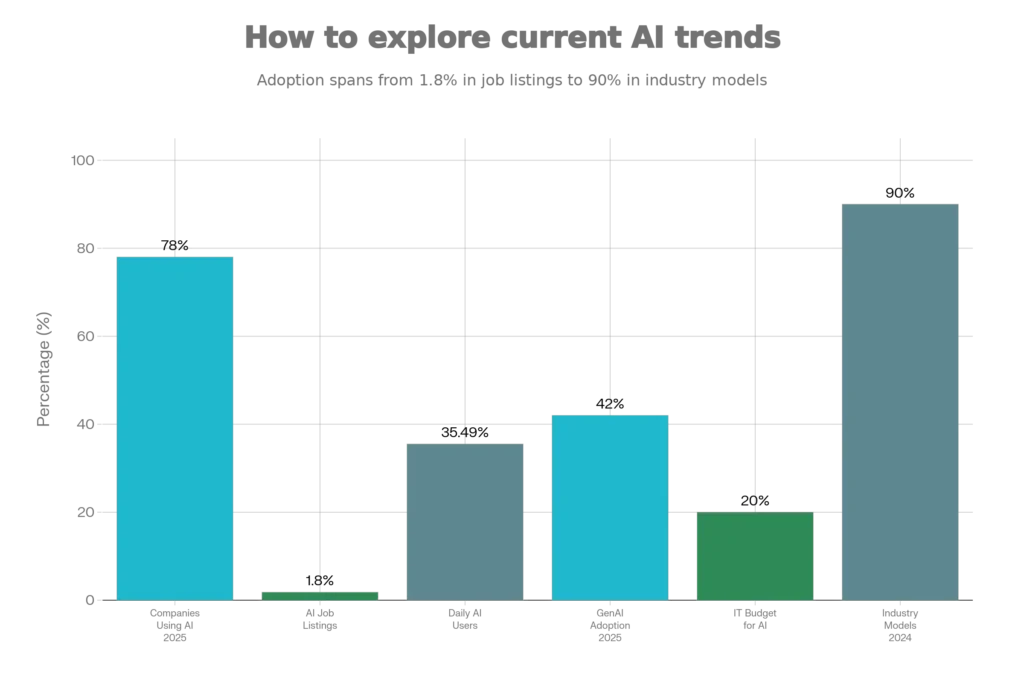
Enterprise Adoption Surge: 78% of companies now implement AI, up dramatically from previous years
Investment Acceleration: 20% of IT budgets devoted to AI in 2025, focusing heavily on GenAI applications
Industry Dominance: 90% of notable AI models created by industry (up from 60% in 2023), showing rapid commercialization
Workforce Transformation: 1.8% of job listings specifically for AI roles—demonstrating explosive talent demand
Primary Information Sources: How to Explore Current AI Trends Effectively
How to explore current AI trends starts with identifying authoritative information sources filtering noise from signal. The explosion of AI content creates information overwhelm—endless papers, sensationalized news, and conflicting predictions compete for attention. Strategic source selection prevents drowning in noise.
AI-Focused Newsletters And Digest Services
Newsletters serve as personal research assistants, curating massive AI developments into digestible weekly summaries. Rather than reading thousands of papers weekly, newsletter services filter for relevance, synthesizing complex research into accessible insights.
Top-tier newsletters cover different perspectives: technical deep-dives, business applications, startup funding, regulatory developments, and ethical implications. Subscribe to multiple sources providing complementary coverage—no single newsletter captures everything.
The beauty: newsletters arrive automatically, requiring minimal effort beyond reading. Most offer free tiers covering essential content, with premium options for deeper analysis.
Industry Research Reports And Market Analysis
Major consulting firms and research organizations publish comprehensive trend analyses, synthesizing industry data into strategic insights. PricewaterhouseCoopers, McKinsey, Accenture, and Gartner produce annual AI trend reports invaluable for understanding market direction.
These reports provide:
Market size projections and growth trajectories
Industry adoption patterns showing sector-specific implementations
Competitive landscapes identifying market leaders and emerging players
Investment trends revealing capital allocation patterns
Access many reports freely through corporate websites, though comprehensive deep-dives often require subscriptions.
Advanced Research Tracking: How to Explore Current AI Trends
How to explore current AI trends requires engaging with academic research directly—the source of genuine innovation. Industry applications follow academic breakthroughs by 12-24 months, making research papers leading indicators of emerging capabilities.
Monitoring Cutting-Edge Research Papers
Major conferences and journals publish breakthrough research shaping AI’s future trajectory. The AAAI Conference on Artificial Intelligence, IJCAI (International Joint Conference on Artificial Intelligence), and NeurIPS feature peer-reviewed papers representing frontier knowledge.
Google Scholar provides free research access—set up alerts for keywords tracking specific AI areas. ArXiv.org hosts preprints making research available immediately before formal publication.
Key research areas reshaping AI currently:
Multimodal AI systems understanding multiple data types simultaneously
Efficient smaller models reducing computational requirements dramatically
Agentic AI systems operating autonomously on complex tasks
Synthetic data generation addressing human-data scarcity
Quantum computing enabling previously impossible computations
Attending Industry Conferences And Symposiums
Conference attendance provides immersive trend exposure impossible through passive reading. Keynotes reveal strategic directions, networking conversations surface emerging applications, and technical sessions demonstrate cutting-edge capabilities.
Premier AI Conferences Include:
AAAI Conference—comprehensive academic and applied AI
IJCAI (Montreal 2025)—premier global AI research forum
NeurIPS—deep learning and neural information processing
ICML—machine learning innovations
Regional symposiums featuring local AI communities
Conferences accelerate learning dramatically compared to solitary research. Direct conversations with researchers and practitioners reveal nuances missed in publications.
Following Regulatory Developments And Policy Shifts
Government regulation reshapes AI landscape fundamentally, imposing compliance requirements and ethical guardrails. Staying informed on regulatory changes prevents costly surprises.
Current Regulatory Trends:
EU AI Act establishing comprehensive risk-based framework
California AI laws effective January 2025 on privacy and deepfakes
Federal agencies issuing 59 AI-related regulations in 2024 alone—double 2023 levels
Over 60 countries developing national AI strategies
Government websites, legal newsletters, and compliance platforms track emerging regulations.
Building Your Personal AI Trend-Tracking System
How to explore current AI trends systematically requires building personalized information infrastructure—newsletters, alerts, community memberships, and calendar reminders. Random browsing wastes enormous time without comprehensive understanding.
Structured Approach To Trend Exploration
Step 1: Select 3-5 Primary Information Sources
Choose complementary sources providing different perspectives. Combine industry reports, technical newsletters, and research alerts for balanced coverage. Avoid subscribing to everything—overwhelm paralyzes.
Step 2: Set Up Search Alerts And Keywords
Google Alerts for important AI topics deliver daily summaries automatically. Track specific areas matching your professional interests—”multimodal AI,” “enterprise AI implementation,” “AI regulation,” or “quantum computing advances”.
Step 3: Join Professional Communities
AI communities—LinkedIn groups, Discord servers, Reddit communities, Slack workspaces—provide peer insights and practical experience sharing. Professionals discussing real implementations often surface practical trends ahead of formal publications.
Step 4: Calendar Conference And Webinar Attendance
Block calendar time for quarterly or monthly webinars, conferences, and symposiums. Treat attendance seriously rather than “optional if time permits”.
Step 5: Monthly Trend Synthesis
Monthly review sessions consolidate learning—what’s emerging, what’s accelerating, what’s plateauing. This synthesis transforms passive consumption into actionable intelligence.
Critical Statistics Every AI Explorer Needs
Global Impact Metrics:
AI market expanding to $3.5 trillion by 2033 (37% CAGR from current levels)
78% of companies using AI in some capacity currently
90% of recent notable AI models from industry (vastly accelerated commercialization)
Inference cost dropped 280-fold between November 2022 and October 2024
Workforce Implications:
1.8% of new job listings specifically in AI space
90% of tech workers use AI in their jobs daily
AI could displace 92 million jobs by 2030 but create 170 million new roles
Business Applications Driving Adoption:
25% conversion rate increases from AI lead generation
51% of email marketers believe AI-supported campaigns outperform manual efforts
Manufacturing gains $3.78 trillion from AI by 2035
Conclusion
How to explore current AI trends demands shifting from passive consumption to active intelligence gathering. Newsletters alone fail—supplementing with research papers, conference attendance, community engagement, and regulatory tracking builds comprehensive understanding. The professionals, entrepreneurs, and organizations staying informed on AI trends position themselves advantageously for emerging opportunities.
The artificial intelligence landscape transforms so rapidly that last year’s cutting-edge becomes this year’s standard. Deliberate trend exploration prevents falling behind competitive peers while identifying innovation opportunities. Structured approaches—combining multiple information sources, setting up automated alerts, and engaging communities—make this feasible without consuming entire calendars.
At StartupMandi, we recognize that how to explore current AI trends represents critical competitive advantage for modern businesses. Explore our comprehensive AI strategy guide covering trend identification, technology evaluation, and business application frameworks. Discover our detailed AI adoption roadmap, helping entrepreneurs implement emerging AI capabilities aligned with business objectives.
For founders building AI-native products or integrating AI into existing operations, understanding how to explore current AI trends accelerates decision-making dramatically. Visit our complete AI technology assessment guide providing frameworks for evaluating emerging solutions. Connect with our AI strategy consultants to develop customized approaches matching your specific business challenges and competitive positioning.
Frequently Asked Questions
Q1: What are the most reliable sources for how to explore current AI trends?
Combine multiple sources: AI-focused newsletters (specialized tech publications), industry research reports (McKinsey, PwC, Accenture), academic conferences (AAAI, IJCAI, NeurIPS), research platforms (Google Scholar, ArXiv), and professional communities. No single source captures everything—diversification prevents bias and ensures comprehensive understanding of AI developments.
Q2: How frequently should I explore AI trends to stay current?
Dedicate 3-5 hours weekly to trend exploration for comprehensive awareness. This breaks down as: 1 hour reviewing newsletter digests, 2 hours reading research papers or reports, 1-2 hours in community discussions or webinars. Monthly synthesis reviews consolidate learnings into actionable intelligence rather than scattered facts.
Q3: Which AI trend areas matter most for business leaders?
Prioritize: (1) Regulatory developments affecting your industry, (2) Competitor AI implementations in your sector, (3) Customer-facing AI capabilities changing customer expectations, (4) Workforce implications and hiring needs, (5) Efficiency opportunities through AI automation. Business leaders should focus narrower than academics exploring AI broadly.
Q4: How to evaluate AI trends distinguishing hype from genuine developments?
Cross-reference multiple sources—if only marketing materials mention something, it’s likely hype. Academic papers and industry implementations by established companies indicate genuine developments. Check Stanford’s AI Index Report and academic conference proceedings for peer-reviewed, rigorous trend analysis.
Q5: What tools automate how to explore current AI trends?
Use Google Alerts for topic tracking, Feedly for newsletter aggregation, GitHub for monitoring open-source projects, LinkedIn for industry updates, and Discord/Slack communities for real-time discussions. These tools reduce manual effort while ensuring consistent information flow without overwhelm.

Mariyam Bandookwala
i am a professional content writer with a strong focus on clarity, strategy, and audience engagement—helping brands communicate smarter and grow faster.