The Future of Website Builders: AI, No-Code, and What Comes Next
Explore the future of website builders in an AI-first, no-code era. Understand how AI design assistants, AI Overviews, and fast-growing no-code platforms are changing who builds websites, how they’re built, and what this means for marketers, founders, and tech enthusiasts.
What Is the Future of Website Builders in an AI-First Web?
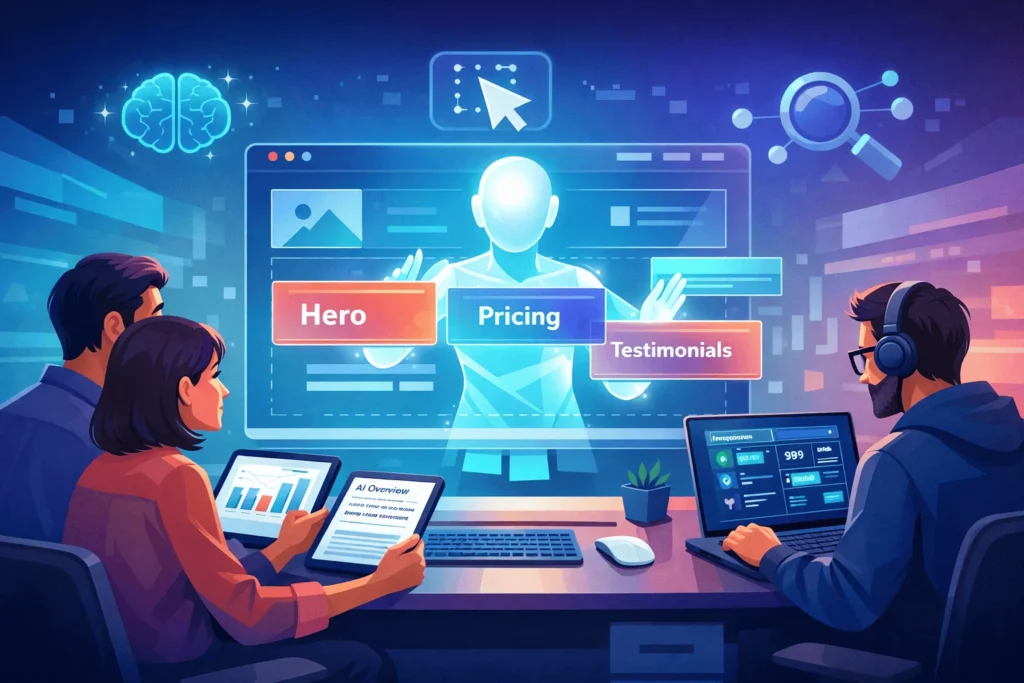
The future of website builders is moving from simple drag-and-drop tools to AI-orchestrated, no-code platforms that build, personalize, and even optimize sites with minimal human input. In the next 5–10 years, website builders will act less like static design canvases and more like collaborative AI partners that translate natural-language ideas into full digital experiences.
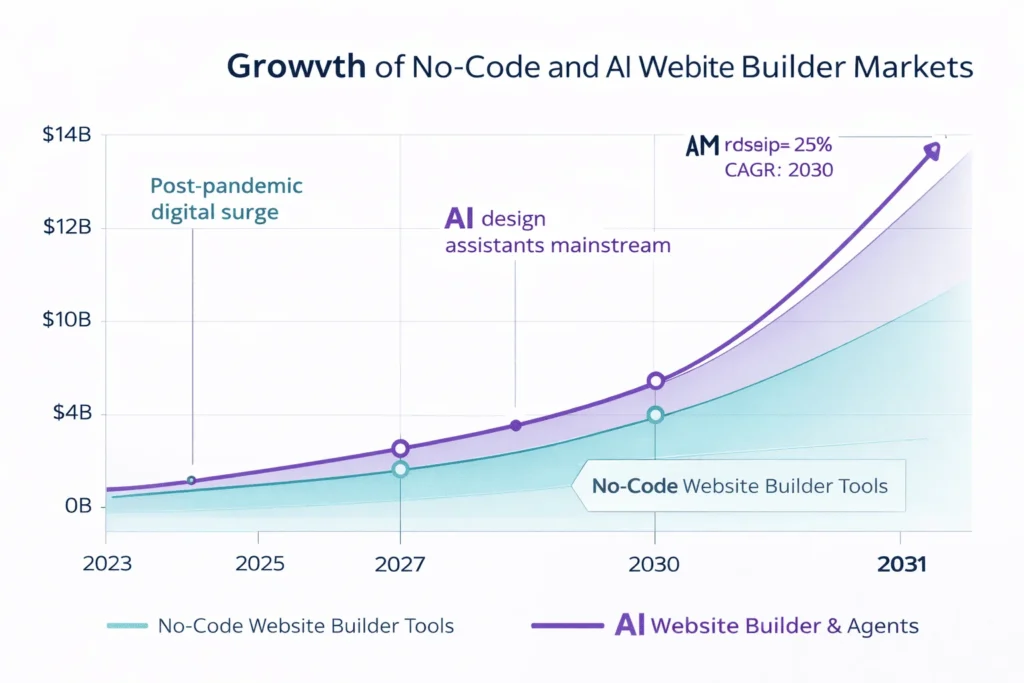
Analysts already project the no-code website builder tools market to grow from about USD 1.97 billion in 2023 to USD 3.58 billion by 2031 (7.7% CAGR), while other forecasts see broader no-code builder categories reaching USD 14 billion by 2030 at ~18.5% CAGR. This growth, combined with the rise of AI agents and AI Overviews in search, signals a structural shift in how websites are created, discovered, and monetized.
How Are AI and No-Code Changing Website Builders Right Now?
Today’s website builders are already far beyond static templates. AI and no-code are driving three concrete changes.
AI design assistants and layout generators AI website builders can generate full page layouts, color schemes, and component structures in minutes from a short prompt or questionnaire. Experiments show AI-assisted tools can accelerate development by 55–96% for common tasks like building landing pages or dashboards.
No-code becoming the default for non-developers Market research shows the no-code website builder tools segment alone is projected to grow from USD 835 million in 2026 to USD 1.169 billion by 2034 at 5.8% CAGR. Broader no-code builder tools are projected to grow closer to 18–25% CAGR in some analyses, reflecting rapid adoption across SMBs and creators.
AI-enabled personalization and experimentation AI-powered personalization systems can reduce costs by up to 20% and drive 35% higher user engagement, as they tailor content, offers, and layouts based on real-time behavior. This level of automation is increasingly being embedded directly into website builders and not just enterprise stacks.
“No-code and AI together are creating a new dynamic where anyone can prototype, test, and deploy applications easily.” — Bubble State of No-Code 2025
These developments mean the default experience of “building a site” is rapidly shifting from manual assembly to guided orchestration, especially for marketers and founders.
How Fast Is the No-Code and Website Builder Market Growing?
The growth story behind website builders and no-code tools explains why innovation is accelerating.
Segment
2023–2026 Size
2030–2034 Projection
CAGR / Growth
No-code website builder tools (narrow segment)
USD 1.97B in 2023
USD 3.58B by 2031
~7.73% CAGR (2024–2031)
Broader no-code website builder tools
~USD 4B base (2025)
USD 14B by 2030
~18.5% CAGR (2025–2030)
AI website builder / AI agents market
US$ 5.25B in 2024 (agents incl.)
Growing at ~25.2% CAGR through 2030
~25% CAGR to 2030
At the same time, no-code/low-code isn’t just for side projects. Bubble’s 2025 State of No-Code report finds 64.29% of no-code users believe most human developers will primarily use no-code solutions by 2030, and over 40% believe AI will make many traditional developer roles largely obsolete.
This doesn’t mean developers disappear. It means they move up the stack, orchestrating AI and platforms rather than hand-coding every detail.
No-code and AI website builder markets are projected to grow quickly through 2030, reflecting accelerating adoption across SMBs and enterprises.
What Will AI Website Builders Actually Do by 2030?
Looking ahead, AI website builders are expected to evolve across three horizons.
Current (2024–2026): Assisted creation and optimization
AI suggests layouts, components, and copy based on prompts and brand guidelines.
Code-generation tools like GitHub Copilot and similar agents cut implementation time for common web tasks by 55–96%.
Builders integrate AI-based A/B testing and personalization to adjust sections in real time.
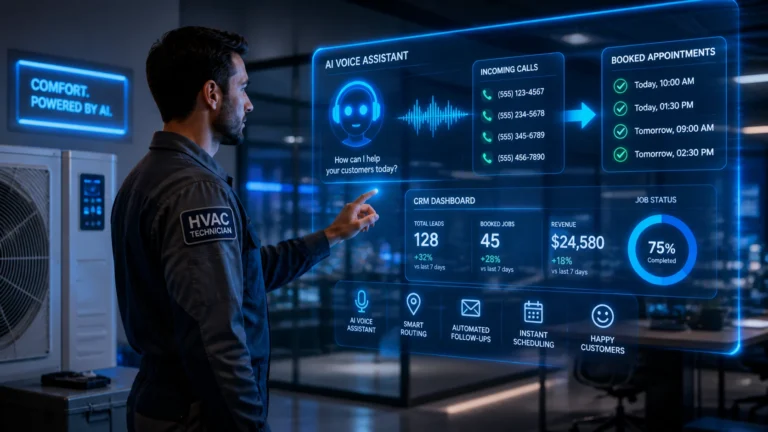
Everyday users describe what they want (“a consulting site with lead capture and calendar booking”), and AI assembles a full funnel—pages, forms, automations.
No-code platforms expand from simple marketing sites into internal tools, dashboards, and workflow apps, blurring the line between “website” and “application”.
Long-term (2028–2032+): Self-optimizing digital systems
Sites become self-optimizing ecosystems: AI monitors performance and modifies layouts, copy, and flows continuously.
Conversational and voice interfaces become standard layers on top of content, with AI orchestrating which modules to show each user.
Human creators focus on goals, ethics, and brand storytelling while AI handles most structural and technical work.
“By 2030, developers won’t code—they’ll orchestrate AI systems that create and optimize code for them.” — Hamza Janjua
How Will AI Overviews and Zero-Click Search Affect Website Builders?
The rise of Google’s AI Overviews and other AI search experiences is reshaping how websites earn attention.
Recent analyses show:
AI Overviews appeared in 35%+ of U.S. Google desktop searches by March 2025, with some forecasts suggesting over 50% of queries by late 2025.
Early case studies report CTR drops of 34–60% for traditional organic listings when AI Overviews appear, and some verticals have seen traffic declines of up to 70%.
Zero-click searches (where users get answers without clicking) were already 50%+ of queries pre-AI and are expected to approach 70% by mid‑2025.
This matters for website builders because:
Volume ≠ value anymore. Getting indexed is not enough; content must be structured and authoritative enough to be cited in AI Overviews and other AI surfaces.
Builders must expose advanced SEO structures. Schema markup, clear headings, and content chunking become critical, so platforms that surface these controls in simple UIs will win marketers’ trust.
Success is measured in assisted visibility, not just raw clicks—brands want their page to be the source behind AI answers, even if traffic is more focused and smaller.
Website builders of the future will therefore need native AI SEO capabilities, not just title and meta fields: things like schema presets, FAQ and HowTo blocks aligned with AI Overview patterns, and analytics that track AI-sourced visibility.
How Will the Role of Marketers, Founders, and Developers Change?
As AI and no-code mature, the roles around website builders are already shifting.
Marketers become orchestrators, not just content editors
Marketers will define experience blueprints (“evergreen content hub with AI-personalized CTAs for three audience segments”) while AI configures the site structure and experiments.
No-code AI platforms already let marketers build functional AI apps and experiences; by 2025, everyday employees are projected to create 65%+ of new AI applications without traditional dev teams.
Founders prototype faster and de-risk ideas
Startup founders can launch full MVPs—landing pages, gated content, payment flows—on no-code AI builders before writing any custom code.
Bubble reports that no-code is heavily used by startups, with 80% of surveyed founders planning to bootstrap and relying on no-code to reduce upfront engineering spend.
Developers move “up the stack”
Instead of hand-coding every page, developers become AI orchestrators and platform integrators—bridging website builders, APIs, and custom backends.
Their focus shifts to performance, governance, and complex customizations that generic AI builders can’t yet handle.
“No-code AI changes who gets to build. Marketers, teachers, and small business owners are now building functional AI apps without touching code.” — American Technology Net
This redistribution of power is why understanding the future of website builders is now a strategy question, not just a tooling decision.
How Do Traditional and AI-First Website Builders Compare?
The next generation of website builders will coexist with traditional tools for years. But their strengths differ.
Dimension
Traditional Drag-and-Drop Builder
AI-First / No-Code Builder
Interface
Manual layout with pre-made sections
Natural language prompts + smart suggestions
Speed to first draft
Hours to days
Minutes to hours (55–96% faster)
Personalization
Manual A/B tests, limited rules
Real-time AI personalization and experimentation
SEO/AI Overview readiness
Basic meta + URL controls
Structured content blocks, schema presets, AI snippet optimization
Integrations
App marketplaces, manual API setup
Deeper SaaS integrations and no-code workflow builders
Target user
Small businesses, freelancers
SMBs + enterprises + non-technical internal teams
Traditional builders remain excellent for simple sites, but AI-first platforms will lead for complex, iterative, and data-driven experiences.
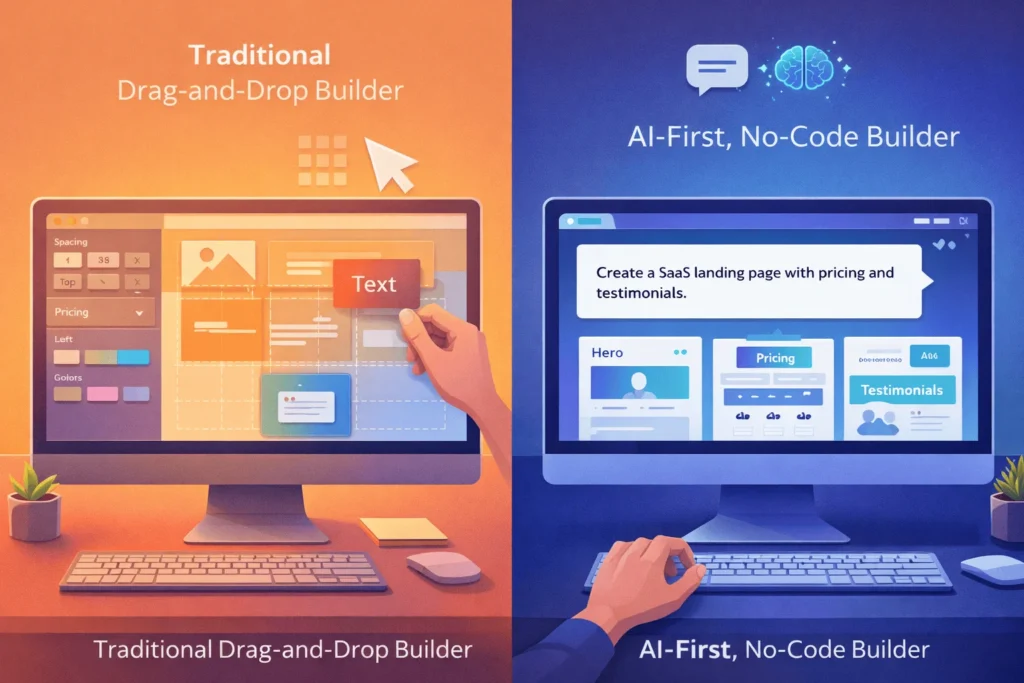
Traditional builders rely on manual layout, while AI-first platforms turn natural-language prompts into full page designs within seconds.
How To Prepare Your Website Strategy for AI-First Builders
Times Needed: 7 Days
Estimated Cost: 0–300 USD (depending on tools and experiments)
Description: A one-week, practical roadmap for marketers and founders to future-proof their website strategy for AI-first, no-code builders and AI Overviews.
Steps
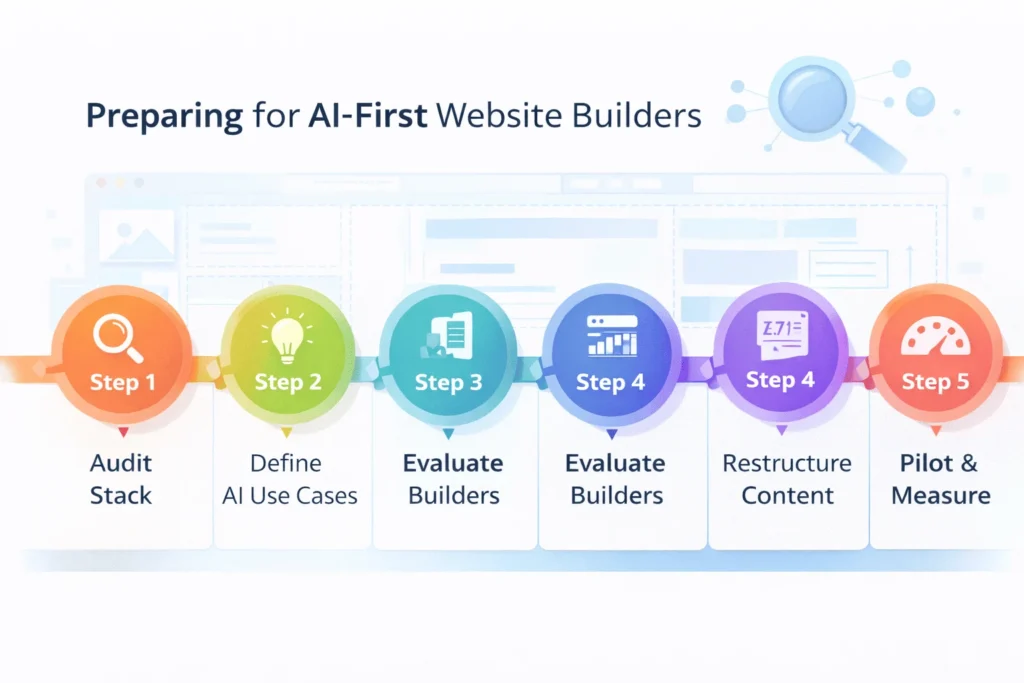
Audit Current Site and Tooling Step Title: Map Your Current Website and Stack Step Description: List your CMS/builder, key integrations, and content types (blogs, landing pages, docs). Identify which parts rely on manual work (copy, tests, schema) and which are automated. This reveals where AI-first builders could help.
Define AI and No-Code Use Cases Step Title: Decide What to Automate and Augment Step Description: Choose 2–3 pilot use cases—e.g., AI-generated landing page variants, automated FAQ sections, or AI-powered personalization widgets. Prioritize high-impact, low-risk experiments that won’t break core revenue flows.
Evaluate AI-Enabled Builder Options Step Title: Compare Traditional vs AI-First Builders Step Description: Shortlist platforms (AI assistants in existing builders, or new AI-first tools). Compare ease of use, AI features, performance, and export options. Use trial accounts to build a single test landing page on each.
Structure Content for AI Overviews Step Title: Reshape Key Pages for AI and Snippets Step Description: Rewrite 3–5 strategic pages with question-based headings, direct answers, and structured blocks (FAQs, HowTos, tables). Add schema where possible. This improves both traditional SEO and AI Overview eligibility.
Pilot an AI-Powered Landing Page Step Title: Launch One AI-Built Experience Step Description: Use an AI-first builder or AI assistant in your current platform to generate a new campaign page. Refine copy and design, then A/B test it against a manually built page for conversion rate, time-on-page, and build time.
Measure, Iterate, and Document Learnings Step Title: Turn Experiments Into Playbooks Step Description: After 2–4 weeks, review metrics and qualitative feedback. Document what worked, where AI outputs needed human editing, and how long builds took. Use this to create internal guidelines on when to use AI-first builders vs traditional methods.
Tools Name: Existing website builder or CMS, one AI-first builder (trial), analytics platform, Google Search Console
Materials Name: Current site map, list of priority pages, baseline analytics, content briefs
A simple five-step roadmap helps teams experiment with AI-first builders without risking their core website or revenue.
FAQ Section
Will AI website builders replace human designers and developers?
Probably not completely—but they will change their roles. Articles exploring 2030 scenarios suggest developers will act more as AI orchestrators than line-by-line coders, while designers focus on brand, storytelling, and complex UX, leaving repetitive layouts to AI. AI website builders will handle more of the production work, but humans will still guide strategy, aesthetics, and ethics.
Are no-code website builders just for small businesses?
Not anymore. Market reports show no-code website builder tools are expanding into enterprise-grade applications, including internal CRMs, dashboards, and workflow tools. Enterprise adoption is one reason the broader no-code builder market is projected to reach roughly USD 14 billion by 2030 at ~18.5% CAGR.
How will AI Overviews affect traffic from websites built on these platforms?
AI Overviews are already appearing in 35–50% of queries and can reduce traditional organic CTR by 34–60% in some tests. This affects all sites, regardless of platform. Builders that make structured content and schema easy will help users adapt by improving the odds of being cited in AI answers, even if total clicks become more concentrated.
What skills should marketers learn to stay relevant in an AI-builder world?
Marketers should deepen skills in prompt design, analytics, UX writing, and AI SEO. Since tools increasingly handle layout and code, human advantage will be in crafting problem definitions, messaging, and experiments. Reports on no-code and AI emphasize that strategy and interpretation—not button-clicking—are the durable skills.
Will open-source and code-based frameworks disappear?
Unlikely. While many simple sites will move to AI-first builders, open-source frameworks (React, Next.js, etc.) and headless architectures remain essential for complex, high-performance, and highly customized experiences. AI tools will likely generate more of the code in those frameworks, but they won’t erase the ecosystem.
How do AI website builders impact website performance and Core Web Vitals?
AI does not magically fix performance; it can even make bloat easier to generate. However, competitive AI-first builders will likely ship performance-aware components and automatic optimizations as differentiators. Market analyses note that technical performance and integrations are among the top criteria users consider in no-code platforms.
Is it safe to rely heavily on a single AI-first website builder?
There is always platform risk. Market reports highlight intense competition and rapid change in no-code tools. Mitigate risk by choosing platforms with export options, open standards, and strong financial backing—and by keeping critical business logic documented outside any single tool.
How soon should small brands start experimenting with AI builders?
Now. With AI Overviews already reshaping search and AI-enabled builders accelerating development cycles by 50–90%, early experimentation lets brands build internal expertise before these tools become baseline expectations. Small tests—like a single AI-built landing page—are low-risk ways to learn.
Key Takeaways
The future of website builders is AI-first and no-code, with markets for no-code builder tools projected to grow at 7–18%+ CAGR and AI website-builder ecosystems around 25% CAGR through 2030.
AI-enabled builders already accelerate development by 55–96% and power real-time personalization that improves engagement by roughly 35% while reducing costs by 20%.
Google’s AI Overviews and zero-click search trends mean builders must evolve from simple design tools to SEO and AI-visibility platforms, exposing structured content, schema, and analytics tuned for AI surfaces.
Roles are shifting: marketers and founders become experience orchestrators, while developers move into AI orchestration, performance, and integration rather than raw page assembly.
The winning strategy is not to abandon code or rush blindly into AI, but to blend AI-first builders with traditional stacks, using the right tool for each layer—from fast experiments to long-term, mission-critical systems.
Next Steps
Audit your current website stack and identify bottlenecks where AI builders could speed up experimentation without risking core revenue.
Pilot at least one AI-first builder or AI assistant within your existing platform to create a new landing page or microsite.
Restructure 3–5 key pages for AI Overviews, using question-based headings, direct answers, and structured elements that AI can easily summarize.
Track results: compare build time, conversion rates, and search visibility between AI-assisted and traditional pages.
Use the learnings to update your website and content roadmap, deciding where no-code AI builders will be the default and where custom development still makes strategic sense.
Conclusion
The future of website builders is not a choice between AI and humans, or between no-code and “real” development. It is a convergence where AI, no-code, and traditional engineering each play to their strengths. AI-first builders will handle more of the boilerplate: layouts, components, and even ongoing optimization. Human teams will increasingly focus on problem framing, brand, ethics, and high-stakes systems.
At the same time, Google’s AI Overviews and similar experiences are rewriting the rules of visibility. Websites built on any platform must now be designed not just for humans and classic SERPs, but for AI systems that summarize and recommend content at scale. Builders that surface advanced SEO, schema, and analytics in simple, opinionated ways will lead.
For marketers, founders, and tech enthusiasts, the opportunity is clear: start experimenting now. The brands that learn to co-create with AI website builders, structure their content for AI Overviews, and choose platforms with strong no-code and integration capabilities will be those still visible—and winning—when today’s “future of website builders” becomes tomorrow’s default.
Journalism and Mass Communication student and currently interning as a News Writer at Yug Varta News Agency. Skilled in content writing, news writing, anchoring, voice-over, and bilingual storytelling. Actively learning SEO to boost digital visibility and optimize content for online audiences.
The shift toward AI-orchestrated, no-code platforms is really exciting to see—especially how it’s moving beyond simple drag-and-drop tools into more collaborative AI partnerships. It makes me curious about how this will impact the role of designers and marketers in the next few years. The idea of translating natural language into full digital experiences is a game-changer, and I’m interested to see how platforms will balance automation with creative control.
The shift toward AI-orchestrated, no-code platforms is really exciting to see—especially how it’s moving beyond simple drag-and-drop tools into collaborative AI partnerships. It makes me curious about how this will impact the role of designers and marketers in the next few years. I’d love to hear more on how these tools are being adopted by smaller teams or solo founders.
The shift toward AI-orchestrated, no-code platforms is really exciting to see—especially how it’s moving beyond simple drag-and-drop tools into collaborative AI partnerships. It makes me curious about how this will impact the role of designers and marketers in the next few years. I’d love to hear more on how these tools are already being adopted by small businesses or startups.





The shift toward AI-orchestrated, no-code platforms is really exciting to see—especially how it’s moving beyond simple drag-and-drop tools into more collaborative AI partnerships. It makes me curious about how this will impact the role of designers and marketers in the next few years. The idea of translating natural language into full digital experiences is a game-changer, and I’m interested to see how platforms will balance automation with creative control.
Thank you for your comment. To use your site link & generate backlink on our platform, 1st go through a paid plan on this page: https://startupmandi.in/services/digital-services/premium-brand-promotion-on-startupmandi/
The shift toward AI-orchestrated, no-code platforms is really exciting to see—especially how it’s moving beyond simple drag-and-drop tools into collaborative AI partnerships. It makes me curious about how this will impact the role of designers and marketers in the next few years. I’d love to hear more on how these tools are being adopted by smaller teams or solo founders.
Thank you for your comment. To use your site link & generate backlink on our platform, 1st go through a paid plan on this page: https://startupmandi.in/services/digital-services/premium-brand-promotion-on-startupmandi/
The shift toward AI-orchestrated, no-code platforms is really exciting to see—especially how it’s moving beyond simple drag-and-drop tools into collaborative AI partnerships. It makes me curious about how this will impact the role of designers and marketers in the next few years. I’d love to hear more on how these tools are already being adopted by small businesses or startups.
Thank you for your comment. To use your site link & generate backlink on our platform, 1st go through a paid plan on this page: https://startupmandi.in/services/digital-services/premium-brand-promotion-on-startupmandi/