



Introduction
The Future of Work 2030 isn’t just about robots replacing jobs — it’s about how work itself is evolving. Studies show millions of roles will change, new careers will emerge, and skills will shift faster than ever. According to the World Economic Forum, 170 million new roles could be created by 2030, even as automation reshapes industries.
If you’re wondering what skills matter, which careers will grow, and how to stay relevant — this guide breaks it down clearly.
Quick Summary
- Automation will reshape tasks, not eliminate most jobs entirely.
- AI, digital, and human skills will grow together.
- Nearly 40% of skills may change by 2030, making continuous learning essential.
- The biggest opportunity lies in adaptability, not specialization alone.
What Is Future of Work 2030?
Future of Work 2030 refers to how technology, demographics, and economic trends reshape careers, skills, and workplace structures over the next decade.
Many activities — especially routine tasks — could be automated, but most jobs will evolve instead of disappearing completely. McKinsey estimates about 15% of global work hours could be automated by 2030 depending on adoption speed.
Transitioning from traditional roles to hybrid digital-human roles will become the norm.
“Automation will change tasks inside jobs more than it eliminates entire occupations.” — McKinsey Future of Work Research

Why Does Future of Work 2030 Matter?
Because career stability will depend on skills, not titles.
Businesses are shifting toward agile teams, remote work, and AI-assisted workflows.
Here are the biggest reasons it matters:
- 22% of global jobs may face disruption before 2030.
- Skill gaps are already the biggest barrier to growth for companies.
- Human-centric skills like creativity and collaboration are rising in importance.
Transitioning into this new era requires understanding both technology and human adaptability.
Key Trends Shaping Work
| Trend | Impact | Example Roles |
|---|---|---|
| AI Automation | Repetitive tasks reduced | Data processing |
| Remote Work | Global hiring expands | Freelancers |
| Digital Transformation | New tech roles | AI specialists |
| Human Skills Growth | Leadership demand | Team managers |
Which Skills Will Be Most Valuable?
The top skills in the Future of Work 2030 combine technical and human abilities.
High-Demand Skills
- AI & Big Data analysis
- Cybersecurity awareness
- Creative thinking
- Emotional intelligence
- Leadership & adaptability
Research shows higher cognitive skills like critical thinking may grow by nearly 19% demand in advanced economies.
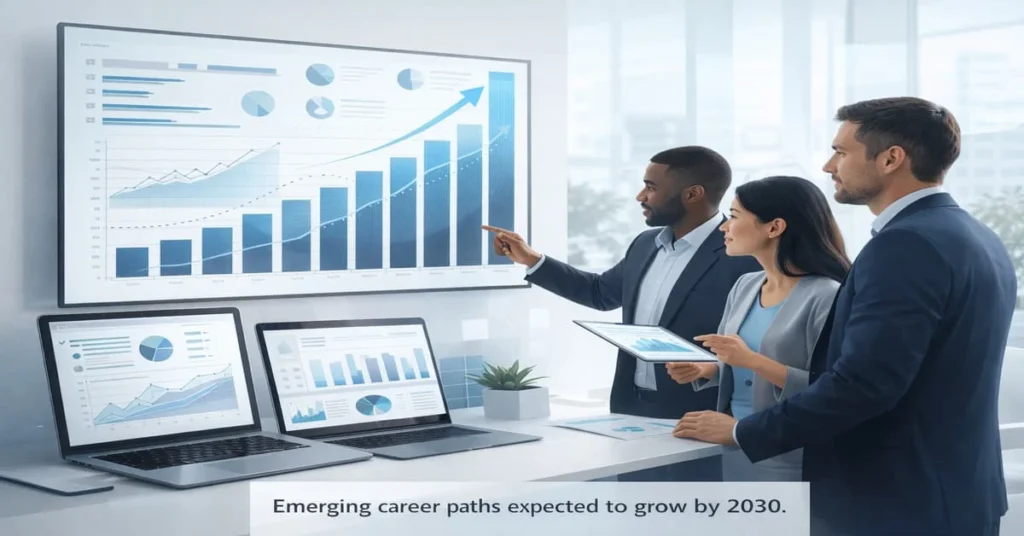
Technical vs Human Skills Comparison
| Skill Type | Why Important | Long-Term Value |
|---|---|---|
| Technical Skills | Drive innovation | High growth |
| Human Skills | Hard to automate | Long-lasting |
| Hybrid Skills | Combine both | Future-proof |
Transitioning between these skill types will define successful professionals.
What Jobs Will Grow By 2030?
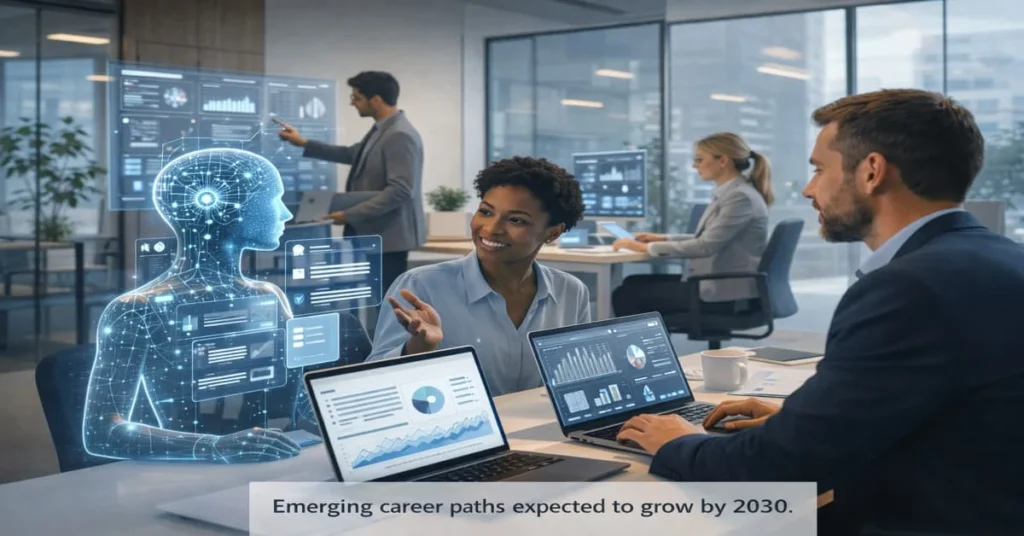
The biggest growth areas align with technology and human-centered work.
- AI & Machine Learning Specialists
- Renewable Energy Engineers
- Healthcare & Care Economy Roles
- Data Analysts
- Cybersecurity Experts
The World Economic Forum predicts 78 million net new jobs globally despite automation pressures.
Meanwhile, routine clerical roles may decline due to AI-driven automation.
How Can Professionals Prepare for Future of Work 2030?
Start by upgrading skills, not switching careers blindly.
Here’s a practical roadmap:
- Identify future-relevant skills aligned with your industry.
- Learn AI-assisted workflows rather than avoiding technology.
- Build a portfolio demonstrating adaptability.
- Focus on communication and collaboration skills.
- Develop continuous learning habits.
According to research, 59% of workers may need reskilling by 2030, making lifelong learning essential.
How To Section
Times Needed: Days: 30, Hours: 02, Minutes: 00
Estimated Cost: Currency: USD, Price: 50
Description:
A beginner-friendly framework to prepare for Future of Work 2030 by upgrading digital, strategic, and human skills through structured learning and practice.
Steps:
Step Title: Identify Future Skills
Step Description: Research emerging job trends and compare them with your current strengths to identify skill gaps quickly.
Step Title: Learn One Digital Tool Weekly
Step Description: Focus on AI tools, automation software, or analytics platforms that align with your industry.
Step Title: Build Proof of Work
Step Description: Create small projects or portfolios demonstrating real skills instead of relying only on certificates.
Step Title: Network With Future-Focused Communities
Step Description: Join startup groups, online forums, or professional networks discussing future job trends.
Tools Name: Notion, LinkedIn, ChatGPT, Canva
Materials Name: Online courses, Skill reports, Case studies
How Will AI Change Workplace Culture?
AI won’t replace people entirely — it will reshape workflows.
Many organizations are moving toward human-AI collaboration models, where machines handle repetitive tasks while humans focus on strategy and creativity.
“AI is expected to transform roles, not simply eliminate them.” — World Economic Forum
This shift may lead to:
- Faster decision-making
- Remote-first teams
- Skill-based hiring instead of degree-based hiring
Conclusion
The Future of Work 2030 isn’t a distant prediction — it’s already shaping how companies hire and how professionals grow. The biggest winners won’t be those with the most experience, but those willing to adapt, learn, and build hybrid skillsets.
At StartupMandi, the focus is on helping professionals and startups stay ahead by understanding these evolving trends and turning insights into action.
FAQ Section
It describes how technology and global trends reshape jobs, skills, and workplace structures by the year 2030.
No. Research suggests tasks will change more than entire occupations.
Technology, healthcare, sustainability, and data-driven sectors.
Digital literacy, communication skills, and problem-solving abilities.
Yes, global remote hiring is expected to continue growing.
Nearly 40% of current skills may evolve before 2030.
Yes, startups often adapt faster to new work models and technologies.
Absolutely — human skills remain highly valuable alongside technology.
External and Internal Links
Future workforce analysis by McKinsey
Read workplace evolution insights
How to Get a Government Job in India: Step-by-Step Roadmap 2026
AI YouTube Automation: How to Build a Profitable Faceless Channel in 2026
Airtel Adobe Express Premium Free Offer: How to Get 1-Year Access



The shift toward AI collaboration and digital tools is really reshaping how we think about future-ready skills, and it’s reassuring to see the emphasis on continuous learning as a key differentiator. It’s also interesting to note that while automation will change tasks, it won’t eliminate the need for human skills like empathy and creativity — that’s a reminder that adaptability and emotional intelligence will be just as crucial as technical know-how.
Thank you for your comment. To use your site link & generate backlink on our platform, 1st go through a paid plan: https://startupmandi.in/services/digital-services/premium-brand-promotion-on-startupmandi/