

If you’ve ever run ads on Meta Platforms and felt like you’re just burning budget without real results, chances are you’re missing one thing — a proper conversion funnel.
A Meta ads conversion funnel is a structured approach where you guide your audience step-by-step — from discovering your brand to finally taking action. Instead of expecting someone to click on an ad and instantly buy, this method builds trust gradually using three stages: TOF (Top of Funnel), MOF (Middle of Funnel), and BOF (Bottom of Funnel).
Most beginners make the mistake of running a single conversion campaign for everyone — cold, warm, and hot audiences together. But in reality, people at different stages behave differently. Someone who has never heard of your brand won’t convert the same way as someone who has already visited your website or engaged with your content.
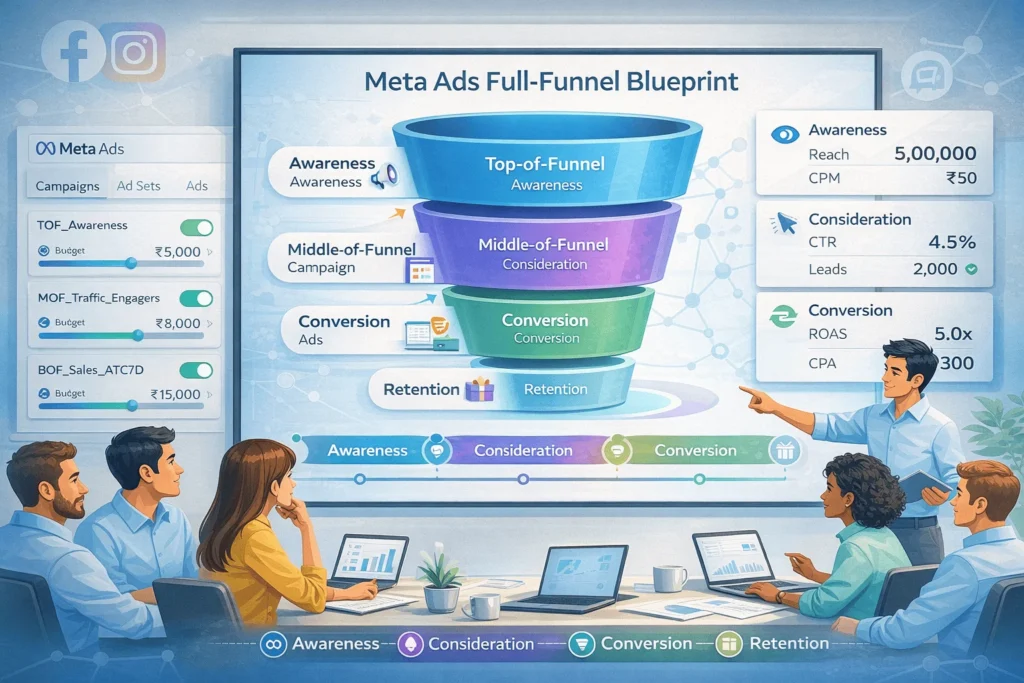
This is why the TOF–MOF–BOF funnel works better. At the top, you focus on awareness and reach. In the middle, you nurture interest and engagement. And at the bottom, you push for conversions with strong intent-driven messaging. This layered approach not only improves performance but also reduces wasted ad spend.
Another common issue is relying too much on boosting posts, running ads without retargeting, or expecting cold traffic to convert immediately. These tactics often lead to frustration because they skip the relationship-building phase that modern advertising requires.
This guide shows exactly how to structure your Meta ad account by funnel stage, map objectives, build audiences, allocate budget, and launch a full-funnel setup you can reuse across brands.
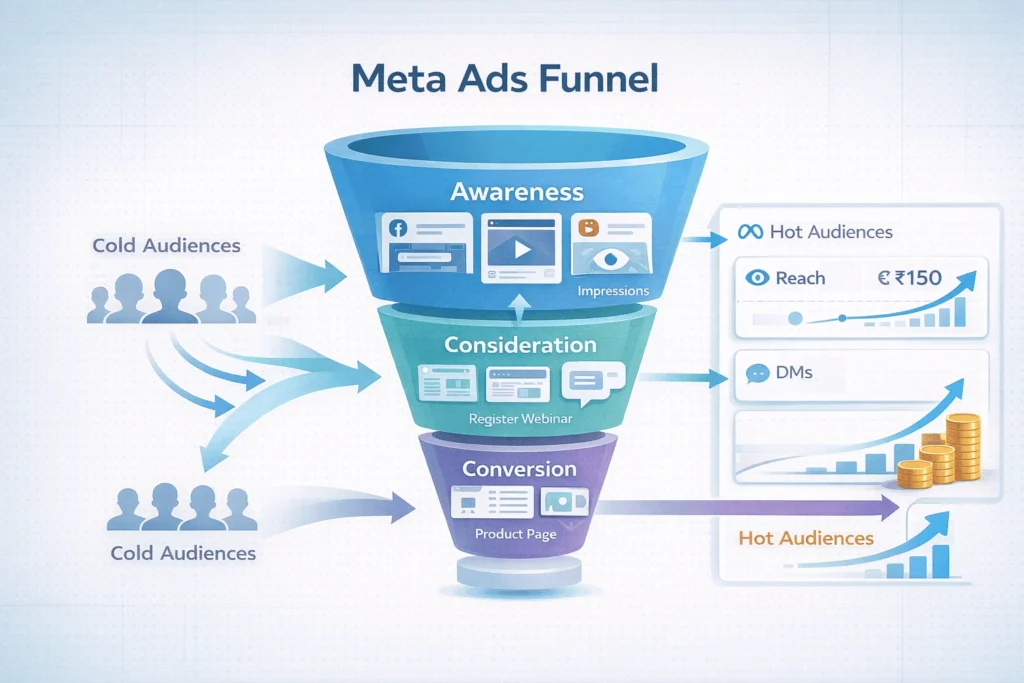
What is a Meta ads conversion funnel? (Awareness, consideration, conversion)
A Meta ads conversion funnel is a structured marketing approach that guides users from discovering your brand to taking a final action like purchasing or signing up. Instead of targeting everyone with a single conversion ad, it nurtures audiences at different stages based on their intent.
- Awareness (Top of Funnel – TOF): Targets cold audiences who are new to your brand and focuses on reach and visibility.
- Consideration (Middle of Funnel – MOF): Engages warm users who have interacted with your content and builds trust through value-driven messaging.
- Conversion (Bottom of Funnel – BOF): Targets high-intent users such as website visitors or cart abandoners and encourages them to take action.
For example, an Indian D2C brand or course creator may first run engaging video ads to attract new users, then retarget viewers with testimonials or webinars, and finally offer discounts or limited-time deals to convert them.
This full-funnel strategy works because it builds familiarity and trust before selling, leading to higher conversions and a lower customer acquisition cost (CAC) compared to running only conversion-focused campaigns.
Core Meta Ads funnel stages
“A structured funnel outperforms random ad campaigns—8+ touchpoints and smart retargeting can boost CTR by up to 10x.” — Banch Marketing
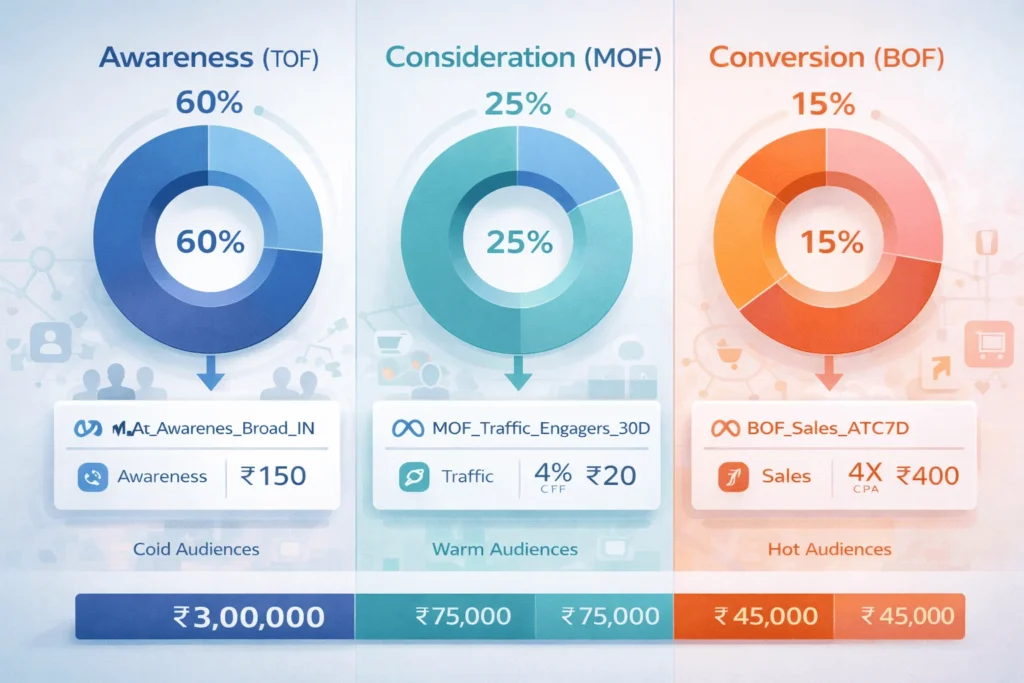
Meta ads funnel stages: awareness, consideration, conversion
A Meta ads funnel targets users at different intent levels—from discovering your brand to taking action. It is divided into three key stages: awareness, consideration, and conversion. Each stage uses different campaign objectives, creatives, and metrics to move users closer to purchase.
Awareness (Top of Funnel – TOF)
Goal: Reach new audiences and build brand visibility
Campaign Objectives: Awareness, Reach, Video Views
Key Metrics: Impressions, Reach, CPM, Video Views
At this stage, the focus is on grabbing attention rather than selling.
Creative Examples:
- Short-form video ads with strong hooks (e.g., “Struggling with hair fall?”)
- Educational or entertaining reels introducing your product or niche
👉 Targets cold audiences who are new to your brand.
Consideration (Middle of Funnel – MOF)
Goal: Build trust and engage interested users
Campaign Objectives: Traffic, Engagement, Leads
Key Metrics: CTR (Click-Through Rate), Engagement Rate, Cost per Lead
Here, users are aware of your brand and need more convincing.
Creative Examples:
- Customer testimonials and reviews
- Product demos or explainer videos
- Free webinars or lead magnets (for course creators)
👉 Targets warm audiences like video viewers, page engagers, or website visitors.
Conversion (Bottom of Funnel – BOF)
Goal: Drive final action (purchase, sign-up)
Campaign Objectives: Sales, Conversions
Key Metrics: Conversion Rate, Cost per Acquisition (CPA), ROAS
This stage focuses on converting high-intent users.
Creative Examples:
- Limited-time offers or discount ads
- Cart abandonment reminders
- Urgency-based creatives like “Only a few spots left”
👉 Targets hot audiences who are closest to converting.
Recommended budget split
To maximize results, distribute your budget strategically across the funnel:
- 40–50% → Awareness (TOF)
- 25–30% → Consideration (MOF)
- 20–30% → Conversion (BOF)
This balance ensures a steady flow of new users while nurturing and converting existing ones effectively.
How Do Funnel Stages Map to Meta Objectives?
Meta’s simplified objective framework has six main objectives: Awareness, Traffic, Engagement, Leads, App Promotion, Sales.
Each maps naturally to funnel stages:
- Awareness (TOF)
- Traffic / Engagement (MOF)
- Leads (Late MOF / Early BOF)
- Sales (BOF)
Objective–stage mapping summary
| Funnel Stage | Primary Objectives | Secondary Objectives |
|---|---|---|
| TOF | Awareness | Traffic, Engagement |
| MOF | Traffic, Engagement, Leads | Video views, Messages |
| BOF | Sales (Conversions, Catalog, Leads) | Traffic (Landing Page Views) |
The biggest mistake is using Sales for completely cold audiences with no data or trust. Performance improves when you “warm the funnel” first, then push Sales once enough signal is available.
How Do You Build Meta Audiences for Each Funnel Stage?
High‑ROAS funnels depend on data‑rich audiences built from Pixel + Conversions API signals.
1. Top‑of‑Funnel (Cold) Audiences
- Broad targeting (no interests, only geo + age)
- Lookalikes from high‑value purchasers or high‑LTV customers
- Interest stacks around category, competitors, behaviors
2. Middle‑of‑Funnel (Warm) Audiences
- Video engagement (25–95% view of TOF videos)
- Profile/page engagers (FB & IG)
- Website visitors (last 7/30/90 days) via Pixel + CAPI
3. Bottom‑of‑Funnel (Hot) Audiences
- Add‑to‑cart but no purchase (7/14 days)
- View content on key SKUs (7/30 days)
- Initiated checkout or leads submitted but no sale
Banch Marketing reported that retargeting based on pixel engagement can increase CTR up to 10x compared to cold traffic—but only when audiences are properly segmented by stage.
For AI‑resilient tracking, Meta and independent tracking partners both recommend running Pixel and Conversions API together, with event deduplication for maximum data accuracy and ROAS.
How Do You Allocate Budget Across Funnel Stages?
Meta’s automation (especially Advantage+ Sales campaigns) can cover the entire journey, but manual budget splits by funnel stage still give performance marketers more control.
A common starting point for e‑commerce and DTC:
- 60% Prospecting (TOF) – build volume and signal
- 25–30% Retargeting (MOF/BOF) – monetize warm traffic
- 10–15% Loyalty/Retention – upsell, cross‑sell, LTV plays
Funnel.io’s Advantage+ analysis shows brands often allocate 40–50% to prospecting, 40–50% to retargeting, and 10% to retention inside full‑funnel ASC budgets.
Sample budget split for ₹3,00,000/month
| Funnel Stage | Budget Split | Monthly Budget (₹) |
|---|---|---|
| Awareness / Prospecting | 60% | 1,80,000 |
| Consideration / Retarget | 25% | 75,000 |
| Conversion / Loyalty | 15% | 45,000 |
Scaling tip: As Advantage+ proves stable ROAS, gradually consolidate mid‑funnel sales into ASC, while keeping manual TOF and BOF campaigns for testing and precise control.
How To Set Up a Meta Ads Funnel (End-to-End)
Times Needed: 3 Days
Estimated Cost: 1,000 USD(initial test budget across 30 days)
Description: A 3‑day implementation plan to set up a full Meta Ads funnel—from pixel/CAPI tracking to TOF/MOF/BOF campaigns, budgets, and creatives—so you can launch a scalable awareness‑to‑conversion system.
Steps To Follow
- Define Offers & Funnel Goals
Step Title: Align Offers with Funnel Stages
Step Description: Map one hero offer for BOF (e.g., 10% off, free trial) and 2–3 value assets for TOF/MOF (guides, demos, Reels content). Clarify revenue target and CAC/ROAS goals before touching Ads Manager. - Install Pixel + Conversions API
Step Title: Configure Meta Pixel and CAPI Together
Step Description: Set up Pixel via Meta Events Manager and pair with Conversions API (native integration or server/CDP). Test events (ViewContent, AddToCart, Purchase) and ensure deduplication is enabled. - Create Funnel-Based Campaign Structure
Step Title: Build TOF, MOF, and BOF Campaign Shells
Step Description: In Ads Manager, create three campaigns: Awareness/Traffic (TOF), Traffic/Engagement/Leads (MOF), Sales/Conversions (BOF). Use clear naming (e.g., “TOF_Awareness_Broad_IN”). - Set Up Audiences by Stage
Step Title: Configure Cold, Warm, and Hot Audiences
Step Description: Add broad/lookalike for TOF; video viewers, engaged users, and visitors for MOF; cart abandoners and high‑intent actions for BOF. Always exclude lower‑funnel audiences from upper‑funnel campaigns to avoid overlap. - Design Stage-Specific Creatives
Step Title: Match Creative to Funnel Intent
Step Description: Create 3–5 TOF creatives focused on problem, story, and Reels hooks; 3–5 MOF assets showing proof and education; 3–5 BOF ads with offers, reviews, and urgency. Use 1:1/4:5 for feeds and 9:16 for Stories/Reels. - Allocate Budgets & Launch
Step Title: Distribute Spend and Publish Campaigns
Step Description: Apply 60/25/15 budget split across TOF/MOF/BOF. Turn on Advantage campaign budget for TOF, keep ABO for BOF retargeting. Launch with 7‑day learning window and avoid major edits for the first 3–5 days. - Monitor Metrics & Optimize Weekly
Step Title: Review Funnel KPIs and Iterate
Step Description: Track reach and CPM at TOF, CTR and CPC at MOF, ROAS and CPA at BOF. Refresh fatigued creatives, rebalance budgets, and test new hooks weekly based on data.
Tools Name: Meta Ads Manager, Meta Events Manager, Google Sheets or Looker Studio, Shopify/WooCommerce or CRM
Materials Name: Product catalog, offer matrix, creative assets (images/Reels/UGC), tracking plan (UTMs + naming conventions)
What Creatives Work Best at Each Funnel Stage?
Creative drives the majority of performance; full‑funnel success demands stage-specific messaging.
1. Awareness (TOF) Creatives
- Short‑form video & Reels focusing on pain points and lifestyle outcomes
- Thumb‑stopping hooks in first 3 seconds (pattern interrupts, bold claims)
- Light branding and emotional storytelling; no hard sell yet
For inspiration, see Instagram Reels ads: how to win attention in 3 seconds
2. Consideration (MOF) Creatives
- Explainer videos and carousels that show product in use
- Educational content (how‑tos, comparisons, FAQs)
- Social proof (testimonials, case studies, UGC compilations)
Meta best practices recommend 4–5 creative variations per campaign and monthly refreshes to avoid fatigue.
3. Conversion (BOF) Creatives
- Offer‑driven statics or videos (discounts, bundles, trials)
- Dynamic product ads (DPA) using catalog for e‑commerce
- High‑trust UGC with strong CTAs and clear risk‑reversal
For deeper Instagram placement strategy, see Instagram ads formats, costs, and best practices
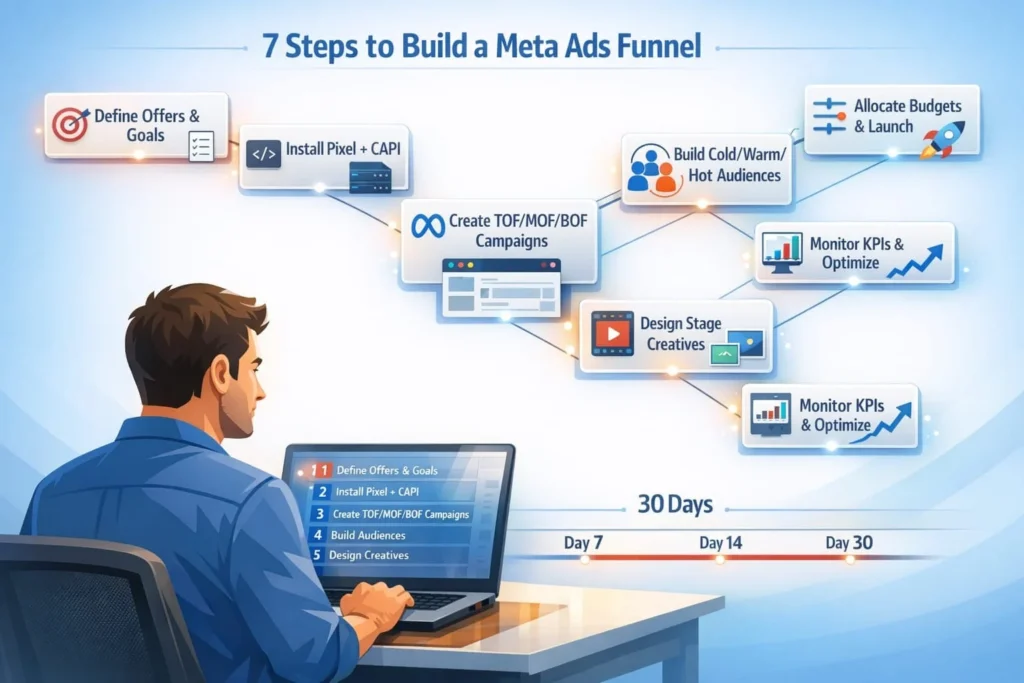
Example naming convention:
TOF_AW_Broad_IN | MOF_TR_WebVisitors30D | BOF_Sales_ATC7D
How Should You Measure Funnel Performance?
Full‑funnel Meta performance requires stage‑specific KPIs, not just last‑click ROAS.
Key metrics by stage
| Stage | Primary KPIs | Secondary KPIs |
|---|---|---|
| TOF | Reach, CPM, Video ThruPlay, VTR | Cost per 1,000 thruplays, CTR |
| MOF | CTR, CPC, Time on site, Lead cost | Scroll depth, add‑to‑cart rate |
| BOF | Purchase ROAS, CPA, Conversion rate | Frequency, incremental lift, LTV |
- TOF: Optimize for efficient reach + engagement. High CPM but high video completion can still be valuable if it feeds strong MOF audiences.
- MOF: Focus on CTR uplift and on‑site engagement; this is where retargeting often delivers 10x CTR compared to cold.
- BOF: Judge success on ROAS, CPA, and incremental conversions versus holdout tests.
Advanced practitioners also feed offline conversions and CRM events back to Meta, creating “micro‑algorithms” trained on qualified opportunities rather than just purchases.
FAQ Section
Most accounts perform well with 3–5 core campaigns: one TOF prospecting, one MOF retargeting, one BOF conversion, plus optional Advantage+ Sales and retention campaigns. Over‑fragmentation hurts learning and increases CPMs.
A common starting point is 60% TOF, 25–30% MOF, 10–15% retention/loyalty, then tilt more budget into whatever stage shows the strongest incremental ROAS. Advantage+ allows specifying allocations across prospecting, retargeting, and retention segments.
Yes. Advantage+ Sales can run full‑funnel inside one campaign, but results improve when you feed strong, stage‑specific creatives and high‑quality signals (Pixel + CAPI + offline events). Many media buyers combine ASC for scale with manual TOF/BOF campaigns for testing and control.
Common windows: 7/14 days for high‑velocity e‑com, 30/60 days for high‑consideration products, and 90 days+ for B2B. Shorten or lengthen based on buying cycle and frequency; high frequency with no conversion = shrink windows.
Start with Traffic or Engagement to warm a market. Once you see consistent add‑to‑cart / lead volume and have 50–100 conversion events per week, shift core BOF spend into Sales for algorithmic optimization.
Yes. Pixel alone misses events due to iOS privacy, ad blockers, and cookie limits. Meta and independent tracking guides both recommend a redundant Pixel + CAPI setup with deduplication for more accurate attribution and stronger optimization.
Depends on vertical, but many performance teams aim for 2–3x blended ROAS early, then 4–6x as the funnel matures and creative testing improves. Attribution windows and offline revenue will affect this.
For active e‑com brands, refresh TOF creatives every 2–4 weeks, MOF every 4–6 weeks, BOF as soon as frequency >3–4 and CTR dips. High spend or narrow audiences may require even faster rotation.
Key Takeaways Section
- Funnel structure beats random campaigns. TOF awareness, MOF consideration, and BOF conversion campaigns—connected via Pixel + CAPI—systematically move users from stranger to customer.
- Meta’s six objectives map cleanly to funnel stages. Use Awareness/Traffic for TOF, Traffic/Engagement/Leads for MOF, and Sales for BOF once you have enough signal.
- Audience quality > complexity. Broad + LAL at TOF, behavior‑based retargeting at MOF, and high‑intent BOF segments (ATC, VC, leads) consistently outperform over‑segmented interest stacks.
- Advantage+ is powerful but not magic. The best accounts blend ASC for scale with manual funnel campaigns for testing, retargeting, and niche segments.
- Pixel + CAPI + offline events unlock true performance. Redundant tracking fills signal gaps and lets Meta optimize towards actual business outcomes, not just clicks.
- Creative must match funnel intent. Short, emotional Reels at TOF, educational proof‑driven creatives at MOF, and offer‑heavy UGC at BOF convert better than one generic ad for everyone.
Next Steps Section
- Audit your current structure. Map every existing campaign to TOF/MOF/BOF. Kill or merge random one‑off campaigns that don’t have a clear funnel role.
- Set up or upgrade tracking. Ensure Pixel + CAPI are live, events are deduped, and key actions (lead, add‑to‑cart, purchase) are properly configured.
- Design a funnel blueprint. On a single slide or whiteboard, sketch your TOF campaigns, MOF retargeting, BOF offers, and retention plays, including audiences and estimated budgets.
- Create 3–5 creatives per stage. Build a small but diverse creative pool (statics + Reels + carousels) for each funnel stage before launching.
- Launch with a 30‑day test plan. Commit to a fixed budget and structure for 30 days, then adjust based on TOF CPM, MOF CTR, and BOF ROAS.
- Get the funnel template. Download or request StartupMandi’s Meta Ads funnel template to copy‑paste proven campaign structures, naming conventions, and audience recipes into your own account.
Conclusion
Meta Ads in 2026 reward advertisers who think in funnels, not individual campaigns. When TOF awareness, MOF nurturing, and BOF conversion campaigns are stitched together by Pixel + CAPI tracking, stage‑specific creatives, and smart budgeting, performance compounds instead of cannibalizing itself.
Industry guides and case studies show that full‑funnel strategies can deliver 62% more qualified leads and 41% lower CPA, especially when retargeting uses rich behavioral signals and Advantage+ is layered intelligently on top.
Your next step is not “launch another sales campaign.” It is to design a single, coherent Meta Ads funnel, implement it cleanly in Ads Manager, and then iterate on creative, audiences, and budget allocation with disciplined weekly reviews.
Use this guide as your starting blueprint. For more technical detail on platform mechanics, read StartupMandi’s deep dive on how search engine optimization and paid channels work together in 2026, and for paid social specifically, apply the learnings from our Instagram Reels ads and Instagram ad formats guides linked above.
If you want help implementing this funnel-based account structure, setting up Pixel + CAPI, or getting a ready-to-use funnel template, book a Meta Ads funnel consultation with StartupMandi. A single well‑built funnel often outperforms dozens of disconnected campaigns—and becomes the foundation you can scale for years.